
Hoover Dam sits just 30 miles southeast of the Las Vegas Strip, and most visitors drive right up, snap a photo, and leave within 20 minutes. That’s a mistake. If you’re wondering what to see at Hoover Dam, the answer goes well beyond the dam itself, there are overlooks, guided tours deep inside the structure, historic monuments, and viewpoints that most people walk right past. Knowing what to prioritize makes the difference between a forgettable pit stop and one of the best days of your trip.
We’ve been running tours from Las Vegas to Hoover Dam since 2007, and our guides have logged thousands of trips across that stretch of highway. That experience has taught us exactly which spots deliver the best views, which tours are worth the ticket price, and where to stand for photos that actually do the place justice. This isn’t a recycled list pulled from a brochure, it’s built from years of showing guests the dam the way it deserves to be seen.
Below, you’ll find 10 specific views, tours, and photo spots at Hoover Dam, organized so you can plan your visit based on how much time you have. Whether you’re stopping in for an hour or spending half a day, this guide will help you see the highlights without wasting time figuring out what matters once you’re already there.
1. Another Side Tours guided Hoover Dam experience
The Another Side Tours Hoover Dam experience handles the logistics so you can focus entirely on the visit itself. A knowledgeable guide picks you up from your Las Vegas hotel, explains what you’re looking at during the drive, and walks you through the highlights once you arrive, covering the dam’s structure, history, and engineering story in a way that a self-guided visit won’t match. You get context, not just scenery.
What you’ll see on this tour
On this tour, you’ll cover the top-of-dam walkway, the Winged Figures of the Republic, the Arizona side overlook, and the Mike O’Callaghan-Pat Tillman Memorial Bridge viewpoint. Your guide will point out lesser-known details that most visitors walk right past, including the original construction plaques, the Nevada-Arizona state line marker, and the best positions for photos of the dam face and Lake Mead. For anyone researching what to see at Hoover Dam without wanting to do hours of pre-trip reading, this tour maps it all out for you.
A guided visit means you spend your time actually looking at the dam instead of reading signage and second-guessing where to walk.
Who this option fits best
This tour works best if you’re visiting Las Vegas for a short time and want to see the dam properly without renting a car or navigating an unfamiliar stretch of highway. It’s a strong choice for families, couples, and anyone who prefers expert narration over wandering independently and piecing together the story on their own.
Travelers with mobility concerns should call ahead at 1-702-819-9127, as the tour covers outdoor walkways and some uneven surfaces near the dam. The private tour option using the Mercedes Limo Van is available for groups who want a more personal experience from pickup to drop-off.
Timing, pickup, and what to bring
Tours typically depart in the morning or early afternoon to dodge the worst of the midday desert heat. Hotel pickup is included, so you don’t need to arrange separate transportation. Bring sunscreen, a wide-brim hat, and a full water bottle, since the dam sits in an exposed environment with minimal shade and temperatures rise fast from late spring through early fall.
2. The top-of-dam walkway and rim views
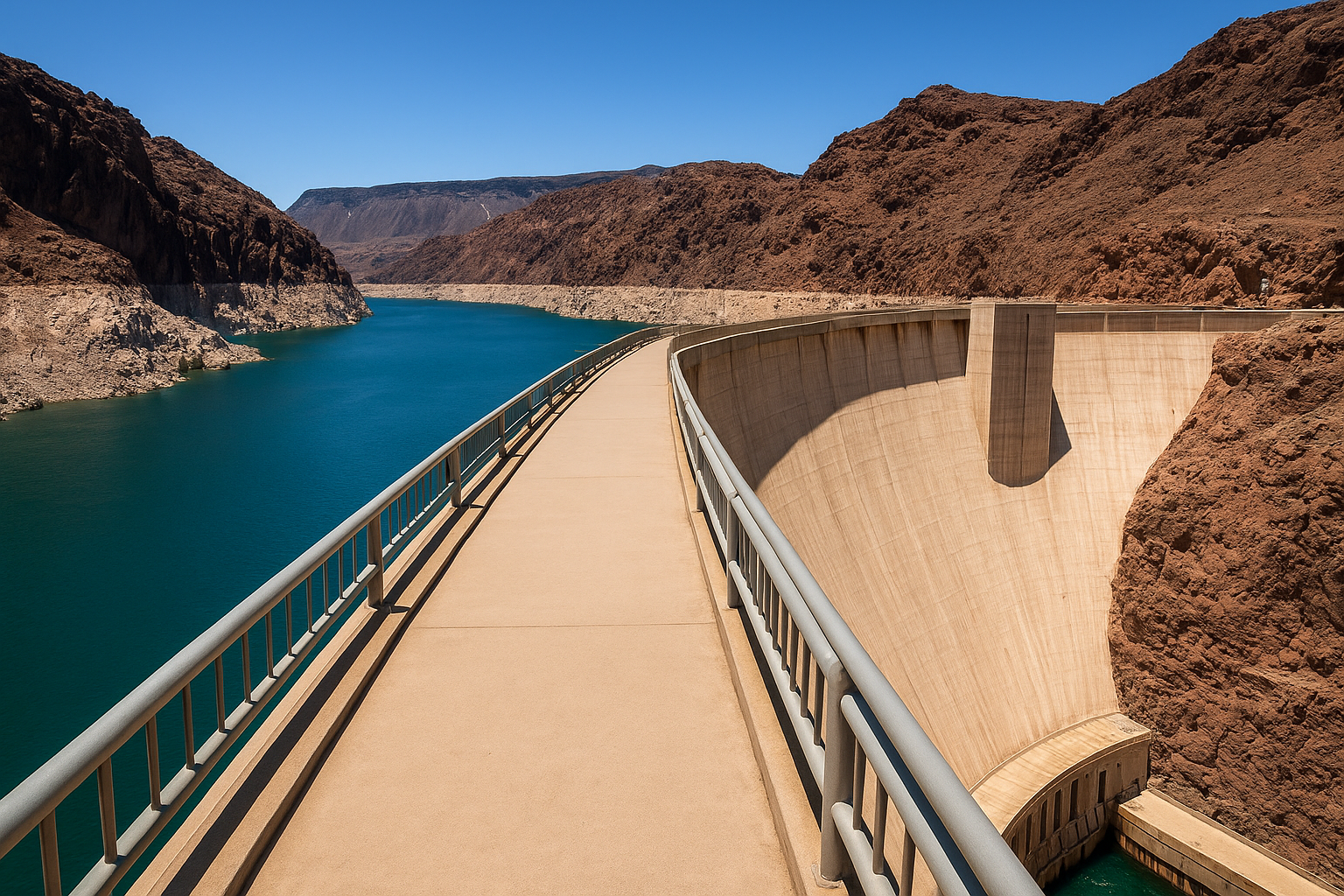
The top-of-dam walkway is the first thing most visitors step onto, and it consistently catches people off guard. Walking across the crest puts you directly above 726 feet of concrete with Lake Mead stretching behind you and the Colorado River far below, and that combination of scale hits differently in person than in any photo.
What you’ll see from the dam crest
Standing on the walkway, you get unobstructed sightlines in both directions: the reservoir side shows Lake Mead’s blue-green water framed by red canyon walls, while the downstream side reveals the sheer concrete face and the powerplant structure sitting at the base. This is one of the most honest answers to what to see at Hoover Dam, because nothing fully prepares you for how far down it goes.
Lean over the downstream railing at the midpoint and look straight down for the most visceral sense of the dam’s full height.
Best photo angles and where to pause
The walkway midpoint gives you the clearest shot of the dam face with the river below. Moving toward the Nevada side improves your lake view, where the canyon walls frame the water on both sides. Both ends of the crest work well for full-length shots that show the walkway itself in context.
Safety, heat, and walking notes
You’ll find the walkway is fully paved and level, but shade is nonexistent along the entire route. Consider these essentials before you walk:
- Water: carry at least 16 oz per person, more from May through September
- Sun protection: hat and sunscreen are non-negotiable in the open desert
- Extra time: security screening before the walkway adds 10 to 15 minutes
3. The guided dam tour inside the tunnels
The guided dam tour takes you below the surface of the structure itself, which is a completely different experience from standing on the walkway above. If you want to go beyond the postcard view and understand what to see at Hoover Dam at a deeper level, this is the tour that delivers it.
What you’ll see below the surface
Your guide leads you through elevator shafts and concrete tunnels cut directly into the dam body, descending over 500 feet to see the inner workings up close. You’ll walk past inspection galleries, pipes, and infrastructure that keep the dam operating, while your guide explains the engineering decisions behind each element.
The tunnel sections give you a real sense of the dam’s thickness and the engineering complexity that most surface-level visits completely miss.
Who can take the tour and who should skip it
The tunnels involve confined spaces, elevator rides, and extended walking on uneven surfaces, so anyone with claustrophobia or limited mobility should consider skipping this one. Follow-through on guide instructions is required throughout the descent.
Adults and older children who handle structured, group-paced movement through tight spaces will get a lot from this tour. If your group includes young kids or anyone uncomfortable in enclosed areas, the visitor center and powerplant tour offer solid alternatives without the confinement.
Tickets, timing, and security screening
Purchase your guided dam tour ticket separately at the visitor center, since it is not included in general admission. Tours run on a set schedule throughout the day, so check availability early or book online before you arrive. Budget an extra 15 to 20 minutes for security screening before your tour start time.
4. The powerplant tour and generator hall
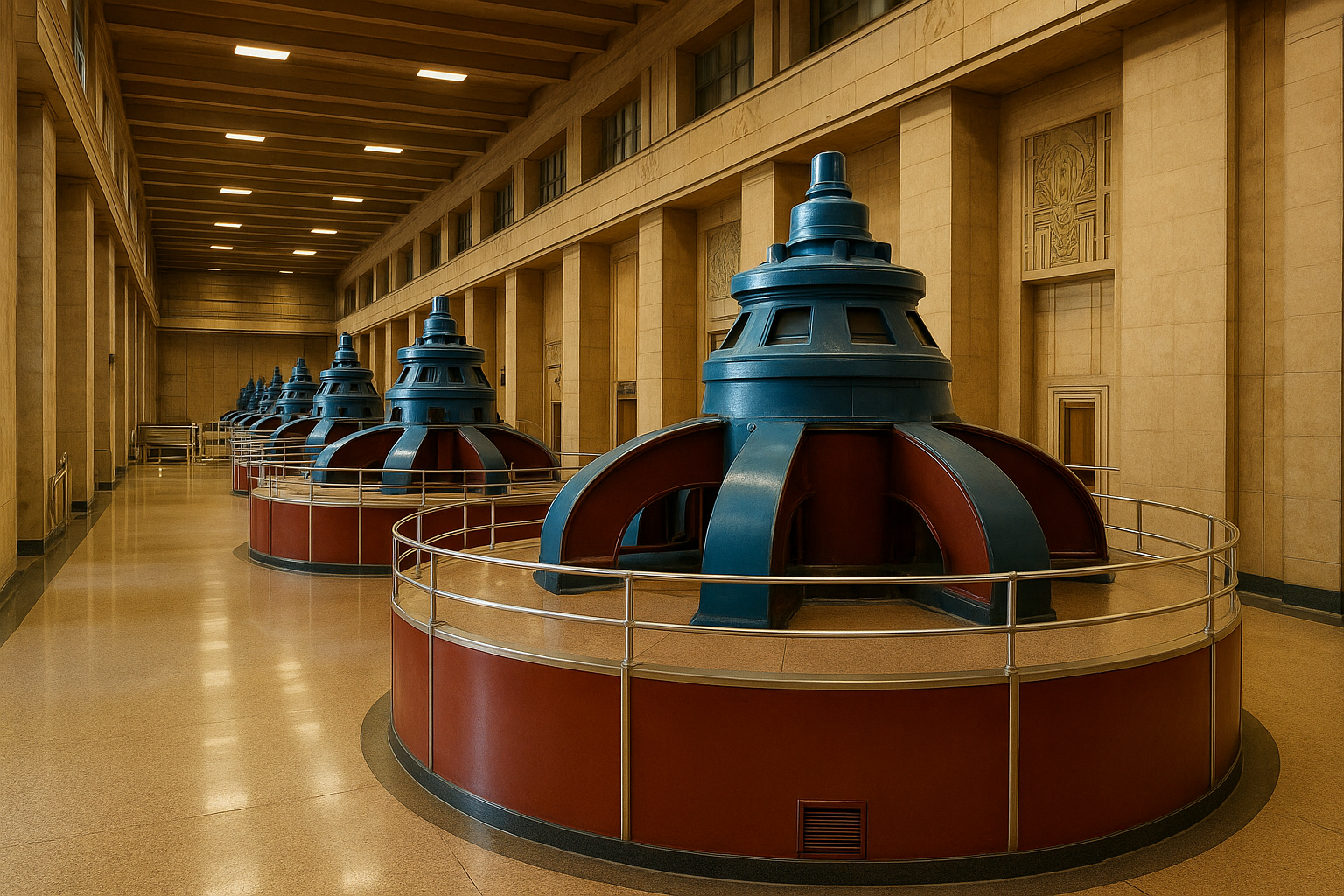
The powerplant tour gives you access to the working heart of Hoover Dam, a space most visitors never enter. Eight massive generators line the floor of the Art Deco generator hall, each one capable of producing enough electricity to power hundreds of thousands of homes. Standing next to these machines while they’re actively running puts the dam’s real function into sharp perspective.
What you’ll see in the powerplant
Inside the generator hall, you’ll see the original Art Deco design that the Bureau of Reclamation commissioned in the 1930s, with terrazzo floors, decorative railings, and sculptural details that feel more like a museum than a working facility. Your guide walks you through how water pressure from Lake Mead spins the turbines below your feet and feeds power into the western grid.
The generator hall is one of the most visually striking answers to what to see at Hoover Dam, combining industrial function with genuine architectural detail.
What’s different from the dam tour
Unlike the dam tour, which takes you through tunnels inside the structure, this tour stays at ground level in the powerplant building itself, with larger spaces that are better lit and easier to navigate throughout.
Both tours cover different systems, so they complement each other well if your schedule allows for both. This option works as a strong standalone for anyone who wants an inside look without the confined tunnel experience.
Tickets, timing, and accessibility notes
Purchase powerplant tour tickets at the visitor center, since they sell out faster than most visitors expect. Arriving early or booking online secures your preferred time slot. Consider these practical notes before you go:
- Tickets: sold separately from general admission at the visitor center desk or online
- Timing: tours run throughout the day; morning slots fill fastest
- Accessibility: the powerplant floor is fully accessible with no stairs required on the standard route
5. The visitor center exhibits and observation deck
The visitor center sits on the Nevada side of the dam and serves as the main orientation point for your entire visit. If you’re still sorting out what to see at Hoover Dam, this is the right starting place since the exhibits give you a solid foundation before you walk out to the dam itself.
What you’ll see and learn quickly
Inside, the exhibits cover the construction history, water management systems, and the human story behind building the dam during the Great Depression. A short film runs on a loop and gives you the full context in under 15 minutes. The observation deck on the upper level extends your sightline over Lake Mead and the canyon walls, offering a panoramic view that works especially well for first-time visitors who want to orient themselves before walking the dam crest.
The observation deck gets overlooked because most people head straight to the dam walkway, but the elevated angle gives you a lake view that’s hard to match from ground level.
Best times to visit to avoid crowds
Morning hours between 8 and 10 a.m. move through the visitor center quickly and leave time for the dam walkway before midday heat sets in. Tour buses typically arrive mid-morning, so getting there early keeps the exhibits accessible and the observation deck clear enough to actually enjoy the view.
Tickets, restrooms, and amenities
General admission covers the visitor center and observation deck without a separate purchase. Restrooms, a gift shop, and a small café are all located inside, making this a practical first stop before heading out to the more exposed sections of the dam.
6. Winged Figures of the Republic and plaza views
Most people walk straight past the Winged Figures of the Republic on their way to the dam walkway, which means they miss one of the most striking pieces of public art built during the New Deal era. These two 36-foot bronze sculptures stand on the Nevada side plaza and were designed by sculptor Oskar Hansen to honor the workers who constructed the dam.
What you’ll see and why it matters
The figures face each other with wings spread wide above a plaza that honors the 112 workers who died during construction. A celestial star map and inscribed text are embedded directly into the plaza floor beneath the sculptures, giving this spot more depth than a typical monument. When you’re deciding what to see at Hoover Dam, this is the stop that earns more time than most visitors give it.
The star map was designed to record the exact date of the dam’s dedication for any civilization that might discover it thousands of years from now, making it one of the most unusual details on the entire site.
Best photo framing tips
Stand between the two figures and shoot toward the canyon to pull both sculptures into the same frame. Key options that work well here include:
- Ultrawide mode to capture the full wingspan of both figures without stepping back too far
- Looking up from the base of either figure to show scale against the open sky
When the light works best
Morning light from the east hits the bronze surfaces directly and pulls out the detail in the facial features and feathers. Later in the day, the shadows lengthen across the plaza floor, adding contrast and depth that flat midday light simply does not deliver.
7. The Nevada–Arizona line and time zone spot
The state line runs directly across the top of Hoover Dam, and most visitors don’t notice they’ve already crossed it. This spot is one of the easiest answers to what to see at Hoover Dam that costs nothing extra and takes under five minutes to find.
What you’ll see and how to find the marker
A brass marker embedded in the dam walkway identifies the exact boundary between Nevada and Arizona. Walk toward the midpoint of the crest from either end and look down rather than outward. Both state names are engraved clearly on the surface, and the marker is large enough to read in a photo without getting right on top of it.
Standing with one foot in each state while the Colorado River runs 726 feet below you turns a quick stop into something worth remembering.
Fun photo ideas that actually work
The straddle shot with one foot in Nevada and one in Arizona is the most requested photo at this spot. A few setups that work well here:
- Low angle from the ground to show both feet and the engraved marker in the same sharp frame
- Overhead shot from a friend standing directly above to show the line running between both feet
Quick etiquette and crowd flow tips
Foot traffic on the walkway moves constantly, so step to one side before stopping rather than halting in the middle of the path. The marker draws the most foot congestion between 10 a.m. and 1 p.m., when organized groups arrive in waves. Getting there before 9 a.m. leaves you enough space to set up a clean shot without managing a crowd around you.
8. Mike O’Callaghan–Pat Tillman Memorial Bridge overlook
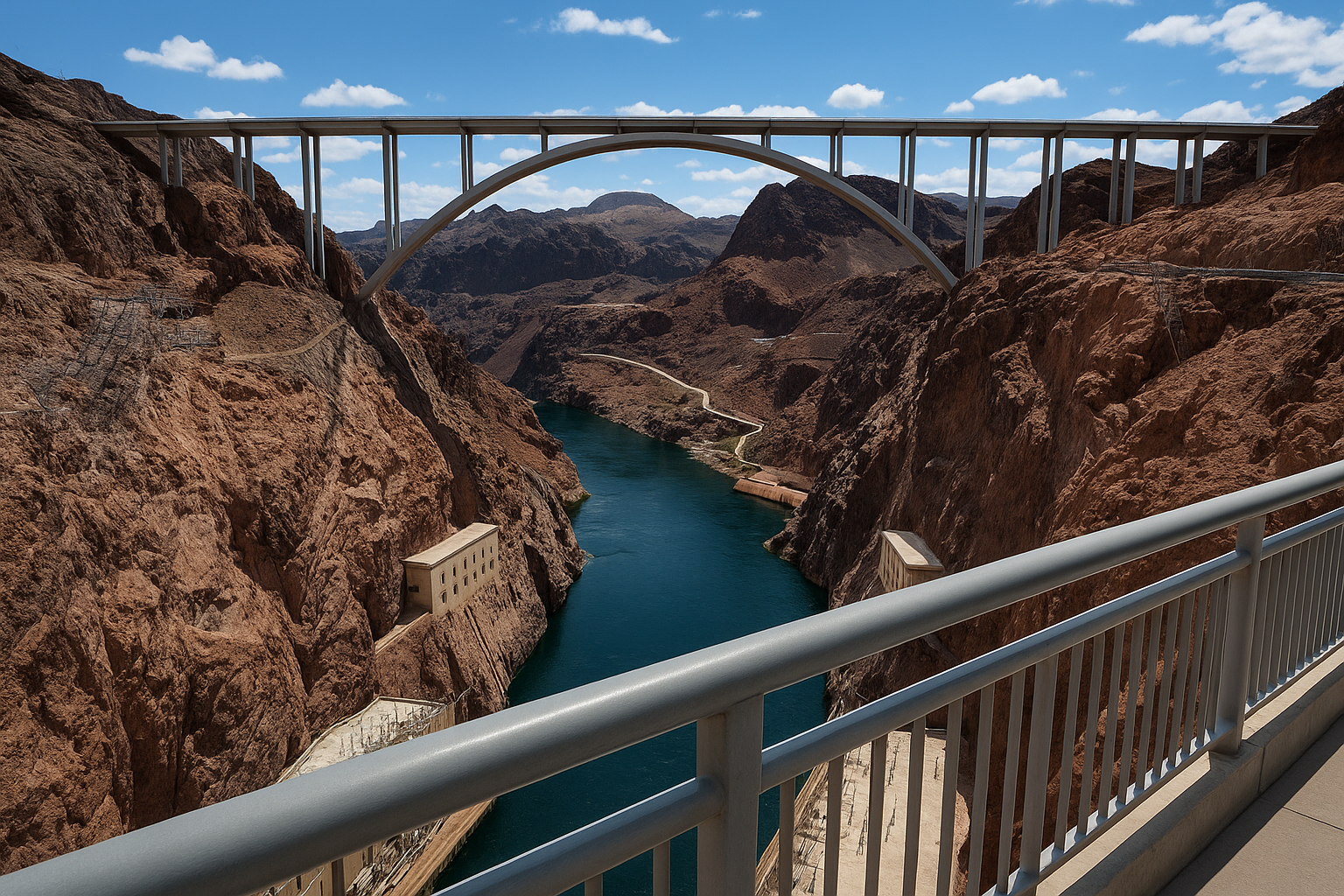
The Mike O’Callaghan–Pat Tillman Memorial Bridge sits roughly 1,500 feet downstream from the dam and gives you the single best full-structure view anywhere on the site. If you’re still building your list of what to see at Hoover Dam, this overlook belongs near the top because no other vantage point shows the dam face, the river below, and the canyon walls together in one unobstructed frame.
What you’ll see from the bridge area
From the pedestrian walkway on the bridge, you get a straight-on view of the entire downstream face of the dam with the Colorado River running through the canyon below it. The bridge itself sits at 890 feet above the river, so the sightline is elevated enough to show the dam’s full height without any foreground obstruction cutting into the frame.
This is the only viewpoint where the dam looks exactly the way it does in aerial photography, giving you a perspective that the walkway on top of the dam simply cannot offer.
Best photo lens and composition tips
A standard or slightly telephoto lens pulls the dam face closer and compresses the canyon walls into the background for a tighter, more dramatic composition. Shooting from the center of the pedestrian walkway centers the dam symmetrically between the canyon walls.
Parking, walking distance, and wind notes
Parking is available in the designated lot near the Nevada approach, and the pedestrian walkway adds roughly a 10-minute round-trip walk from your car. Wind at bridge level runs noticeably stronger than at dam level, so secure loose items before you reach the railing.
9. Arizona side lookout for the classic dam panorama
The Arizona side lookout delivers the view most people picture when they think about visiting the dam. This roadside pull-off sits on the opposite side from the visitor center and gives you a wide, unobstructed angle on the entire structure from the upstream side, showing the dam face, the canyon walls, and Lake Mead in a single frame.
What you’ll see from this viewpoint
From the lookout, you get the full curved face of the dam set against the canyon with the lake behind it. This angle shows the dam’s signature curved design more clearly than any other ground-level spot on the site, making it one of the most complete answers to what to see at Hoover Dam if you only have time for a few stops.
This viewpoint gives you the shot most people associate with Hoover Dam, but few visitors actually make the short drive over to get it.
Best time of day for the "postcard" shot
Morning light from roughly 7 to 9 a.m. hits the dam face directly from the east, bringing out the concrete texture and the depth of the canyon walls behind it. Afternoon light flattens the scene considerably, so arriving early makes a real difference in the quality of your photos here.
Driving route and parking strategy
Cross to the Arizona side via US-93 heading southeast, then take the first marked pull-off on your right after the bridge. Parking fills quickly on weekends, so arriving before 9 a.m. gives you the best chance of finding a clear spot without waiting.
10. Lake Mead and Colorado River viewpoints near the dam
The dam sits at the intersection of two very different water environments, and both are worth a look before you leave. Lake Mead stretches north and east from the upstream face, while the Colorado River runs downstream through Black Canyon toward the south. Spending a few extra minutes at each side rounds out your understanding of what the dam actually manages.
What you’ll see on the lake side vs river side
Lake Mead gives you a wide, calm reservoir view framed by red and tan canyon walls that stretch toward the horizon. Flip to the downstream side and the scale shifts entirely, the river runs narrow and fast through the canyon below, with the powerplant building sitting right at the base of the dam wall. Both perspectives together show you the full scope of what to see at Hoover Dam in a way that neither side delivers alone.
The contrast between the still reservoir and the moving river below the dam captures the dam’s entire purpose in a single visit.
Best quick stops if you only have 30-60 minutes
If your time is limited, prioritize the Nevada side observation area near the visitor center for the lake view and the downstream railing on the dam crest for the river view. Both stops take under 10 minutes each and cover the essential contrast without backtracking.
Heat, water, and wildlife expectations
Each side sits in fully exposed desert terrain with no shade structures nearby. Bring at least 16 ounces of water per person and expect to see lizards and occasional ravens near the rocky shoreline edges, particularly during the early morning hours.
Put your Hoover Dam plan together
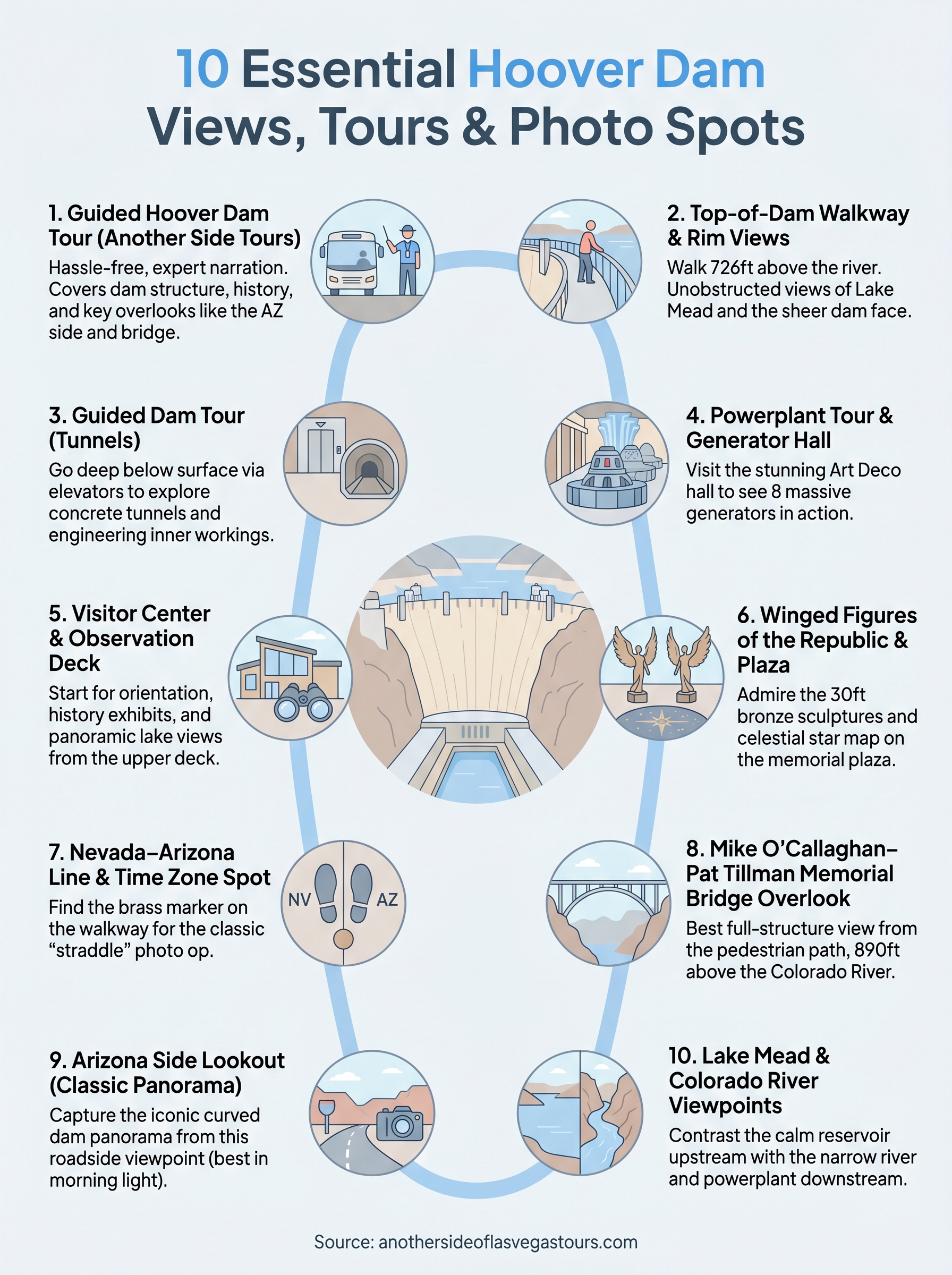
You now have a complete picture of what to see at Hoover Dam, from the tunnel tours and generator hall to the bridge overlook and Arizona side panorama. The dam rewards visitors who arrive with a plan, because the best spots are spread across both sides of the canyon and the best light disappears fast once the morning hours pass. Prioritize the bridge overlook, the dam crest, and the Winged Figures if your time is limited, and add the powerplant or tunnel tour if your schedule allows a longer stay.
If you want the full experience without the logistics, our guided Hoover Dam tour handles hotel pickup, expert narration, and all the key stops so you spend your time at the dam instead of figuring out where to park and what to look for. Book your spot through our private Hoover Dam tours page or call 1-702-819-9127 to get started.