The four-mile stretch of Las Vegas Boulevard holds some of the most photographed, over-the-top architecture on the planet. But walking past these Las Vegas Strip landmarks without context means you’re only seeing the surface. Each casino, fountain, and sign along the Strip carries a story, one tied to decades of reinvention, ambition, and spectacle that shaped the city into what it is today. Knowing what you’re actually looking at changes the entire experience.
At Another Side Tours, our guides have spent years walking and driving guests through these landmarks, sharing the history and details that most visitors never hear. That firsthand perspective is exactly what shaped this list. We’ve narrowed it down to 12 iconic landmarks that deserve a spot on your 2026 itinerary, whether you’re visiting for the first time or finally paying attention to what you’ve walked past before.
Here’s what to see, where to find it, and why it matters.
1. The Las Vegas Strip with Another Side Tours
The Las Vegas Strip itself is the landmark before any individual attraction along it. Stretching roughly four miles along Las Vegas Boulevard South, from Mandalay Bay at the southern end to the STRAT Hotel at the northern end, the Strip concentrates more neon, architecture, and engineered spectacle per square foot than anywhere else on earth. That density is exactly what makes it overwhelming to navigate without a plan.
What makes it a landmark
The Strip earned its reputation through decades of one-upmanship, with each new resort trying to outshine the last in size, theme, and scale. Today it holds more than 30 major hotel-casino resorts, several of the world’s largest hotels by room count, and attractions ranging from a replica of the Eiffel Tower to a massive LED sphere. The character of the Boulevard shifts block by block, so walking without context often means missing what you’re actually looking at.
Knowing the history behind each property transforms a walk down the Strip from a blur of lights into a clear story about how Las Vegas reinvented itself, decade after decade.
Best time to go
Evening hours, from around 7 PM onward, are when the Strip makes its strongest impression. The light shows, fountain displays, and illuminated facades are all designed to be seen after dark, and crowds tend to peak in a way that actually adds to the energy rather than detracting from it. Mornings between 8 AM and 10 AM work well if you want to cover ground on foot before the heat and weekend traffic build up.
Summer afternoons in Las Vegas regularly exceed 110°F, so timing your outdoor time around dawn or dusk is a practical decision, not just an aesthetic preference. Spring and fall offer the most comfortable temperatures for extended walking along the boulevard.
How to visit it
Booking a guided Strip tour through Another Side Tours is the most efficient way to cover the major las vegas strip landmarks without guesswork. Tours run 2 to 4 hours and combine transportation with expert narration, so you’re not burning time figuring out logistics between stops. Your guide walks you through the stories behind each property, covering architecture, history, and the personalities who built the city into what it is today.
- Tours depart with small, manageable group sizes
- Transportation is included, reducing walking fatigue
- Guides provide context that self-guided apps and maps can’t replicate
What it costs
Another Side Tours’ Strip tours are priced between $169 and $249 per person, depending on tour length and itinerary. That price includes professional guide narration and private transportation, which compares well against what most visitors spend piecing together the same experience independently through ride-shares, entry fees, and wasted time.
2. Welcome to Fabulous Las Vegas Sign
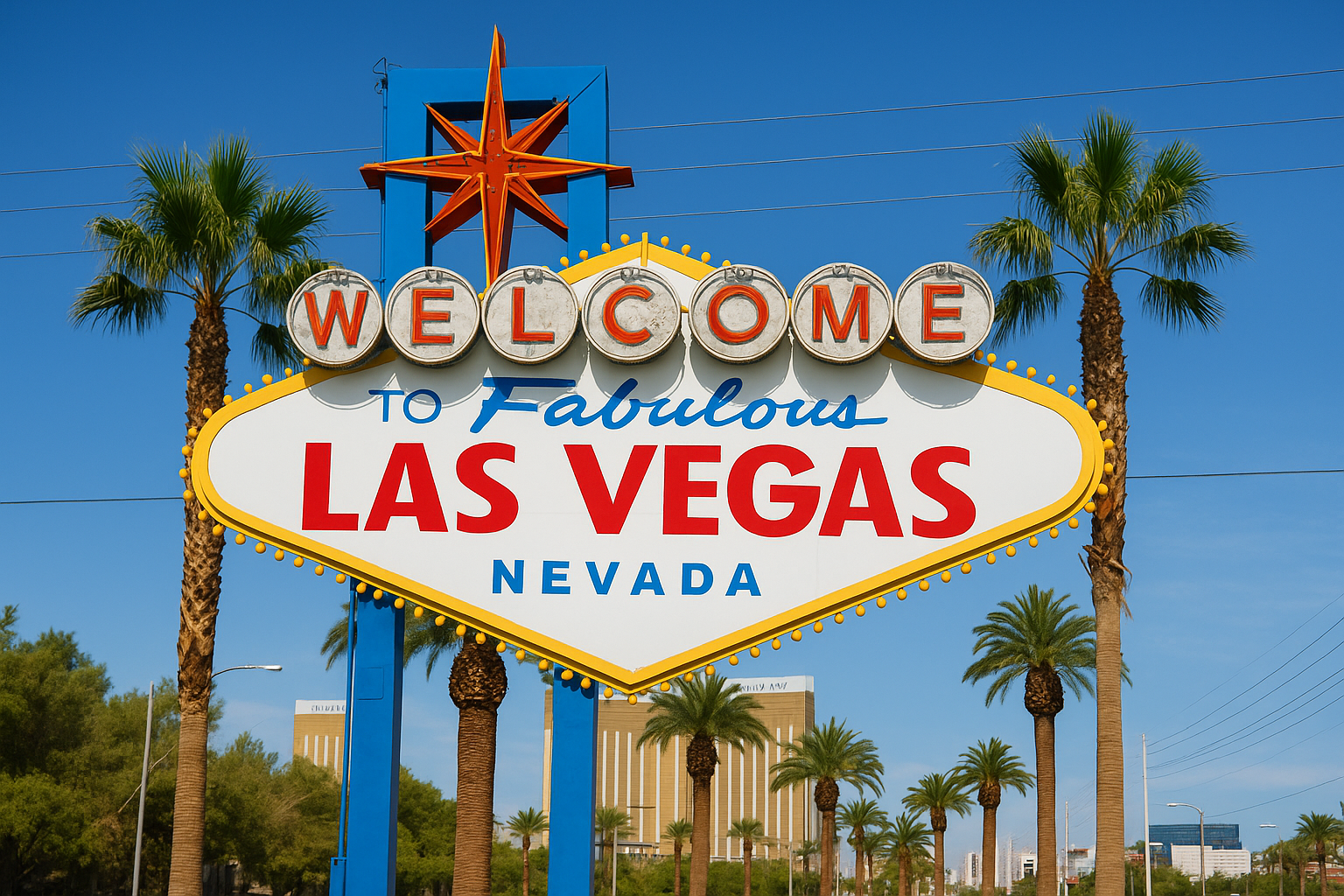
The Welcome to Fabulous Las Vegas sign sits at the southern end of the Strip, just past Mandalay Bay, and has welcomed visitors since 1959. It’s one of the most photographed spots in Nevada and one of the few las vegas strip landmarks that requires no ticket and no reservation.
What makes it a landmark
Designer Betty Willis created the sign in 1959 as a piece of commissioned public art, drawing on the Googie architectural style that defined mid-century American roadside design. The bold, diamond-shaped sign used futuristic angles and bright colors to signal arrival into something larger than an ordinary city. Willis never trademarked the design, which is why it appears on souvenirs, murals, and merchandise worldwide. The sign earned a spot on the Nevada State Register of Historic Places in 2009, making it an officially recognized piece of American roadside history.
The fact that Willis never trademarked the design is part of what made the sign so culturally durable. It belongs to everyone who has ever driven into Las Vegas.
Best time to go
Early morning between 7 AM and 9 AM gives you the best chance at photos without a crowd lined up behind you. The sign faces north, so afternoon light hits the front directly, making late afternoon another strong option for photography. Midday in summer combines extreme heat with peak tourist traffic, so either of those windows serves you better.
How to visit it
The sign stands in a dedicated median parking lot on Las Vegas Boulevard South, about a half-mile south of Mandalay Bay. Your options for getting there include:
- Driving and parking for free in the median lot
- Adding it as a stop on a guided Strip tour
- Walking from nearby hotels, which takes roughly 20 to 30 minutes
What it costs
Seeing the sign is entirely free. No entry fee, no timed ticket, and no line reservation system exists. If you visit as part of a guided Strip tour, the stop is included within your overall tour pricing.
3. Fountains of Bellagio
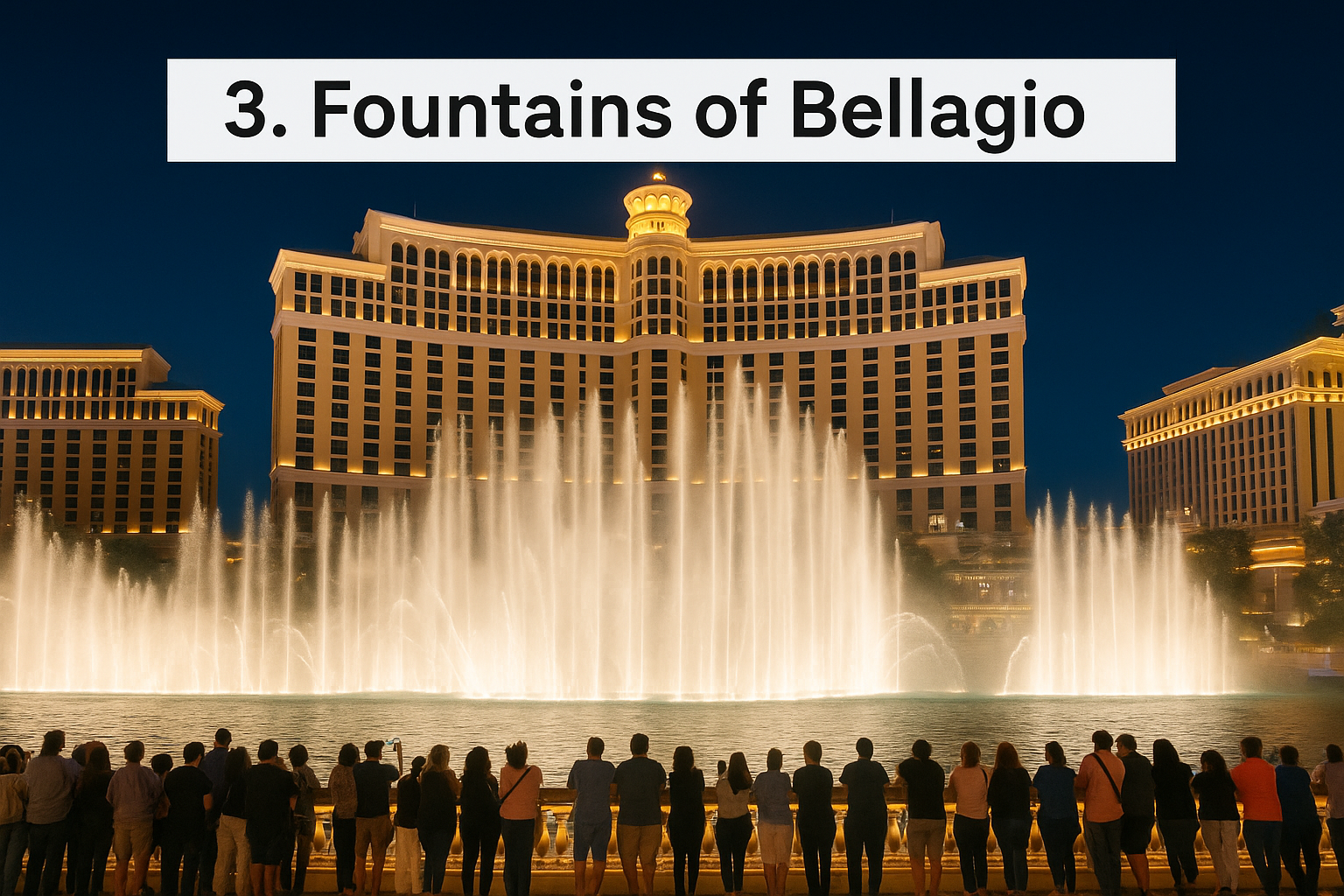
The Fountains of Bellagio rank among the most recognized las vegas strip landmarks in the world. This choreographed water show runs across an 8.5-acre lake in front of the Bellagio hotel and draws crowds to the sidewalk every single day of the year.
What makes it a landmark
The fountains launched in 1998 alongside the Bellagio resort and set a new standard for what a casino could offer as public entertainment. Over 1,000 water jets work in sync with music, shooting streams as high as 460 feet into the air. The show cycles through a rotating playlist that spans opera, pop, and classical, so no two visits feel identical. The scale and precision of the display make it genuinely difficult to watch without stopping.
The fountains were designed not just as a hotel amenity but as a public spectacle, which is why they’re visible and free from the sidewalk on Las Vegas Boulevard.
Best time to go
Evening shows produce the most dramatic effect, with the lit water columns visible against the dark sky. Shows run every 15 minutes after 8 PM on weekdays and every 15 minutes after 7 PM on weekends, with afternoon shows running every 30 minutes from noon. Arriving 10 minutes early gets you a front-row spot along the sidewalk railing.
How to visit it
You can watch the fountains from the free public sidewalk along Las Vegas Boulevard without entering the hotel. For a closer elevated view, the Bellagio’s restaurant and bar spaces overlook the lake directly. Many guided Strip tours time their itinerary around a fountain show, which gives you the spectacle with full context from your guide.
What it costs
Watching from the sidewalk is completely free. Restaurant or bar seating inside the Bellagio requires a purchase, with prices varying by venue. Guided Strip tours that include a fountain viewing stop are priced as part of your overall tour package.
4. Bellagio Conservatory and Botanical Gardens
The Bellagio Conservatory and Botanical Gardens sits just inside the hotel lobby and gives you one of the most visually striking indoor spaces among all the las vegas strip landmarks you’ll encounter. This isn’t a small side attraction. The conservatory spans over 14,000 square feet under a 50-foot glass ceiling, and its seasonal displays draw visitors who have no intention of gambling.
What makes it a landmark
The conservatory changes its entire display five times per year, with major installations built around Chinese New Year, spring, summer, fall, and winter. Each display involves thousands of live plants, custom-built structures, and large-scale sculptural pieces that take weeks to install. A dedicated horticulture team of about 140 people maintains the garden year-round, which explains why the plants always look fresh rather than neglected.
The scale of the seasonal installations means a visit in January looks almost nothing like a visit in July, which makes this a rare Strip attraction worth returning to.
Best time to go
Weekday mornings between 9 AM and noon give you the least crowded access to the conservatory. Because it sits inside the Bellagio, it stays climate-controlled and open 24 hours, making it a useful stop during the midday heat or late at night when most outdoor attractions lose their appeal.
How to visit it
Walk through the Bellagio’s main lobby entrance on Las Vegas Boulevard and follow the signs toward the conservatory. No separate entrance or reservation is needed. Many guests combine this stop with a fountain viewing since both attractions sit within the same property.
- Free entry directly from the hotel lobby
- Open 24 hours, every day of the year
- Photography is welcome throughout the space
What it costs
Entry to the conservatory is completely free. There is no ticket, no timed entry, and no minimum purchase required to walk through.
5. Eiffel Tower at Paris Las Vegas
The Eiffel Tower at Paris Las Vegas stands at roughly half the scale of the original in France, making it one of the most recognizable las vegas strip landmarks visible from almost anywhere along the boulevard. The replica rises 541 feet above the Strip and includes a working elevator that carries guests to an observation deck with unobstructed views in every direction.
What makes it a landmark
Paris Las Vegas opened in 1999, and the Eiffel Tower replica became an instant reference point on the skyline. The structure was built using the original 1889 blueprints from Gustave Eiffel’s engineering firm, which makes it far more accurate in detail than most visitors expect. At night, the tower illuminates in gold and white, creating one of the most photographed nighttime views on the entire boulevard.
Standing across the street near the Bellagio fountains, you get a direct sightline to the tower, which is why this stretch of Las Vegas Boulevard consistently ranks among the best spots to photograph in the city.
Best time to go
Evening visits between 8 PM and midnight give you the full impact of the tower’s lighting program. The observation deck stays open until midnight most nights, and clear evenings allow for views stretching across the valley floor to the surrounding Spring Mountains.
How to visit it
You reach the Eiffel Tower elevator by walking through the Paris Las Vegas casino floor and following the signs toward the tower base. No advance reservation is required for most visits, though weekend evenings can produce short lines at the elevator entrance.
What it costs
Observation deck tickets run approximately $22 to $37 per person, depending on the time of day. Evening rates typically run higher than daytime rates, and tickets can be purchased on-site at the tower base.
6. Caesars Palace and the Forum Shops
Caesars Palace has anchored the Las Vegas Strip since 1966, making it one of the oldest continuously operating resorts on the boulevard. The property covers over 85 acres and houses the Forum Shops, a themed retail complex built to resemble an ancient Roman streetscape complete with a painted sky ceiling that shifts from dawn to dusk.
What makes it a landmark
Few las vegas strip landmarks set the template for themed resort design as decisively as Caesars Palace did in the decades after it opened. The Forum Shops launched in 1992 and expanded multiple times, eventually covering over 675,000 square feet of retail space. The indoor streetscape includes animatronic fountains, classical statues, and a spiral escalator that became a reference point for entertainment retail design worldwide.
Caesars Palace has maintained its cultural relevance across six decades by hosting championship boxing matches, award ceremonies, and film productions that keep reintroducing it to new audiences.
Best time to go
Weekday afternoons between 1 PM and 5 PM give you the most comfortable access to both the casino floor and the Forum Shops before weekend crowds arrive. The Forum Shops stay open until 11 PM on most nights, which makes them a practical stop after evening sightseeing on the boulevard.
How to visit it
Walk in through the main Las Vegas Boulevard entrance and follow the Forum Shops signage from the casino floor. No reservation is needed for general access to either space.
- Entry to the casino and Forum Shops is free
- The spiral escalator near the Atlantic entrance is worth a look on its own
What it costs
General access to both Caesars Palace and the Forum Shops is completely free. Individual dining, retail, and entertainment purchases are priced by each venue.
7. The Venetian and the Grand Canal Shoppes
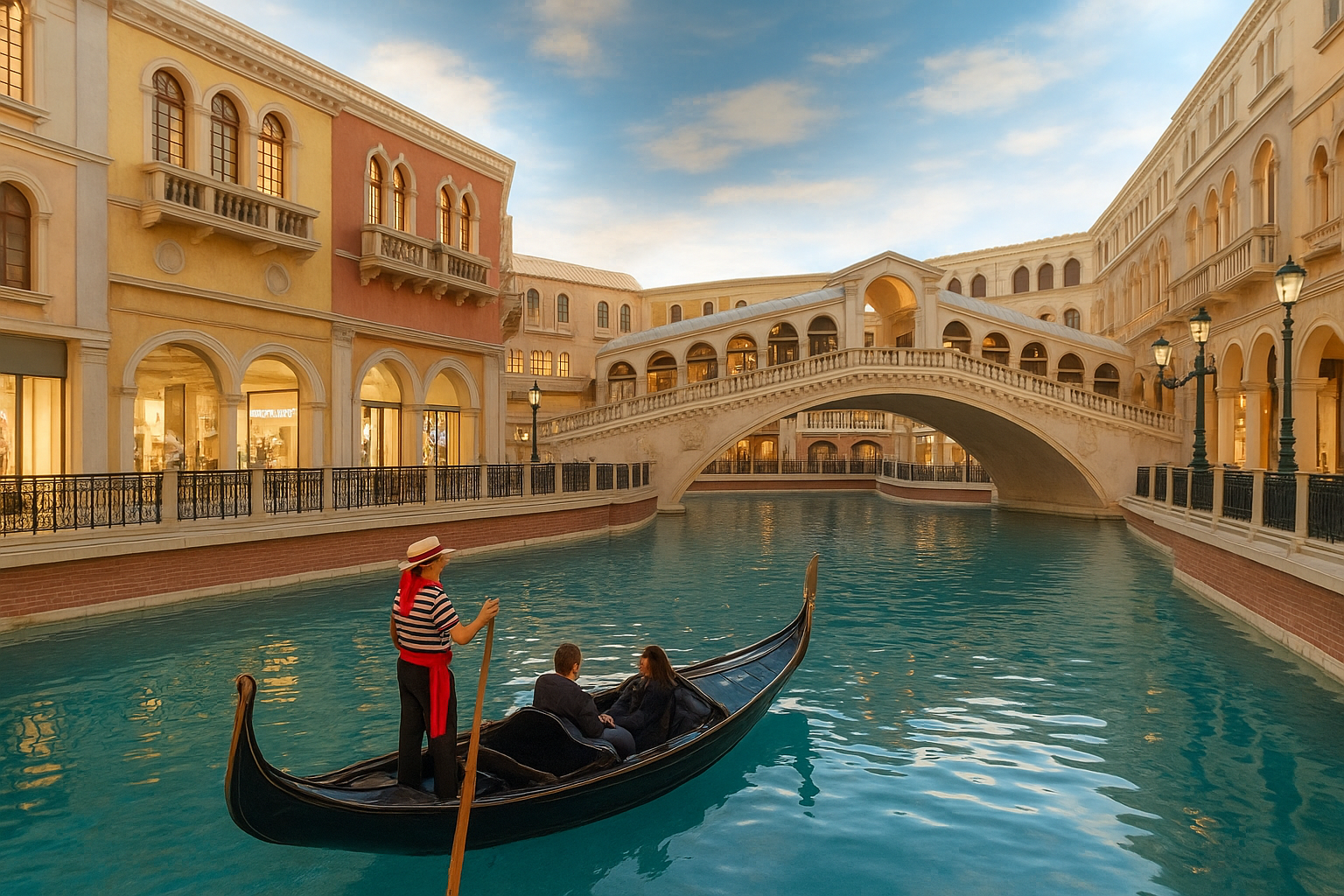
The Venetian Resort opened in 1999 on the former site of the Sands Hotel and immediately raised the bar for themed resort design among all las vegas strip landmarks. The property replicates Venice’s most recognizable architecture at full scale, including the Grand Canal, St. Mark’s Square, and the Rialto Bridge, all built indoors and accessible without a single ticket.
What makes it a landmark
The Grand Canal Shoppes run along an indoor waterway where costumed gondoliers ferry guests in authentic gondolas while singing Italian opera. A painted ceiling simulates an open blue sky overhead, and the stonework, archways, and murals throughout the space are detailed enough to make you forget you’re inside a casino resort. No other property on the Strip has replicated this experience at the same scale.
The gondola rides remain one of the few genuinely unique Strip experiences that you won’t find duplicated anywhere else along Las Vegas Boulevard.
Best time to go
Weekday mornings between 10 AM and noon give you the most open access to the canals and shoppes before afternoon foot traffic fills the walkways. The climate-controlled interior also makes this a practical destination during peak summer heat when extended outdoor time becomes genuinely uncomfortable.
How to visit it
Enter through the main Las Vegas Boulevard entrance and follow the signs toward the Grand Canal Shoppes. Gondola rides depart from two locations inside the property and typically run throughout the day without requiring advance booking. You can spend an hour here without spending a dollar if your goal is just to take in the space.
- General access to the shoppes is free
- Gondola rides operate on a walk-up basis most days
What it costs
Walking through the property is completely free. Gondola rides cost approximately $45 per person for the indoor canal route, with pricing subject to seasonal adjustments.
8. The LINQ Promenade and High Roller
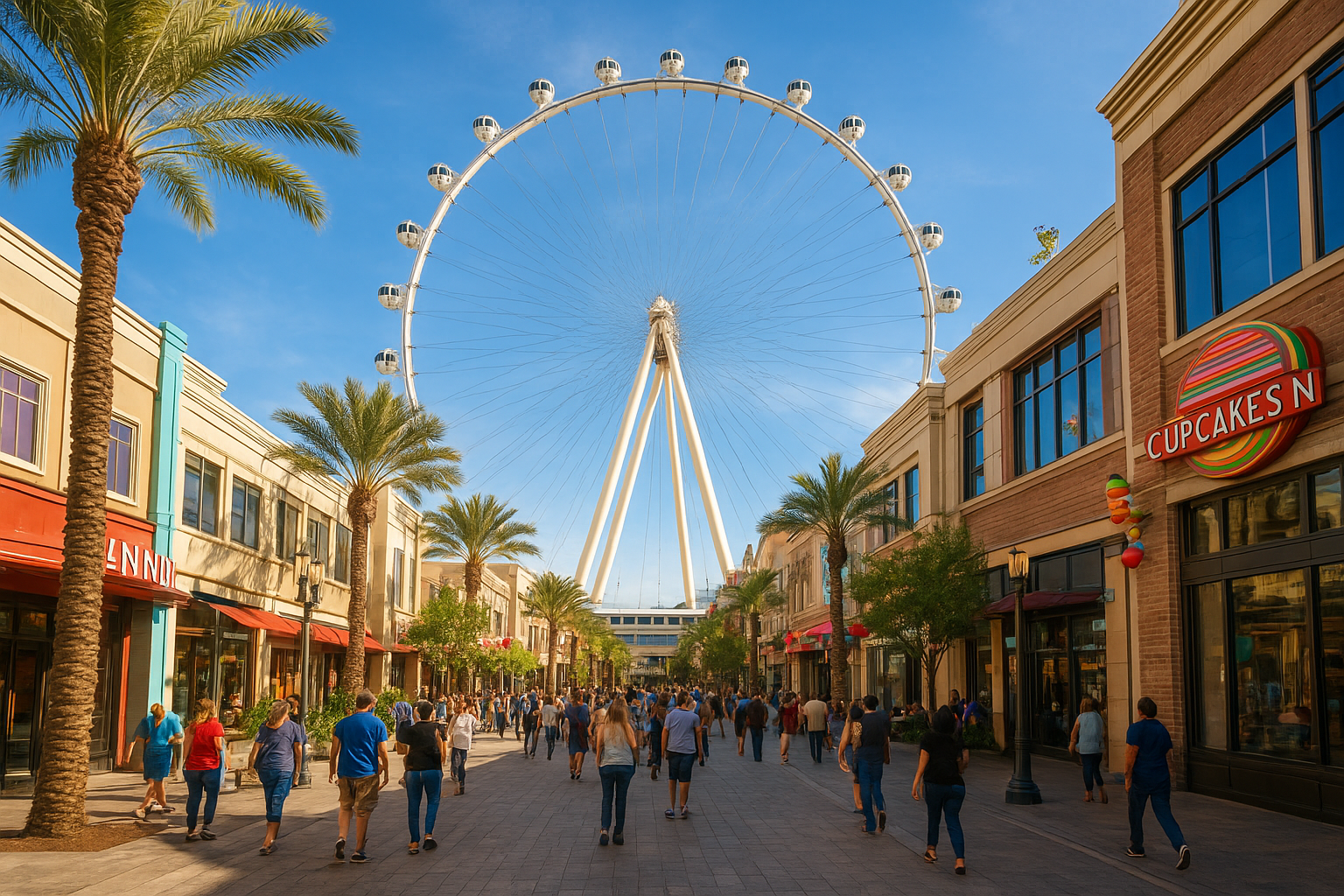
The LINQ Promenade is an open-air retail and dining corridor running behind the LINQ Hotel, connecting Las Vegas Boulevard directly to the base of the High Roller observation wheel. At 550 feet tall, the High Roller held the title of the world’s largest observation wheel when it opened in 2014, and it remains one of the most distinctive las vegas strip landmarks on the mid-Strip skyline.
What makes it a landmark
The High Roller’s 28 enclosed glass cabins each hold up to 40 people and complete one full rotation in approximately 30 minutes. The pods are large enough to move around inside, which separates the experience from a standard Ferris wheel ride. Below it, the LINQ Promenade stretches over 300 yards with more than 35 restaurants, bars, and shops giving you a full evening’s worth of activity without leaving the corridor.
The combination of a walkable open-air promenade and a 550-foot observation wheel gives you one of the few mid-Strip destinations that rewards both daytime and nighttime visits equally.
Best time to go
Evening rides after 9 PM deliver the most dramatic views of the illuminated Strip below. For clearer sightlines across the valley floor, daytime rides between 10 AM and 2 PM work best on low-haze days when the Spring Mountains are visible in the distance.
How to visit it
Walk east from Las Vegas Boulevard through the Promenade to reach the High Roller ticket counter at the far end. No advance reservation is required for most visits, though weekend evenings can produce short wait times at the boarding area.
- The Promenade itself is open to the public at no charge
- Rides depart continuously throughout daily operating hours
What it costs
High Roller tickets run approximately $25 to $37 per person, with evening rates typically running a few dollars higher than daytime pricing depending on the day of the week.
9. The Cosmopolitan and its rooftop views
The Cosmopolitan of Las Vegas opened in 2010 as one of the most design-forward properties among all the las vegas strip landmarks that define the mid-Strip corridor. Unlike older resort-casinos built around a single theme, the Cosmopolitan positioned itself around a vertical layout that maximizes views from multiple levels, including a series of rooftop spaces that give guests a perspective on the boulevard that most properties simply don’t offer.
What makes it a landmark
Built around a three-tower design, the Cosmopolitan stacks its amenities upward rather than outward, pushing the rooftop pool deck and bar spaces roughly 14 stories above Las Vegas Boulevard. The property also carries a distinctive identity built around commissioned art installations and an interior aesthetic that separates it visually from the themed mega-resorts on either side, which is why it draws visitors who aren’t there to gamble.
The Cosmopolitan’s vertical layout made rooftop access a defining feature rather than an afterthought, which is why its elevated spaces remain some of the most requested views on the Strip.
Best time to go
Late afternoon between 4 PM and 7 PM gives you the best transition from clear valley sightlines to the Strip’s evening lighting program. Weekdays consistently offer less competition for space at the rooftop bar areas compared to Friday and Saturday evenings when wait times at popular spots extend significantly.
How to visit it
Enter through the main Las Vegas Boulevard entrance and follow signage to the interior elevator banks that connect to the upper-floor bars and lounges. No advance reservation is required for general access during standard operating hours, though specific rooftop venues may enforce a guest list on peak nights.
What it costs
Access to the casino floor and lobby is completely free. Rooftop bar areas typically carry a minimum drink purchase, with cocktails starting around $15 to $20 depending on the specific venue and night of the week.
10. CityCenter and The Shops at Crystals
CityCenter stands as one of the most architecturally ambitious projects ever built on the Las Vegas Strip, covering 67 acres between the Bellagio and the Monte Carlo. Developed by MGM Resorts and opened in 2009, the complex includes hotels, residences, and a retail center that reshaped what large-scale urban development could look like in Nevada.
What makes it a landmark
Among all the las vegas strip landmarks built in the 21st century, CityCenter comes closest to functioning as a self-contained city block. The Shops at Crystals anchor the retail side of the complex with a building designed by architect Daniel Libeskind, whose sharp angular forms and soaring atrium ceilings make the structure visually distinct from any other shopping space on the boulevard. The complex commissioned over $40 million in original artwork displayed throughout the property, including large-scale pieces by Maya Lin and Jenny Holzer.
The combination of world-class architecture and commissioned public art makes Crystals worth visiting even if you have no interest in the luxury retail brands inside.
Best time to go
Weekday afternoons between noon and 4 PM give you the most open access to the Crystals building before the post-work and evening crowd moves through. The climate-controlled interior also makes this a practical stop during summer when outdoor temperatures push past 110 degrees and covered destinations become a priority.
How to visit it
Enter the Shops at Crystals directly from Las Vegas Boulevard or through the connected walkways from Aria and Vdara. No reservation is required, and the public spaces inside the building are accessible without any purchase.
What it costs
General access to CityCenter and the Shops at Crystals is free. Individual dining and retail purchases are priced by each tenant.
11. T-Mobile Arena and Toshiba Plaza
T-Mobile Arena opened in 2016 on a parcel tucked behind New York-New York and the Park MGM, bringing a 20,000-seat live event venue to the center of the Strip corridor. It quickly became one of the most visited las vegas strip landmarks that doesn’t require a hotel key to experience.
What makes it a landmark
The arena serves as the home of the Vegas Golden Knights NHL franchise and hosts boxing matches, UFC events, and major concert tours throughout the year. Toshiba Plaza, the open-air public space directly in front of the arena entrance, gives the surrounding blocks a gathering point that the mid-Strip corridor previously lacked. Large LED screens, public seating, and a walkable layout make the plaza worth visiting even when no event is scheduled.
The Golden Knights’ arrival in 2017 gave Las Vegas its first major professional sports franchise, and T-Mobile Arena became the physical anchor for that identity almost overnight.
Best time to go
Event nights between 6 PM and 8 PM produce the best atmosphere in Toshiba Plaza, with crowds gathering before doors open and food and drink vendors operating at full capacity. Check the T-Mobile Arena events calendar before your visit to plan around a game or show that interests you.
How to visit it
Walk south from the Bellagio or north from Mandalay Bay along the Strip and turn east at Park MGM. Toshiba Plaza sits directly between the two properties and connects to the arena’s main entrance. No ticket is required to access the plaza itself.
- Toshiba Plaza is open to the public at no charge
- Arena access requires a valid event ticket
What it costs
Accessing Toshiba Plaza is free. Event tickets vary widely depending on the show or game, with Golden Knights tickets typically starting around $60 to $80 per seat for regular-season games.
12. Las Vegas Sphere
The Las Vegas Sphere sits just east of the Venetian on Sands Avenue and represents the most significant addition to the Strip skyline in decades. Standing 366 feet tall and 516 feet wide, the structure is visible from miles away and has fundamentally changed what visitors expect from live entertainment in Las Vegas.
What makes it a landmark
The Sphere holds the distinction of carrying the world’s largest LED screen on its exterior, wrapping the entire building in programmable visuals that change nightly. Inside, the venue seats approximately 17,500 people and hosts both concert residencies and immersive film experiences using a screen that covers the full interior surface. U2 opened the venue in September 2023, and it has since drawn residencies that sell out months in advance.
The Sphere doesn’t fit neatly into any existing category of las vegas strip landmarks because it functions simultaneously as an architectural spectacle, a concert hall, and a cinematic experience unlike anything else on the boulevard.
Best time to go
Evening hours between 8 PM and midnight give you the best view of the exterior LED display from Las Vegas Boulevard. The exterior visuals change regularly, so no two nights look identical from the street, which makes it worth checking more than once during a multi-day visit.
How to visit it
Walk east from the Venetian’s main entrance on Las Vegas Boulevard and follow Sands Avenue to the Sphere’s ticketed entrance. For exterior viewing, you can see the building clearly from several points along the northern Strip without purchasing a ticket.
- The exterior display is visible from the street at no cost
- Interior experiences require an advance ticket purchase through the official Sphere website
What it costs
General admission tickets for immersive film experiences start around $49 to $79 per person, while concert and residency tickets vary significantly by artist and seat location, often ranging well above $100 for premium positions.
Make your Strip plan
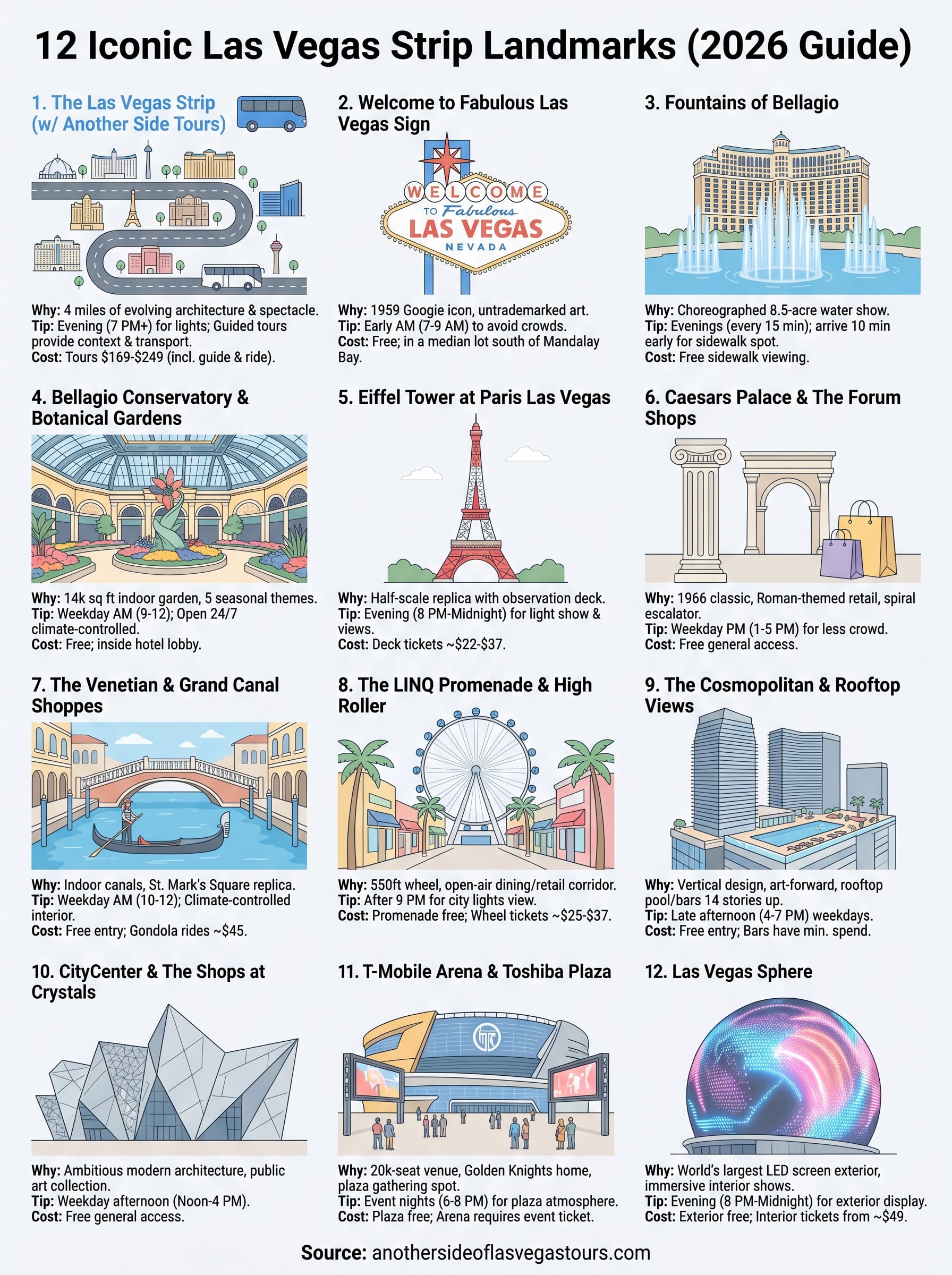
These 12 las vegas strip landmarks give you a concrete framework for planning your time on the boulevard rather than wandering and hoping you land on the right spots. Each one carries history, architecture, or spectacle worth understanding, and knowing what you’re looking at before you arrive makes every stop more memorable.
Planning still takes work, especially when you’re trying to sequence stops around show times, heat, and crowd patterns. A guided tour removes that friction entirely. Another Side Tours builds your itinerary around what actually matters, handles transportation between stops, and gives you the insider context that maps and travel apps can’t replicate.
If you want a fully customized experience built around your schedule and interests, check out our custom Las Vegas tours to see how we put it together. Your time in Las Vegas is limited, so spending it right matters.