Every neon sign, mega-resort, and poker chip on the Strip exists because of a Las Vegas casino history that stretches back more than a century. What started as a dusty railroad stop in 1905 became the gambling capital of the United States through a mix of frontier ambition, organized crime, corporate reinvention, and sheer spectacle. Understanding that arc changes the way you see the city, every building tells a story, and every corner has a past.
At Another Side Tours, our guides walk guests through these stories in person, pointing out the landmarks and hidden details that connect modern Las Vegas to its rougher, wilder origins. It’s one thing to read about Bugsy Siegel or the Rat Pack, it’s another to stand where it happened and hear the full context from a local who knows the city inside out. That firsthand perspective is exactly what we bring to every tour we run.
Below, you’ll find a complete timeline covering the key events, power players, and turning points that shaped Las Vegas from a small desert settlement into a $15 billion gaming industry. Whether you’re planning a trip or just curious, this chronological breakdown will give you the full picture, decade by decade.
Why Las Vegas casino history matters
Most visitors walk the Strip focused on what’s in front of them: the lights, the buffets, the slot machines. But the buildings, the street layout, and even the business model of every casino you step into all trace back to specific decisions made across more than a hundred years of Las Vegas casino history. Knowing that history does not just satisfy curiosity, it changes how you experience the city in real time.
The history explains the city’s layout
Las Vegas was not planned the way most American cities were. Downtown Fremont Street developed first, anchored by the railroad and early license-holders, while the Strip grew up later on land that sat just outside city limits, giving early operators freedom from local regulations. That geographic split still shapes where you go and what you find today. The original casino corridor downtown and the resort mega-complex corridor on the Strip have different atmospheres, different price points, and different stories, and both exist because of historical decisions made under very different conditions.
Understanding why Downtown and the Strip feel so different puts you in a much stronger position to choose where to spend your time and money.
The history explains who built the industry
The casino industry in Las Vegas was not built by hotel chains or Wall Street firms at the start. It was built by gamblers, bootleggers, and organized crime figures who saw opportunity in Nevada’s 1931 gambling legalization. Figures like Bugsy Siegel, Meyer Lansky, and Benny Binion shaped the early culture of the industry, including the concept of the casino as entertainment destination rather than just a gambling hall. Later, Howard Hughes and then corporate operators like Hilton and MGM shifted control from individuals to companies, but the DNA of the original operators is still visible in how Vegas markets itself and treats its guests.
The history explains the business model
Every free drink, discounted buffet, and loyalty rewards program you encounter today exists because of lessons learned over decades of trial and error. Early casino operators figured out that keeping players comfortable and on the floor generated more revenue than nickel-and-diming them on incidentals. That insight drove the all-inclusive resort model that Las Vegas perfected and that the rest of the hospitality industry eventually copied. When you understand the origin of these tactics, you stop seeing them as perks and start seeing them as deliberate design, which makes you a smarter visitor.
The history is still physically present
Unlike many cities where old buildings get torn down to make way for new ones, Las Vegas has preserved or adapted a surprising number of its historic structures and districts. The Mob Museum downtown, the original Flamingo site, the neon sign graveyard known as the Neon Museum, and the Arts District all sit within a few miles of each other. Knowing the chronological context behind these places turns a walk through downtown from a casual stroll into something that feels more like reading a living document of American urban history.
How to read this timeline like a local
A timeline of las vegas casino history is more useful when you read it as a story about power and money changing hands rather than just a list of dates and building openings. Each decade in Vegas history represents a different group of people gaining or losing control of the industry, and understanding that dynamic helps you spot patterns that still play out today on the casino floor and along the Strip.
Look for the power shifts, not just the dates
Most people read historical timelines looking for facts to memorize. A better approach is to track who held influence at each stage and what forced the next group to take over. In Las Vegas, power moved from railroad pioneers to gambling operators to organized crime figures, then to corporate hotel chains, and eventually to global entertainment conglomerates. Each handoff happened because the previous group either ran out of capital, ran into legal trouble, or simply got outspent by a bigger player. When you frame the timeline that way, every event starts to connect logically to the next one.
Reading history as a series of power transfers, rather than isolated facts, gives you a framework that makes the entire arc of Las Vegas development click into place.
Connect each era to what you can still visit today
The other habit worth building is mentally mapping each historical period to physical locations that still exist. Downtown Fremont Street reflects the 1930s and 1940s era, when the city’s first licensed casinos clustered near the railroad. The mid-century resort architecture visible at certain older properties on the Strip points directly to the Mob-era build-out of the 1950s and 1960s. The Neon Museum preserves actual signs from properties that no longer exist, giving you a tangible connection to eras you otherwise only read about.
When you combine these two habits, tracking power and connecting history to place, the timeline stops being a sequence of names and numbers. It becomes a map you can walk through during your time in the city.
Timeline 1905–1930: A railroad town finds its footing
Before the first casino opened, before the Strip existed, and before Nevada legalized gambling, Las Vegas was nothing more than a supply stop for the San Pedro, Los Angeles and Salt Lake Railroad. The city’s entire early identity was shaped by a single industry that had nothing to do with cards or dice, and understanding that starting point is essential context for the rest of las vegas casino history.
1905: The railroad auction that started it all
On May 15, 1905, the Union Pacific Railroad auctioned off 110 acres of land in what would become downtown Las Vegas. Buyers snapped up lots to build hotels, saloons, and supply businesses that served railroad workers and travelers passing through. The population grew quickly for a desert settlement, reaching roughly 1,500 residents within a year. Fremont Street became the main corridor, a pattern that would hold for the next several decades as the city’s commercial and entertainment center.
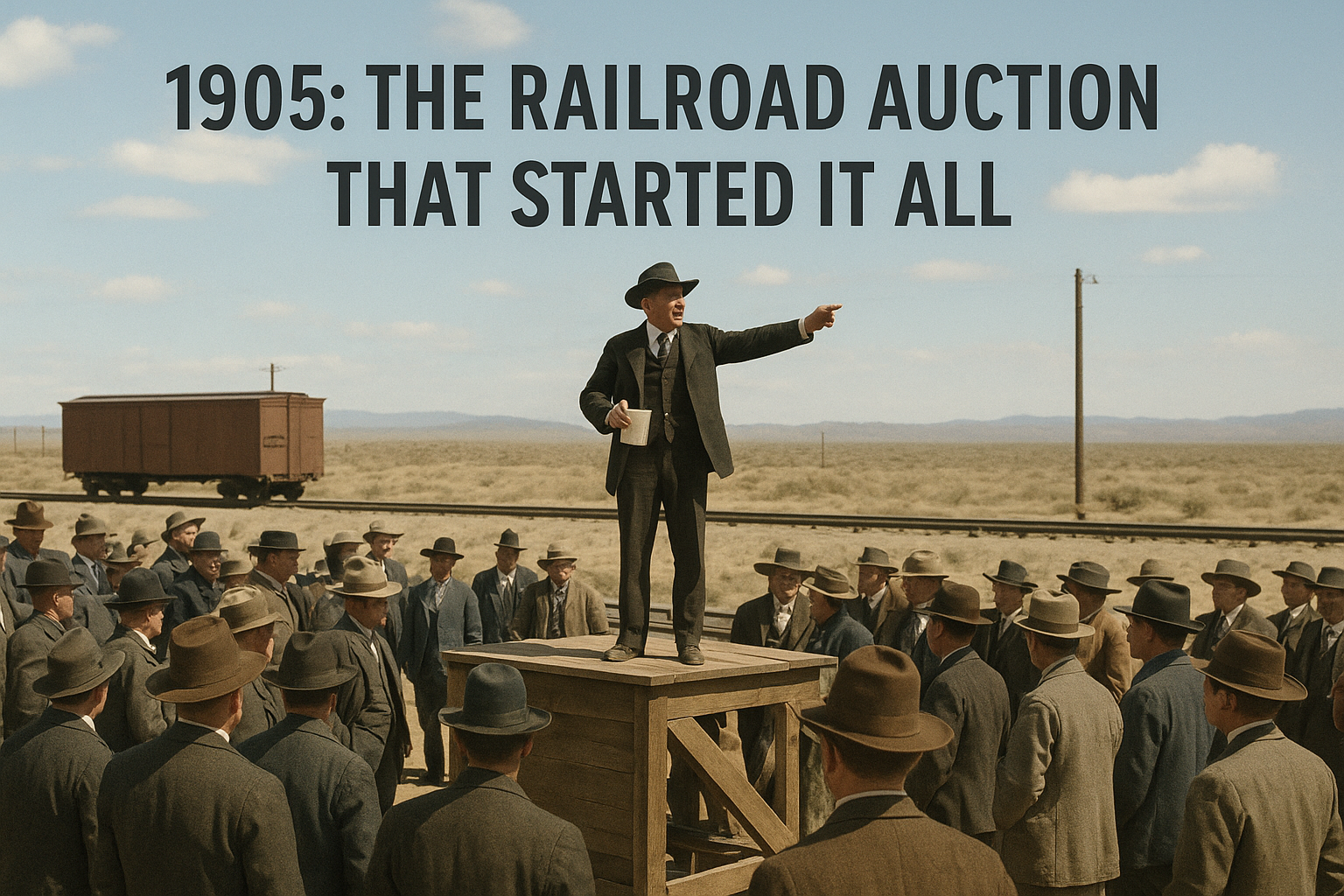
That 1905 land auction set the physical footprint of downtown Las Vegas, and Fremont Street’s dominance in the early casino era traces directly back to it.
Illegal gambling fills the gap
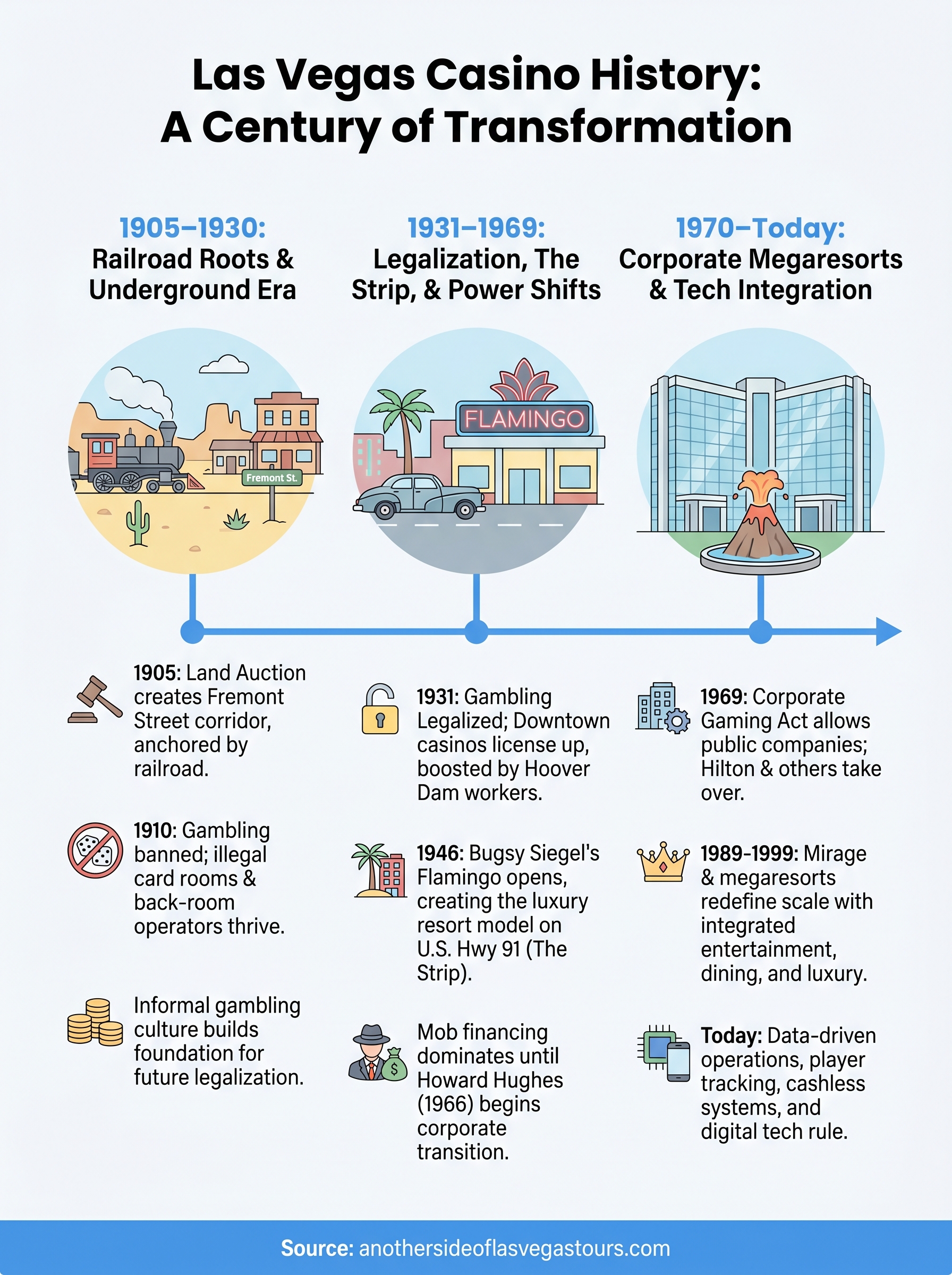
Nevada actually banned gambling in 1910, but that did not stop it from happening. Underground card rooms and dice games operated throughout Las Vegas during the 1910s and 1920s, often with the quiet tolerance of local law enforcement. Saloon owners and back-room operators built a gambling culture that existed outside the law, and that culture proved impossible to suppress. When the Great Depression hit in the early 1930s and Nevada’s government needed revenue, those decades of informal gambling infrastructure gave lawmakers a ready-made industry to legalize rather than build from scratch. The 1905-to-1930 period, though lacking the big casino names you recognize today, laid the social and geographic groundwork for everything that followed.
Timeline 1931–1969: Legal gambling, Fremont, and the Strip
This four-decade stretch is the most consequential period in las vegas casino history. Nevada’s 1931 decision to legalize gambling did not just create a legal framework; it triggered a wave of investment, migration, and ambition that transformed a small railroad town into an international destination. The entire modern casino industry traces its DNA back to decisions made during these years.
1931: Nevada pulls the trigger on legalization
On March 19, 1931, Nevada Governor Fred Balzar signed the Wide Open Gambling Bill into law, making Nevada the only state in the country where casino gambling was fully legal. Within weeks, Fremont Street operators converted their back-room setups into licensed casinos. The Northern Club, the Las Vegas Club, and the Boulder Club all received early licenses and opened their doors to a public that had been gambling illegally for decades. The timing connected directly to the Hoover Dam construction project launching that same year, which flooded the region with thousands of workers who needed somewhere to spend their wages.
That combination of legalization and dam construction created the first real economic engine behind Las Vegas’s casino industry.
Bugsy Siegel and the birth of the Strip
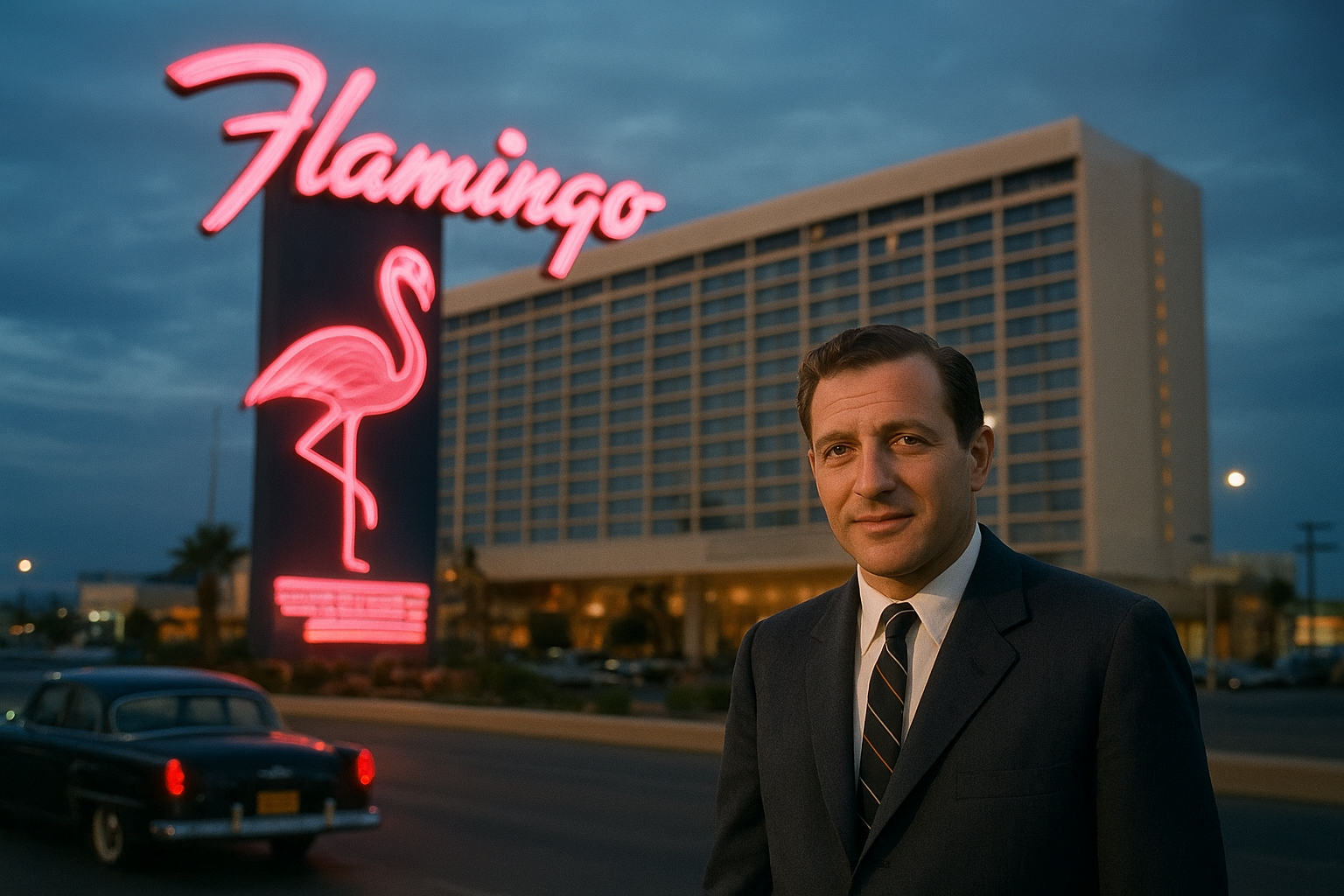
Benjamin "Bugsy" Siegel did not invent Las Vegas, but he did invent the Las Vegas resort concept when he opened the Flamingo Hotel in December 1946. Siegel’s vision was different from the downtown model: a luxury property built on U.S. Highway 91 outside city limits, offering hotel rooms, fine dining, entertainment, and gambling under one roof. The Flamingo struggled initially and Siegel was murdered in 1947, but his blueprint survived him. The Thunderbird, Desert Inn, Sands, and Sahara all followed on the same stretch of highway through the 1950s, and the Strip was born.
The Rat Pack era and corporate transition
Through the late 1950s and 1960s, Las Vegas ran almost entirely on mob-connected financing, with figures like Meyer Lansky and Moe Dalitz operating through layers of front companies. That began to shift when Howard Hughes arrived in 1966, buying the Desert Inn and several other properties outright with clean, traceable money. Hughes’s purchases signaled to Wall Street that casino ownership could be legitimate corporate business, setting the stage for the corporate takeover that would define the next era.
Timeline 1970–today: Megaresorts, brands, and tech
The final stretch of las vegas casino history covers a period when organized crime gave way to public corporations, global hotel brands, and eventually digital technology. Howard Hughes’s purchases in the late 1960s opened the door, but the full corporate transformation happened through the 1970s and 1980s as Nevada passed laws allowing publicly traded companies to hold gaming licenses for the first time.
Corporate operators reshape the rules
Nevada’s Corporate Gaming Act of 1969 was the single most important legal change of this era. It allowed companies with multiple shareholders to own casinos without requiring each shareholder to hold an individual license, which made it possible for hotel chains like Hilton and Holiday Inn to enter the market. By the late 1970s, corporate-owned properties had overtaken mob-connected operations as the dominant force on the Strip, and the shift changed everything from how employees were treated to how the books were kept.
Once publicly traded companies entered the casino business, the rules of the game changed permanently, both legally and culturally.
The megaresort era redefines scale
Steve Wynn’s Mirage Hotel opened in 1989 and set a new standard that every subsequent developer tried to match. The Mirage cost over $630 million, featured a volcano attraction out front, and treated the hotel, entertainment, dining, and casino as one integrated product. That model triggered a building race through the 1990s:
- 1993: MGM Grand opens as the largest hotel in the world at the time
- 1998: Bellagio launches with an $8,500 nightly suite and a gallery of fine art
- 1999: Mandalay Bay and The Venetian both open within months of each other
Technology changes how casinos operate
Today’s casino floor runs on data. Player tracking systems, digital slot machines linked to central servers, and algorithmic loyalty programs have replaced the gut-feel management style of earlier decades. Mobile apps let you book, pay, and check in before you arrive.
Facial recognition and cashless wagering are already in use at several properties, and the physical experience you walk into today sits on top of a technology infrastructure that would be unrecognizable to the Flamingo’s original operators.
Next steps for exploring Vegas history
Reading about las vegas casino history gives you context, but walking through the actual locations turns that context into something you can feel. Downtown Fremont Street, the original Flamingo site, the Neon Museum, and the Arts District all sit within a short drive of each other, and each one connects directly to a specific chapter in this timeline. You now have the background to recognize what you’re looking at instead of just passing through it. That knowledge makes the difference between a trip that feels like a vacation and one that feels like a real education in American history.
The best way to pull all of this together is to go with a guide who knows the stories behind each landmark. Another Side Tours pairs expert local knowledge with private transportation, so you move through the city’s history at your own pace without guesswork or wasted time. Book a private Las Vegas tour and experience the full story firsthand.