Most people know Las Vegas as neon lights, casinos, and round-the-clock entertainment. But Las Vegas history stretches back more than a century before the first mega-resort ever opened its doors, to a dusty railroad stop in the Mojave Desert where the whole unlikely story began.
The city’s path from a small water stop along the San Pedro, Los Angeles & Salt Lake Railroad to the global capital of gambling and entertainment is one of the strangest in American history. It involves land auctions, mob money, dam construction, nuclear test sites, and a cast of characters that no screenwriter could invent. Each decade reshaped the city into something its founders never could have predicted.
This article walks through that full timeline, from the founding of Las Vegas in 1905 through the mob era, the corporate takeover of the Strip, and the modern megaresort boom. It’s the kind of story we share with guests every day at Another Side Tours, where our guides bring these places and events to life on the ground, in person. Knowing what happened here makes every block of this city more interesting to walk through.
Why Las Vegas history matters today
Las Vegas history isn’t just background noise for tourists killing time between casino visits. Understanding the city’s past shapes how you experience everything around you, from the architecture on Fremont Street to the layout of the Strip itself. When you know why something was built, who funded it, and what it replaced, the city stops being a collection of neon signs and starts making real sense as a place with genuine depth and complicated roots.
It changes how you see the city
When you walk through downtown Las Vegas, you’re walking through layers of decisions made by railroad executives, mob bosses, casino developers, and city planners across more than a century. The block where the Mob Museum now stands was once a federal courthouse where organized crime figures faced trial. That’s not trivia. That’s the kind of detail that makes a neighborhood feel real instead of manufactured for consumption.
Your experience of a place improves dramatically when you understand its context. A hotel tower looks entirely different when you know what stood there before and who built the predecessor. The signs, the street names, and the placement of casinos along the boulevard all reflect decisions made by specific people with specific goals at specific moments in time. History gives you the lens to read the city rather than just pass through it.
Knowing the history of Las Vegas turns a sightseeing trip into something closer to reading a great book, where every building and every block has its own chapter.
It explains the culture, not just the landmarks
Las Vegas has a reputation that most cities would never want. But that reputation didn’t appear out of nowhere. It grew from deliberate policy decisions, geographic isolation, and economic necessity. Nevada legalized gambling in 1931 partly because the state needed tax revenue during the Great Depression, and the culture of permissiveness that defines the city today traces directly back to those calculations made nearly a century ago.
Recognizing that history also helps you see past the surface-level version of Vegas that most visitors consume on a short trip. The city has a working population of over 2 million people, a serious arts district, a growing technology sector, and neighborhoods that have nothing to do with casinos. That fuller picture only comes into view once you understand how the city built its identity around tourism and what that required over generations of reinvention.
It makes guided tours more valuable
Visiting Las Vegas without any historical context is like watching a film after missing the first hour. You can follow what’s happening, but the references don’t land and the decisions the characters make don’t add up. A knowledgeable guide fills that gap by connecting what you see in front of you to what happened on that same ground decades earlier.
That’s exactly the approach Another Side Tours takes with every Las Vegas experience. Our guides don’t just point at buildings. They explain the forces that put those buildings there, and why that still matters to anyone standing in front of them today.
How Las Vegas went from oasis to railroad town
Long before any casino existed, the Las Vegas Valley survived because of water. The name itself comes from the Spanish phrase for "the meadows," referring to the natural artesian springs that made the region unusual in the middle of the Mojave Desert. Those springs attracted travelers, settlers, and eventually railroad surveyors who recognized the valley as a practical stopping point between Salt Lake City and Los Angeles.
The springs that made settlement possible
The Paiute people lived in the valley for centuries before European contact, using the springs and surrounding land for hunting and gathering. When Spanish explorers and traders began crossing the desert in the early 1800s, they relied on those same springs as a critical rest point along what became known as the Old Spanish Trail. The springs weren’t just convenient. They were essential to survival in a landscape that offered almost no water for hundreds of miles in any direction.
By the mid-1800s, Mormon settlers had established a fort near the springs in an effort to create a mission and supply route. That fort didn’t last, but it confirmed that the valley could support permanent habitation. The water that made the Las Vegas oasis possible would continue to drive every major decision about the area’s future for the next century.
Water determined the entire trajectory of early Las Vegas, and understanding that fact is the foundation of any honest look at las vegas history.
The 1905 land auction that started it all
On May 15, 1905, the San Pedro, Los Angeles and Salt Lake Railroad held a public land auction in the valley, selling off lots in what would become the original townsite of Las Vegas. Buyers came from across the region, and the auction raised significant capital in a single day. The railroad needed a service and supply stop along its route, and Las Vegas fit the geography perfectly.
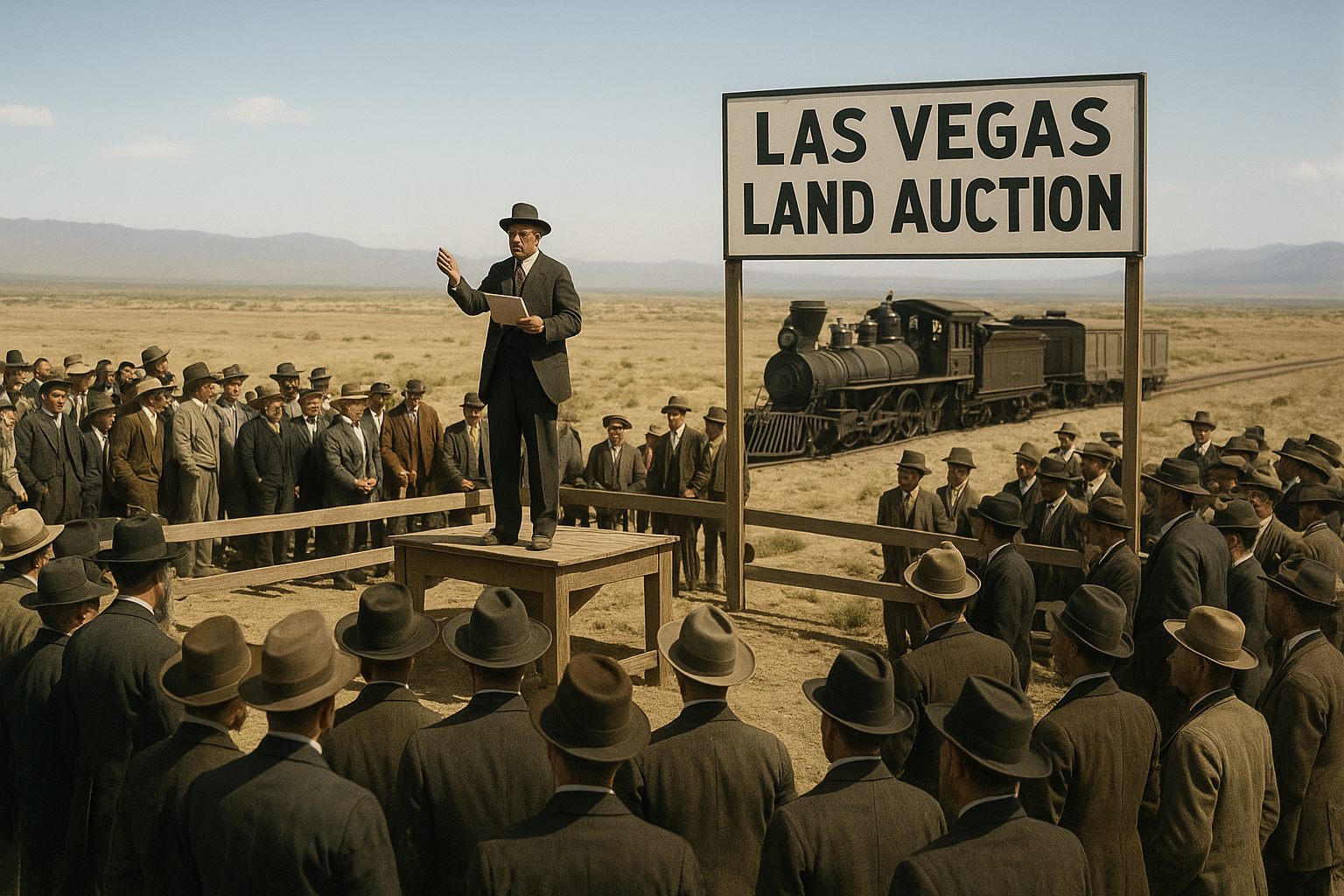
Within months, a small but functioning town had taken shape, built around the railroad depot and the services workers and travelers needed. That auction is the formal starting point of modern Las Vegas as a named, platted, incorporated place.
How Hoover Dam and legal gambling changed everything
Two events in 1931 permanently altered the direction of Las Vegas history and set the city on a path no other American town has ever taken. Nevada legalized wide-open gambling that year, and construction began on Hoover Dam roughly 30 miles southeast of the city. Neither event happened because of visionary city planning. Both happened because the state needed money and the federal government needed somewhere to put thousands of workers. The results changed everything.
The workers who built the dam built Vegas too
The Boulder Canyon Project, which produced what we now call Hoover Dam, brought roughly 5,000 construction workers into the region at the height of the Great Depression. The federal government built a planned community called Boulder City to house them and prohibited gambling and alcohol within its limits. That left Las Vegas as the obvious destination for workers who wanted to spend their wages on evenings off.
The city grew rapidly to meet that demand. Hotels, bars, and small casinos appeared along Fremont Street to capture the income flowing in from the dam project. By the time construction finished in 1935, Las Vegas had developed the basic infrastructure and economic habits of a service and entertainment economy built around visitors with money to spend.
The dam didn’t just generate electricity. It generated the first real tourist economy that Las Vegas had ever seen.
Nevada’s 1931 gambling law opened the floodgates
Nevada legalized casino-style gambling in March 1931, driven primarily by the state legislature’s need for new tax revenue during an economic collapse. The law wasn’t a moral statement. It was a practical one. The state had very little industry and needed income, and regulators calculated that taxing legal gambling would fund state operations more reliably than most alternatives available at the time.
That decision gave Las Vegas a legal framework no other major American city had. Operators could now build and run casinos openly, without the legal risk that came with operating in other states. The combination of a legal structure and a captive workforce from the dam project gave the city the foundation it needed to become something entirely new.
How the Strip, the mob, and corporations shaped Vegas
The Las Vegas you see today didn’t grow from a city plan. It grew from a series of bets made by people who saw opportunity in the desert and moved fast. Organized crime figures, legitimate investors, and eventually major corporations each took a turn reshaping the city, and every phase left something permanent on the landscape. Understanding those forces is essential to reading las vegas history with any accuracy.
When the mob built the modern casino industry
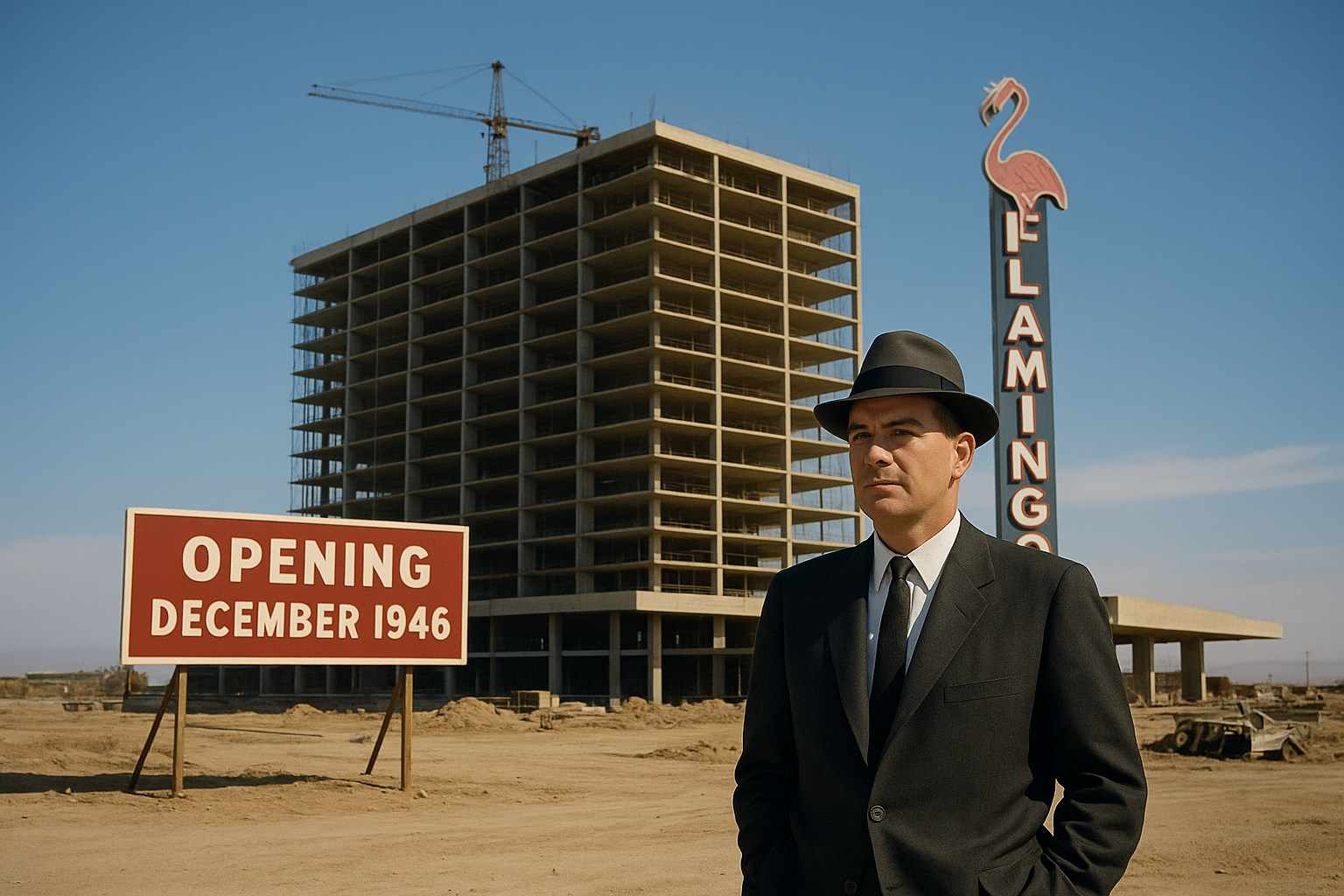
Bugsy Siegel opened the Flamingo Hotel in December 1946 on what was then a mostly empty stretch of Highway 91 south of downtown. The project nearly killed him financially before it found its footing, but the basic model he introduced changed the industry permanently. By combining a hotel, restaurant, entertainment, and a large-scale casino floor under one roof, Siegel established what would become the blueprint for every Las Vegas resort that followed.
Other organized crime figures moved quickly into the market through the 1950s. The Stardust, the Sands, and the Desert Inn all had mob-connected ownership or financing during this period. These operators understood entertainment and customer experience in a way that made the Strip a genuinely attractive destination, not just a place to gamble. The Nevada Gaming Control Board formed in 1955 partly to address corruption, but enforcement remained limited for years.
The mob didn’t invent the casino, but it did invent the Las Vegas resort as a total entertainment experience.
How corporate money replaced mob control
Howard Hughes began buying Las Vegas casino properties in 1966, and his acquisitions signaled a turning point. Where mob-connected operators had financed casinos through hidden investors and cash, Hughes brought corporate structure and public legitimacy. His purchases encouraged regulators and legislators to open casino licensing to publicly traded companies, which Nevada formalized in 1969.
Once corporations could legally own casinos, the economics changed completely. MGM, Hilton, and later Steve Wynn brought Wall Street capital into a market that had previously run on backroom deals. That shift produced the megaresort era and the skyline that defines Las Vegas today.
Las Vegas history timeline from A.D. 700 to today
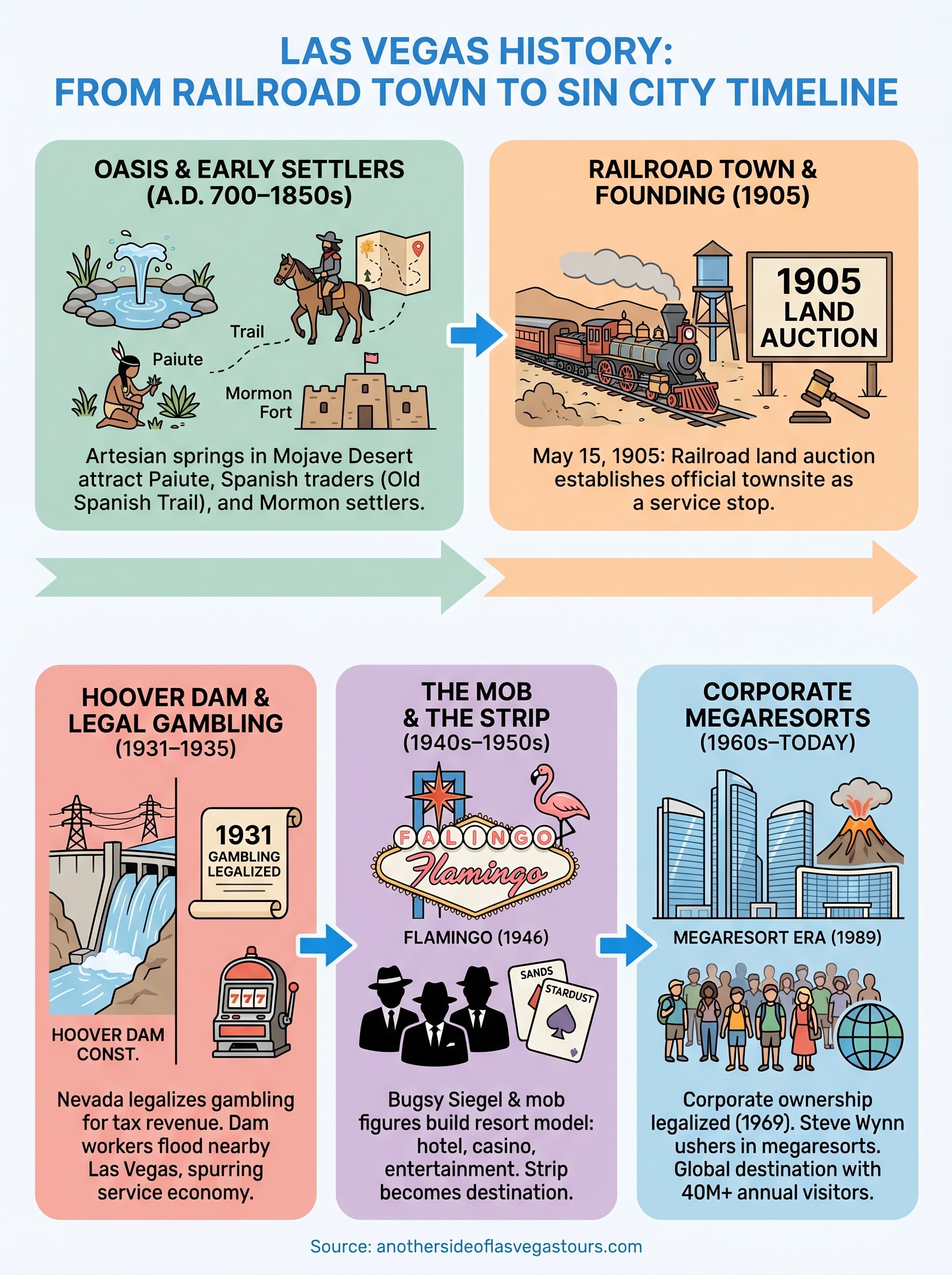
The full arc of las vegas history covers more than thirteen centuries, from early Ancestral Puebloan settlements to the multibillion-dollar resort corridor that exists today. Laying those events out in sequence makes the pace of change visible in a way that narrative alone can’t quite capture. Each entry below represents a moment that shifted the city’s direction and left something permanent behind.
Key dates that define Las Vegas
Compressing the major turning points into a single reference helps you see how each era created the conditions for the one that followed. Reading through it in order, you can also see how external forces rather than deliberate planning drove almost every significant development in the city’s past.
| Year | Event |
|---|---|
| A.D. 700 | Ancestral Puebloans settle the Las Vegas Valley, using natural springs |
| 1829 | Mexican trader Rafael Rivera becomes the first non-Native person to reach the valley |
| 1855 | Mormon settlers build a fort near the springs; it is abandoned by 1858 |
| 1905 | Railroad land auction on May 15 establishes the official Las Vegas townsite |
| 1931 | Nevada legalizes gambling; construction begins on Hoover Dam |
| 1935 | Hoover Dam is completed, cementing Las Vegas as a regional service hub |
| 1941 | El Rancho Vegas opens as the first resort on Highway 91 |
| 1946 | Bugsy Siegel opens the Flamingo Hotel, launching the modern resort model |
| 1955 | Nevada Gaming Control Board is established to regulate casinos |
| 1966 | Howard Hughes begins purchasing Strip casinos, signaling corporate entry |
| 1989 | Steve Wynn opens The Mirage, launching the megaresort era |
| 2009 | CityCenter opens as the largest privately funded construction project in U.S. history |
| Today | Las Vegas hosts over 40 million visitors annually across a metro area of 2+ million residents |
The city went from a railroad stop to a global destination in less than a single human lifetime.
What the timeline reveals
Each shift in this sequence reflects an outside pressure that the city absorbed rather than planned for. The railroad needed a stop, the dam project needed a nearby city, and Depression-era Nevada needed tax revenue. None of those forces originated inside the valley itself. Yet Las Vegas converted each one into the next phase of its own reinvention, which is what makes the city genuinely unusual among American places of comparable size and age.
Conclusion
Las Vegas history runs much deeper than most visitors realize before they arrive. The city grew from a railroad water stop into a global entertainment destination through a sequence of economic pressures, legal decisions, and calculated bets made by people who saw opportunity where others saw empty desert. Every street, building, and neighborhood carries that history in some form, whether you recognize it or not.
Seeing Las Vegas through that lens changes what a trip here actually means. You stop moving from attraction to attraction and start reading the city as a place with real events, real people, and real consequences behind every facade. That shift in perspective is exactly what our guides bring to every experience they lead.
If you want to explore these stories on the ground with someone who knows where to look, check out our private Las Vegas tours and find the experience that fits your visit.