
Search tours hoover dam and you’ll get a flood of options: powerplant tours, guided bus tours, small group excursions, combo trips with Las Vegas stops. Pick the wrong one and you either overpay for something generic or spend your afternoon standing in line instead of seeing the dam. If you’re short on time in Vegas, that’s a bad trade.
The right choice depends on what you actually want. A self-guided visitor tour works if you just want photos and a quick history lesson. A powerplant tour gets you inside the turbine room and dam structure itself, run by the Bureau of Reclamation. But if you want transportation handled, a guide who explains the engineering and the history along the way, and stops that fit your schedule, a private guided tour is the better fit.
This article breaks down each type of Hoover Dam tour, what you’ll actually see and skip with each, realistic pricing, and how to match a tour to your time, budget, and interests, so you book once and get it right.
Why a Hoover Dam tour is worth your time
Hoover Dam isn’t a side attraction you check off between casinos. It’s a 726-foot concrete wall holding back Lake Mead, the largest reservoir in the United States, and it still generates enough electricity to power roughly 1.3 million people across Nevada, Arizona, and California, according to the Bureau of Reclamation. Standing on top of it, you feel the scale in a way photos never capture. Tours hoover dam searches spike for a reason: this is one of the few places near Las Vegas where you can see engineering history and desert landscape in the same afternoon.

The dam is more than a photo stop
Most first-time visitors underestimate how much there is to actually do here. You’re not just snapping a picture from the visitor overlook and heading back to the car. Depending on the tour you pick, you can walk across the dam itself, descend into the powerplant to see the original 1930s generators still running, or drive out to Black Canyon and see the structure from below on the Colorado River. Each angle tells a different part of the story, and skipping the ones that matter to you means missing why this place draws over 7 million visitors a year.
What you actually see up close
Here’s a quick breakdown of what different parts of a Hoover Dam visit typically include:
| Experience | What you see | Typical time needed |
|---|---|---|
| Visitor Center exhibits | History, construction footage, models | 30-45 minutes |
| Dam top walk | Nevada/Arizona state line, spillways, Lake Mead views | 20-30 minutes |
| Powerplant tour | Turbine floor, generators, engineering details | 30 minutes |
| Guided narration en route | Construction history, Colorado River context, local stories | Entire drive |
A lot of independent visitors only get the first two rows on that table. They drive out, walk the dam, take photos, and drive back without ever going inside. That’s not wrong, but it’s incomplete if you actually want to understand what you’re looking at.
Why guided context changes the experience
A plaque tells you the dam was built between 1931 and 1936. It won’t tell you that workers died from carbon monoxide poisoning in the diversion tunnels, that the concrete is still curing decades later because of how thick the pours were, or why the art deco details in the towers came from a single architect brought in specifically to make a utilitarian project look monumental. That’s the difference a knowledgeable guide makes. Instead of reading a sign, you’re hearing the story in the context of the canyon walls you’re driving past, the river below, and the scale of what workers accomplished with 1930s equipment.
A guide turns Hoover Dam from a structure you look at into a story you understand.
This matters more than people expect before they go. Most visitors have a few hours in Las Vegas set aside for a day trip, and they don’t want to spend that time reading interpretive panels or guessing which overlook is worth stopping at. A private guided tour solves that by handling logistics (parking here is genuinely rough during peak season) while giving you the narration that makes the dam make sense.
Who benefits most from touring the dam properly
Some travelers get more value from a full tour experience than others, and it’s worth being honest about that upfront:
- First-time Las Vegas visitors who want more than the Strip
- History and engineering enthusiasts who want the powerplant access
- Families who want a guide handling logistics instead of navigating traffic themselves
- Time-limited travelers who want Hoover Dam paired with Lake Mead or Red Rock Canyon in one trip
- International visitors unfamiliar with driving routes or U.S. security checkpoints at the dam
If you fall into any of those categories, the extra planning that goes into choosing the right tour type pays off in what you actually get to see and understand once you’re standing on that dam.
How to choose the right Hoover Dam tour for you
Picking a Hoover Dam tour comes down to answering three questions honestly: how much time do you have, what do you want to see, and how much do you want handled for you. Get those answers first, and the right tour type becomes obvious instead of a guessing game between a dozen similar-sounding listings.
Start with your time budget
If you’ve only got a half day in Las Vegas, a self-guided visit eats more of it than you’d think once you account for driving, parking, and finding your way around the visitor center. A round trip from the Strip runs about an hour each way, and that’s before you deal with security screening at the dam itself. A private guided tour compresses that time because someone else handles the driving, the parking, and the route, leaving your hours for actually seeing things instead of navigating. If Hoover Dam is one stop on a bigger day that includes Lake Mead or Red Rock Canyon, a guided combo tour is almost always the smarter time trade.
Match the tour to what you actually want to see
Some travelers want to walk the dam, take photos, and move on. Others want the mechanical detail of the powerplant tour, where you descend into the structure and see the original 1930s generators still turning. Be honest about which camp you’re in before you book:
- Want quick photos and a state-line walk: a standard visitor tour covers it
- Want the engineering deep dive: add the powerplant tour through the Bureau of Reclamation
- Want history, storytelling, and context along the drive: book a guided tour with a live narrator
- Want a full day that includes Lake Mead, Red Rock, or the Strip: look for a combo itinerary
Choosing a Hoover Dam tour is really about choosing how much story you want with your sightseeing.
Factor in group size and comfort
A family with young kids or older relatives has different needs than two backpackers renting a car for the day. Larger groups or anyone who wants door-to-door convenience should look at private tours with dedicated vehicles rather than joining a packed shuttle bus where you’re stuck to someone else’s pace. Smaller, flexible groups have more freedom to build a custom itinerary, but that only works if you’re comfortable planning the driving route and timing the checkpoints yourself.
Decide how much you want to spend
Budget shapes this decision as much as time does. Self-guided visits cost you gas, parking, and the price of dam tour tickets, usually the cheapest route. Guided tours cost more upfront but bundle transportation, narration, and often skip-the-line access, which can save real time on a busy day. Weigh the dollar cost against what an extra hour or two of vacation time is actually worth to you before deciding.
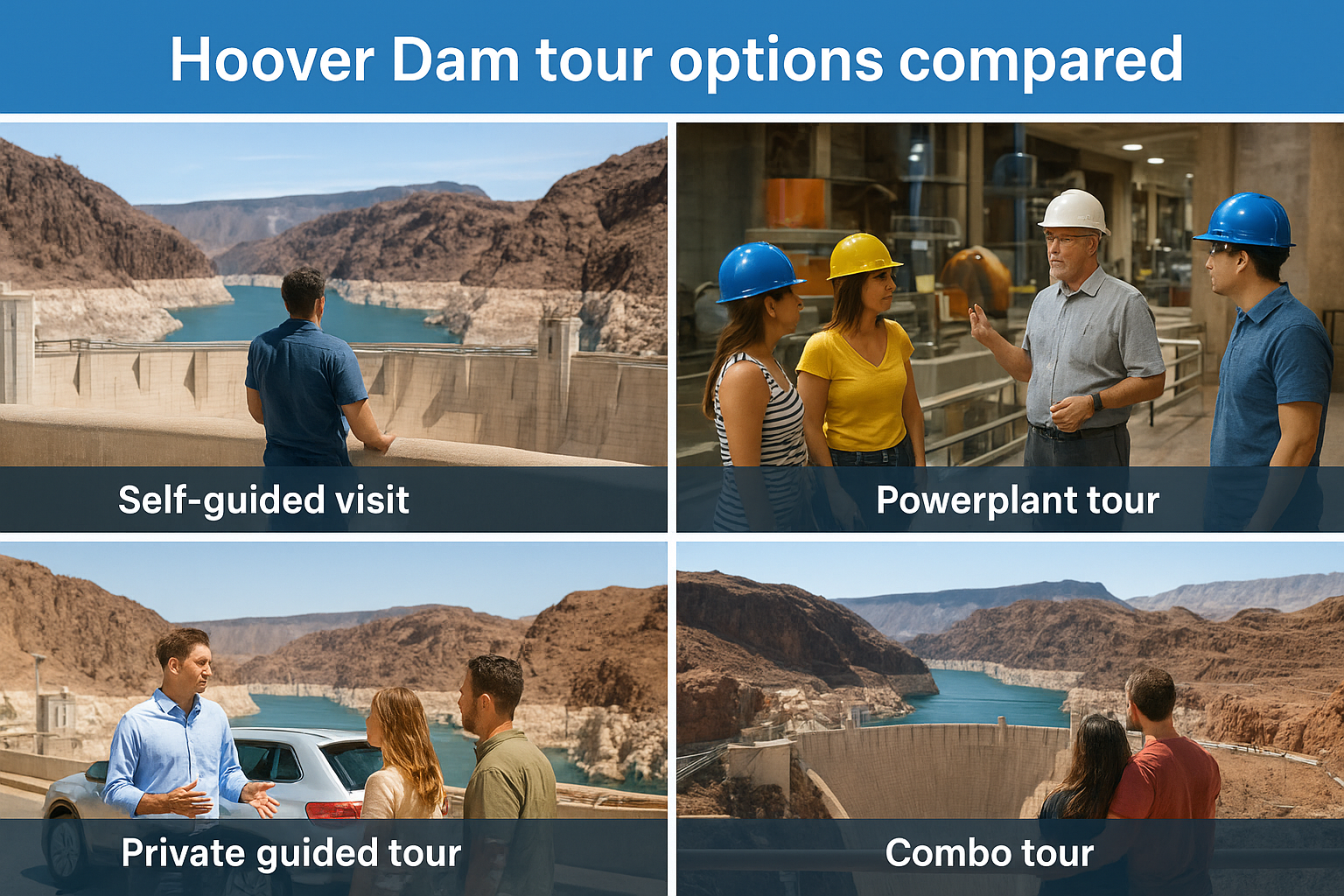
Hoover Dam tour options compared
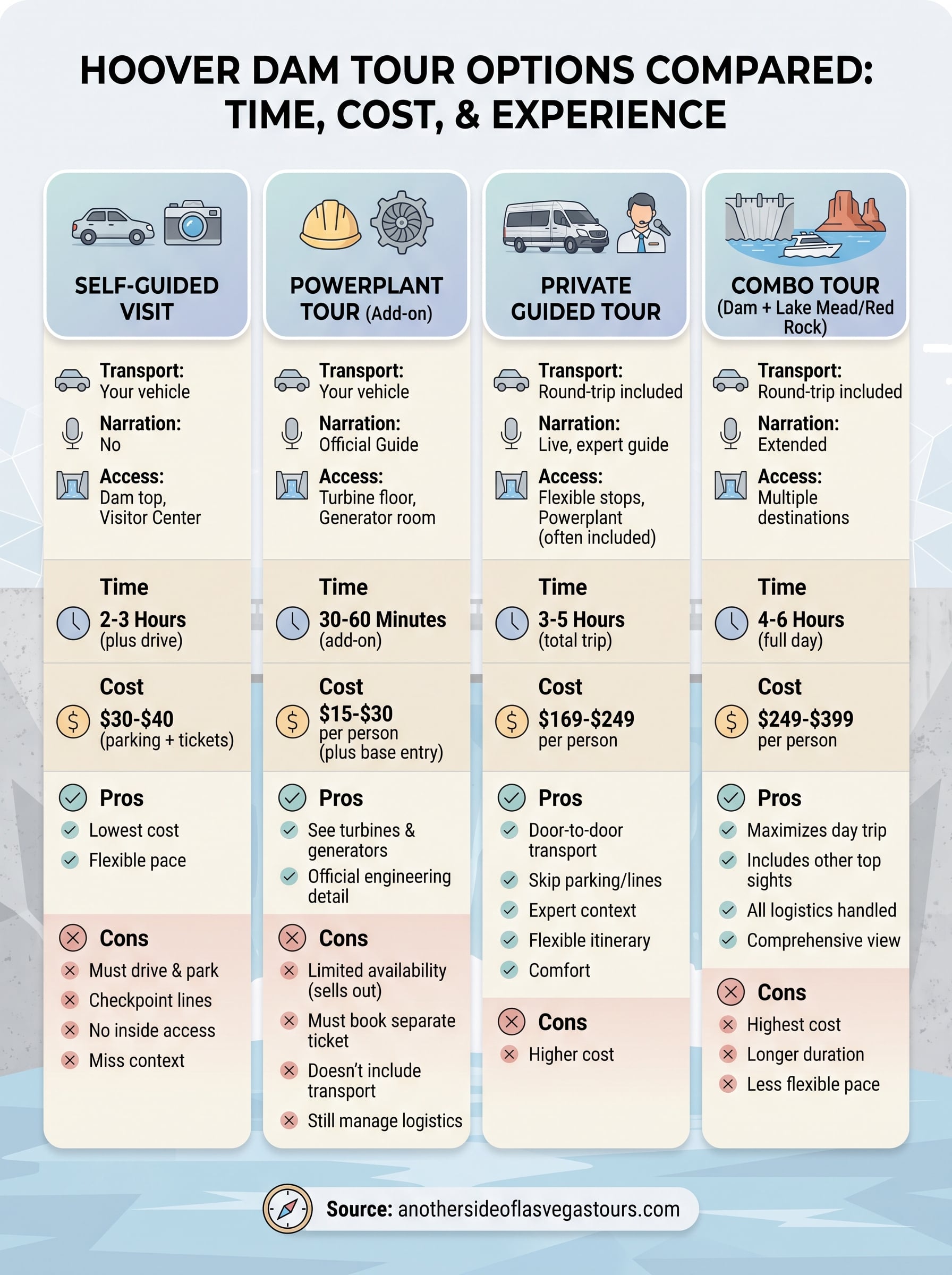
Once you know what you want out of the visit, comparing actual tour types gets a lot easier. Below is how the main options stack up on cost, time, and what’s actually included, based on typical pricing you’ll find when booking a Hoover Dam trip out of Las Vegas.
| Tour type | Typical price | Duration | What’s included |
|—|—|—|
| Self-guided visit | $30-$40 (parking + tickets) | 2-3 hours | Visitor Center, dam top walk, no narration |
| Powerplant tour (Bureau of Reclamation) | $15-$30 per person | 30-60 minutes | Turbine floor access, generator room, official guide |
| Private guided tour | $169-$249 per person | 3-5 hours | Round-trip transport, live narration, flexible stops |
| Combo tour (dam + Lake Mead or Red Rock) | $249-$399 per person | 4-6 hours | Multiple stops, transport, extended narration |
Self-guided and powerplant tours
Going it alone works if you’re comfortable driving, parking, and standing in the security line yourself. You’ll pay less out of pocket, but you’re responsible for timing the visit around checkpoint waits, which can run 20 to 30 minutes during peak season. Adding the official powerplant tour through the Bureau of Reclamation gets you inside the structure itself, walking the turbine floor next to generators that have been running since the 1930s. It’s a great add-on, but tickets sell out early in the day, so you need to book it directly through the Bureau of Reclamation’s site rather than assuming walk-up availability.
Private and combo guided tours
Here’s where a private guided tour earns its higher price tag. You’re not driving, you’re not parking, and you’re not guessing which overlook is worth the stop. A trained guide handles the route and fills the drive with the history and engineering context a plaque can’t give you. Combo tours push that value further by pairing Hoover Dam with Lake Mead or Red Rock Canyon in a single day, which matters if you’re only in Las Vegas for a short stretch and don’t want to burn a full day on one stop.
The cheapest tour isn’t always the best value once you count the hours it costs you.
Match the option to your actual constraints instead of the lowest sticker price:
- Tight budget, comfortable driving: self-guided plus powerplant add-on
- Want engineering detail without the drive hassle: private guided tour with powerplant stop built in
- Limited days in Las Vegas: combo tour covering the dam and a second destination
- Traveling with a larger group: private tour with dedicated vehicle over a shared shuttle
What to expect once you arrive
Arriving at Hoover Dam feels different depending on which tour you booked, but a few things are the same no matter how you got there. Security screening happens at a checkpoint before you reach the parking structure, similar to what you’d see at an airport, and it’s run in coordination with the Bureau of Reclamation and the National Park Service. Guided tour vehicles often move through this faster than individual cars stacking up during peak hours, which is one more reason the drive itself matters as much as what you do once you’re parked.
Security and parking realities
Budget extra time here even if your tour guide handles the logistics for you. Independent drivers report waits of 20 to 30 minutes at the checkpoint on busy weekends, and the parking garage fills up fast between 10 a.m. and 2 p.m. Guided tours typically use designated drop-off areas that skip most of this friction, which is part of what you’re paying for with a private tour.
The line at the checkpoint is where most self-guided visits lose time, not the dam itself.
Walking the dam and visiting the exhibits
Once you’re through, the actual visit breaks into a few distinct stops. You’ll walk across the top of the dam, cross the Nevada-Arizona state line marked right in the roadway, and get views down into Black Canyon and out across Lake Mead. The Visitor Center holds exhibits on construction history, including footage of the original 1930s workforce, plus a scale model that makes the engineering easier to grasp than any plaque. If you added the powerplant tour, this is where you’ll descend by elevator into the structure itself and stand on the turbine floor next to generators still running eight decades later, according to the Bureau of Reclamation.
What a guided group actually does differently
Groups on a guided tour typically move through these stops in a different order than solo visitors, timed around crowd patterns rather than guesswork:
- Drop-off near the dam top walk first, while the morning light and smaller crowds make photos easier
- Guide narration covers construction history and engineering details while walking, not just at designated signs
- Visitor Center exhibits come next, once the group has context for what they’re looking at
- Powerplant tour slotted in based on ticket availability that day
- Return transport timed to avoid the worst of the afternoon checkpoint backup
Expect the whole stop, from arrival to departure, to run two to three hours if you’re doing the dam top walk and exhibits, longer if the powerplant tour is included.
Tips for planning your visit
Getting the timing right matters more at Hoover Dam than most Las Vegas attractions, because you’re dealing with desert heat, security checkpoints, and a location 45 minutes outside the Strip. A few practical decisions made before you leave your hotel can save you an hour or more once you’re there.
Pick your season and time of day
Summer temperatures at the dam regularly hit 105-115°F, and there’s very little shade once you’re walking across the top or standing in the checkpoint line. Early morning departures, ideally before 9 a.m., beat both the heat and the worst of the crowds. If you’re visiting between May and September, treat mid-afternoon as a time to avoid entirely. Spring and fall mornings give you the most comfortable conditions, with cooler air and better light for photos over Lake Mead and Black Canyon.
Book powerplant tickets before you go
Powerplant tour tickets sell out early, sometimes by mid-morning during peak season, and they’re not always available as a walk-up option. If seeing the turbine floor and original generators matters to you, reserve that ticket directly through the Bureau of Reclamation ahead of time, or confirm your guided tour already has it built in.
Waiting to sort out powerplant access once you’ve arrived is the single most common planning mistake visitors make.
Pack for the checkpoint and the walk
Security screening at the dam runs like an airport checkpoint, so what you bring matters. A short packing list keeps things moving:
- Water bottle (refill stations are limited past the checkpoint)
- Sunscreen and a hat, there’s almost no shade on the dam walk
- Comfortable shoes, you’ll be on concrete for at least an hour
- ID for security screening
- A light jacket if you’re visiting in winter, wind picks up on the dam top
Skip large bags or anything that looks like it needs extra inspection. It slows down everyone behind you, guided groups included.
Combine the dam with a bigger day trip
Since you’re already making the drive, pairing Hoover Dam with Lake Mead or Red Rock Canyon stretches the value of your day without much extra travel time. A combo itinerary means one round trip instead of two separate outings, which matters if you’ve only got a few days in Las Vegas. Guided combo tours are built around this logic, sequencing stops so you’re not backtracking or wasting daylight driving the same road twice.
Ready to see Hoover Dam for yourself
Hoover Dam rewards the traveler who plans ahead. Whether you want the quick photo stop, the powerplant deep dive, or a full day that pairs the dam with Lake Mead or Red Rock Canyon, the right choice comes down to your time, your budget, and how much of the story you want along the way. Self-guided visits work fine if you’re comfortable with the driving and the checkpoint line. But if you want the history, the engineering context, and someone else handling the logistics, a guided experience turns a good stop into the highlight of your trip.
You’ve got the information now to book with confidence instead of guessing. If you’d rather skip the parking hassle and let a local expert handle the route and the narration, check out our Hoover Dam tour and see the dam the way it deserves to be seen.