
Red rock formations that glow orange at sunrise, slot canyons narrow enough to touch both walls, and ancient petroglyphs carved centuries ago. That’s what waits on the best valley of fire state park hiking trails, and picking the wrong one can mean a flat, sunbaked walk instead of the scenery you drove out for. With triple-digit heat common from May through September, trail choice matters as much as timing.
This guide breaks down the seven trails worth your time, from short scrambles you can knock out in 30 minutes to longer routes that reward serious hikers with panoramic desert views. You’ll get real numbers on distance and difficulty, plus the specific landmarks, like Fire Wave and White Domes, that make each trail worth the drive from Las Vegas.
We’ve guided guests through this park for years as part of our Valley of Fire tours, and we know which trails deliver on the photos you’ve seen online and which ones just look good from the parking lot. Whether you’re planning a self-guided hike or want the context and history a local guide can add, this list gives you what you need to make the most of your morning or afternoon in one of Nevada’s most striking landscapes.
1. Fire Wave Trail
Fire Wave is the trail everyone means when they ask about the most photographed spot in Valley of Fire State Park. It’s the swirling red-and-white sandstone formation that looks like a frozen wave, and it’s the reason most day-trippers drive out from Las Vegas in the first place.

Trail length and difficulty
The out-and-back route runs about 1.5 miles round trip with roughly 150 feet of elevation gain, which puts it firmly in the easy-to-moderate category. There’s no technical scrambling required, just sandy washes and slickrock sections that get a bit steep in short bursts. Most hikers finish in 45 minutes to an hour, making it one of the most efficient stops if you’re working through a longer trail list in a single day.
Highlights along the way
The trail starts near the Rainbow Vista parking area and winds through a wash lined with striped sandstone before opening onto the wave formation itself. You’ll pass smaller pockets of banded rock that look like miniature versions of the main event, so keep your camera out early rather than saving it for the finish. The swirling rock patterns at the main viewpoint shift color depending on the angle of the sun, and you can scramble up onto several ledges for different vantage points without any real risk.
The Fire Wave’s colors change dramatically within a single hour, so timing your visit matters more here than on almost any other trail in the park.
Best time to hike
Go at sunrise or within the first two hours after sunset light hits the park, since the low-angle sun brings out the deepest oranges and pinks in the rock. Midday sun washes out the colors and turns the trail into an oven, especially between June and September when surface temperatures on the sandstone climb well past what the air temperature suggests.
Insider tips before you go
- Arrive by 7 a.m. in summer; the small trailhead lot fills fast and street parking isn’t really an option
- Bring at least 1 liter of water per person even for this short distance
- Wear shoes with real traction, the slickrock sections get slippery when sandy
- Skip midday visits entirely between May and September for both comfort and photo quality
2. White Domes Loop Trail
White Domes sits at the end of the main park road and delivers more variety per mile than almost any other trail here. You get slot canyon walls, a Hollywood movie backdrop, and those pale sandstone domes that give the trail its name, all in one short loop.
Trail length and difficulty
The loop covers about 1.1 miles with roughly 100 feet of elevation change, and most people rate it easy to moderate. One short section drops you through a narrow slot canyon using a set of built-in steps, which is the only spot that trips up hikers unfamiliar with the terrain. Budget 30 to 45 minutes if you’re moving steadily, longer if you stop to photograph the rock walls.
Highlights along the way
The loop passes the crumbling set from the 1965 film The Professionals, then winds through a slot canyon with walls close enough to touch on both sides. The white domes themselves rise near the trailhead, streaked with the same red bands you’ll see throughout the park, and they contrast sharply against the darker sandstone further along the loop.
The slot canyon section alone makes White Domes worth the drive, even if you skip every other trail in the park.
Best time to hike
Morning works best, before 9 a.m. in summer, since the slot canyon traps heat once the sun climbs higher. Afternoon light flattens the color contrast that makes this loop stand out.
Insider tips before you go
- Wear closed-toe shoes for the canyon steps, sandals slip on the sandy rock
- Watch for flash flood warnings, this canyon floods fast during summer storms
- Walk the loop counterclockwise for better lighting on the domes in early morning
3. Pastel Canyon (Pink Canyon) Trail
Pastel Canyon stays off most tourist radars, which is exactly why you should add it to your list. Fewer crowds mean you can actually stand still in the narrow sections and take in the soft pink and lavender walls without someone squeezing past you.
Trail length and difficulty
This is a short, flexible route, roughly 0.5 to 1 mile depending on how far you push into the canyon’s branching washes. It’s rated easy, with flat sandy footing and no elevation gain to speak of. Plan on 20 to 30 minutes, though it’s easy to wander longer since there’s no single defined endpoint.
Highlights along the way
The canyon walls shift through shades of pink, lavender, and pale gray, a departure from the reds and oranges that dominate the rest of the park. Side passages branch off the main wash, and the narrow rock corridors create natural frames for photos without any crowds in the shot. There’s no dramatic single landmark here, just a quiet, textured walk through unusual color.
Pastel Canyon gives you the park’s most unusual colors without the crowds that pack Fire Wave and White Domes.
Best time to hike
Anytime works better here than at the higher-traffic trails, though morning light still brings out the softer tones best. Midday sun flattens the pastel effect but won’t ruin the visit the way it does at exposed trails.
Insider tips before you go
- Look for the unmarked pullout near the Rainbow Vista area, signage is minimal
- Bring a wide-angle lens if you’re shooting photos, the corridors are tight
- Explore the side branches, the best color often sits off the main path
4. Petroglyph Canyon and Mouse’s Tank Trail
This trail doubles as an open-air history lesson. Petroglyph Canyon holds one of the densest concentrations of ancient rock art in southern Nevada, carved by the Basketmaker and early Puebloan people who passed through this wash centuries before Las Vegas existed.
Trail length and difficulty
The route runs about 0.75 miles round trip with almost no elevation gain, making it one of the easiest hikes in the park. Flat, sandy footing means you can bring kids or older relatives without worry. Most visitors finish in 20 to 30 minutes, though the petroglyphs are worth slowing down for.
Highlights along the way
Canyon walls on both sides carry hundreds of carved symbols, including bighorn sheep, human figures, and geometric patterns that archaeologists still debate the meaning of. The trail ends at Mouse’s Tank, a natural basin that once held rainwater and gave the outlaw Little Mouse a hideout in the 1890s.
Petroglyph Canyon puts you face to face with rock art that predates the city of Las Vegas by over a thousand years.
Best time to hike
Early morning suits this trail well, since the canyon walls block direct sun for part of the day and keep temperatures manageable even in summer.
Insider tips before you go
- Bring binoculars for petroglyphs carved higher on the canyon walls
- Never touch the rock art, oils from skin damage the carvings
- Visit right after the visitor center opens for the smallest crowds
5. Rainbow Vista Trail
Rainbow Vista sits at a high point along the main park road, and it earns its name honestly. The multicolored sandstone hills stretch out below the overlook in bands of red, purple, yellow, and white, giving you one of the widest views in the entire park without much effort.
Trail length and difficulty
The out-and-back trail covers about 1 mile round trip with roughly 100 feet of elevation gain, landing it in the easy category. Footing stays firm along most of the path, with only a short rocky stretch near the overlook requiring careful steps. Budget 30 minutes, less if you’re just hiking to the viewpoint and back.
Highlights along the way
The trail climbs gradually toward an overlook that frames the Fire Canyon wash below, a maze of colorful ridges that looks almost otherworldly in good light. Unlike Fire Wave or White Domes, there’s no single dramatic formation here. Instead, you get a wide panoramic view that puts the park’s full color range in one frame, which makes it a smart stop for photographers who want the bigger picture.
Rainbow Vista trades one iconic formation for the best wide-angle view of the park’s full color palette.
Best time to hike
Late afternoon light works especially well here, since the sun angle lights up the canyon walls below the overlook from the side rather than washing them out.
Insider tips before you go
- Bring a tripod if you’re shooting the overlook, the wide view rewards a steady shot
- Pair this trail with Fire Wave, since both trailheads share the same parking area
- Check the wash below for seasonal wildflowers after spring rains
6. Elephant Rock Trail
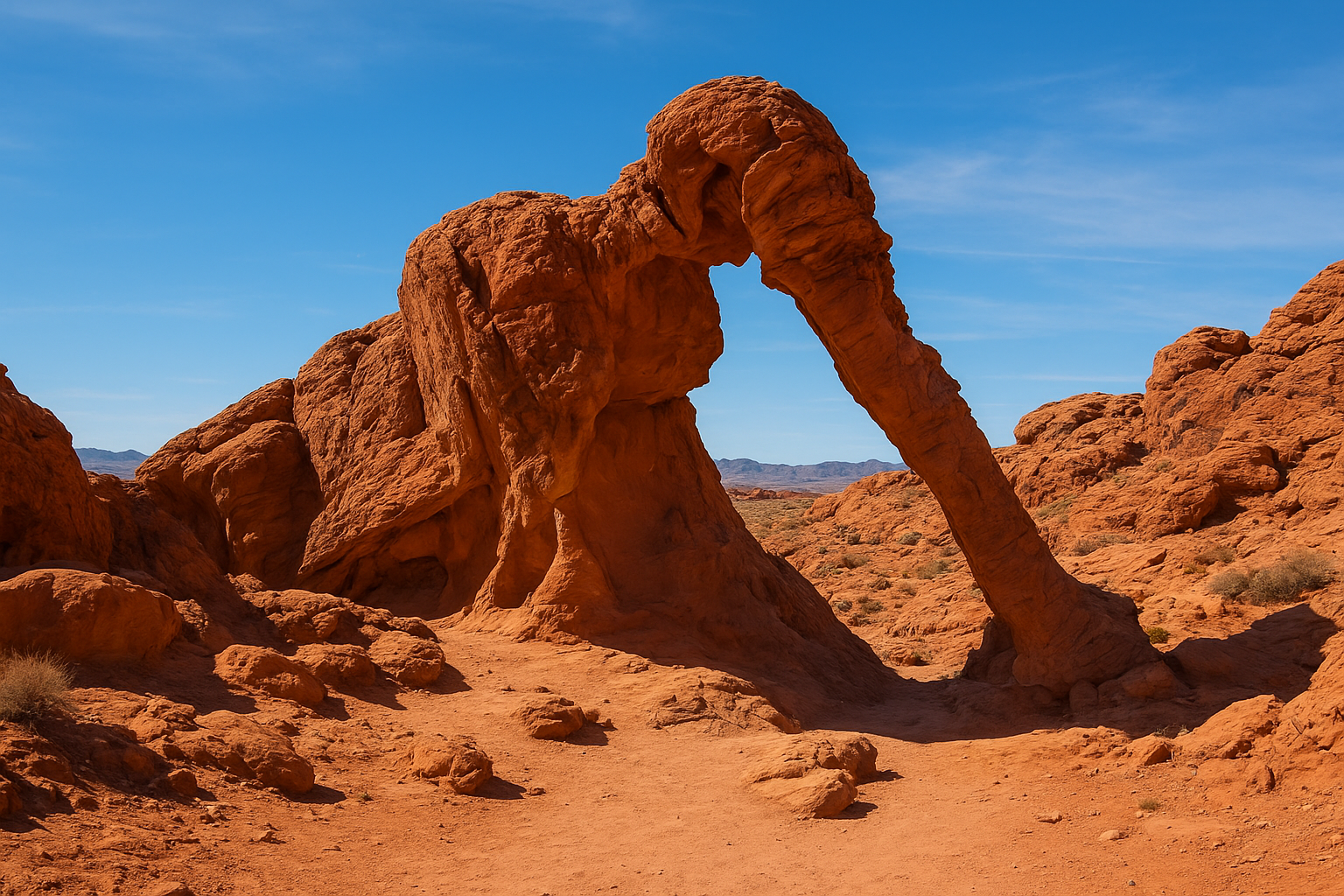
Elephant Rock earns its name from a sandstone arch that genuinely looks like an elephant’s head and trunk, complete with a curved tusk shape carved by centuries of wind. It sits near the park’s east entrance, making it one of the easiest quick stops if you’re driving in from Lake Mead or the Northshore Road side.
Trail length and difficulty
This is one of the shortest hikes on this list, running about 0.3 miles round trip with almost no elevation gain. Anyone can handle the sandy, flat terrain, including young kids and hikers recovering from a long drive. Most people finish in 10 to 15 minutes, which makes it easy to squeeze in even on a packed itinerary.
Highlights along the way
The elephant-shaped arch is the entire draw here, and it delivers even if you’re skeptical about rock formations that supposedly resemble animals. Morning or late afternoon light catches the arch’s curve and casts a shadow that makes the resemblance even more obvious. Beyond the rock itself, you get open desert views back toward the East Entrance Road.
Elephant Rock proves that some of the park’s best photo stops need almost no hiking at all.
Best time to hike
Any time works since the trail is so short, though early morning avoids both heat and the small crowd that gathers near sunset for photos.
Insider tips before you go
- Park in the small pullout right off East Entrance Road
- Combine this stop with a drive through to Lake Mead
- Photograph from a slight distance to capture the full arch shape
7. Natural Arch Trail
Natural Arch Trail closes out this list of Valley of Fire State Park hiking trails with a formation you won’t find on most tourist maps. Tucked off a spur near the park’s western section, this arch rewards hikers willing to skip the busier stops for a quieter payoff.
Trail length and difficulty
The round trip runs about 0.5 miles with minimal elevation change, keeping it in the easy category. Loose sand and a few rocky patches near the arch itself require some attention, but nothing technical. Plan on 15 to 20 minutes, making this an easy add-on if you’ve already covered Elephant Rock or Rainbow Vista nearby.
Highlights along the way
The sandstone arch frames the desert beyond it like a natural window, and the surrounding rock shows the same layered banding you’ve seen elsewhere in the park, just with almost nobody else around. Wind and erosion carved this shape slowly, and standing beneath it gives you a sense of scale the roadside pullouts don’t offer.
Natural Arch Trail rewards patience over distance, since the payoff has nothing to do with how far you walk.
Best time to hike
Morning light works best for photographing the arch, since it sits in a spot that catches shadow early in the afternoon. Visit before 10 a.m. for the clearest shots.
Insider tips before you go
- Bring a paper map or offline GPS, cell signal drops out near this trailhead
- Wear sturdy shoes, the rocky patches near the arch shift underfoot
- Pair this stop with a slow drive through the park’s quieter western loop
Making the most of your Valley of Fire hike
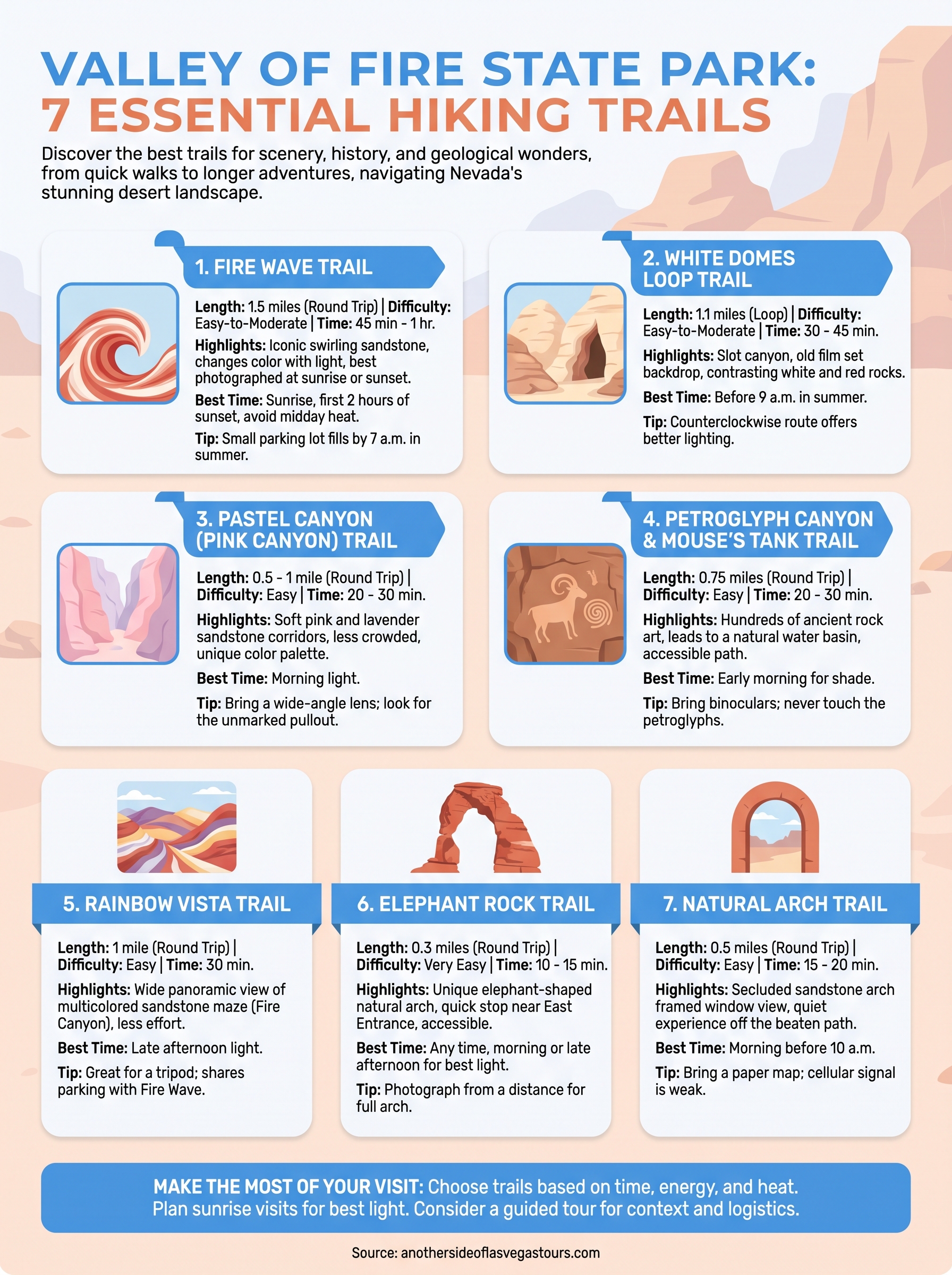
Seven trails, one park, and a lot of ground to cover if you’re doing this solo. Fire Wave and White Domes deliver the postcard shots, but Pastel Canyon and Natural Arch reward you with quiet you won’t find at the crowded stops. Pick two or three based on your energy level and the heat that day, and you’ll walk away with a real sense of why this park earns its reputation.
Planning the drive, timing sunrise light, and finding unmarked pullouts takes effort most visitors don’t have time for on a short Vegas trip. That’s exactly the gap a guide fills. We’ve walked these washes hundreds of times and know which trail matches your group’s pace and interests, plus the history behind the petroglyphs and formations that make the hike mean something beyond a photo. If you’d rather skip the logistics and just show up ready to hike, check out our Valley of Fire tours and let us handle the rest.