
You’ve heard Valley of Fire has red rock formations that look like nowhere else on earth, and you’re wondering if you can actually get there from your Las Vegas hotel without wasting half your trip. How to get to Valley of Fire from Las Vegas comes down to one main route, a short drive, and a decision about whether to go it alone or let someone else handle the driving.
The short answer: it’s about 55 miles northeast of the Strip, roughly a 50 minute drive on I-15 North, and yes, it’s absolutely worth the trip. You can rent a car and navigate the turnoff at exit 75 yourself, or you can book a guided tour and skip the logistics entirely, including the park’s $15 entrance fee confusion and the lack of gas stations once you’re inside.
This guide walks through the exact driving directions, what the road conditions look like, how long to budget for the round trip, and why a guided day tour often makes more sense than renting a car for a single afternoon. We’ve run tours out to Valley of Fire for years, so we know which stops matter and which ones eat up daylight you don’t have.
Is Valley of Fire worth the drive from Las Vegas?
Yes, and it’s not close. Valley of Fire State Park is Nevada’s oldest state park, and the sandstone here glows orange and red in a way that no photo filter quite captures. You’re driving through open desert for less than an hour and stepping into a landscape that looks like Mars decided to visit Nevada. If you’ve only got one day to spend outside the casinos, this is the trip that delivers the most visual payoff for the least amount of driving.

What makes it different from other Vegas day trips
Red Rock Canyon sits closer to the Strip, and Hoover Dam has its own engineering appeal, but neither one matches the color and texture you get at Valley of Fire. The rock formations here, including Fire Wave and Elephant Rock, were shaped by 150 million years of shifting sand dunes turning into stone. Grand Canyon West is farther and takes most of a full day round trip, so it competes for a different kind of traveler.
| Destination | Drive time from Strip | Best for |
|---|---|---|
| Valley of Fire | ~50 min | Photography, rock formations, short desert hike |
| Red Rock Canyon | ~30 min | Quick scenic loop, easy access |
| Hoover Dam | ~45 min | Engineering history, Lake Mead views |
| Grand Canyon West | ~2.5 hrs | Full-day trip, Skywalk |
Valley of Fire packs more visual impact per mile of driving than almost any other day trip out of Las Vegas.
Who should skip it
If you’re traveling with small children who overheat fast, or if you’re visiting between June and August without a reliable air-conditioned vehicle, think twice about a self-driven trip. Summer temperatures in the park regularly hit 110 degrees, and there’s very little shade once you’re out of the car. Travelers with mobility limitations should also know that the best viewpoints, like Fire Wave and White Domes, require walking on uneven sand and rock, some of it a half mile or more from the nearest parking area.
Who it’s perfect for
Photographers, hikers, and anyone who wants to see a side of Nevada that has nothing to do with slot machines will find this trip worth every minute. Couples looking for a change of pace from the Strip, families with older kids who can handle a short hike, and first-time visitors who want one great nature stop without committing to a multi-day itinerary all fit the profile. Groups on a guided tour get the added benefit of a driver who knows exactly which pullouts have the best light for photos and which ones aren’t worth the stop.
The bottom line on timing
Budgeting the trip matters as much as deciding whether to go. A rushed visit, where you drive in, snap a few photos at the visitor center, and drive straight back out, wastes the point of coming at all. Plan for at least three hours inside the park if you’re driving yourself, or let a scheduled tour build that time into the day for you. Either way, the payoff is real: this isn’t a detour, it’s one of the best half-day trips within reach of Las Vegas, and the numbers back that up according to the National Park Service’s broader research on why desert landscapes like this draw repeat visitors year after year, a pattern the U.S. Department of the Interior has documented across similar protected sites in the Southwest.
Step 1. Choose your mode of transportation
Before you touch a map, decide who’s driving. Your options come down to three: a rental car, a rideshare or taxi, or a guided tour that handles the whole trip for you. Each one changes your morning, your budget, and how much of the park you’ll actually see once you get there.
Renting a car
A rental gives you total control over your schedule, and if you’re already comfortable driving in an unfamiliar desert landscape, it works fine. But factor in the extras: a day rental in Las Vegas typically runs $45 to $90 depending on season, plus the $15 per vehicle entrance fee at the park gate, plus gas, since there are no stations inside Valley of Fire. You’re also responsible for navigating the exit 75 turnoff yourself, which is easy to miss if you’re not watching for it.
Rideshare or taxi
Uber and Lyft technically reach Valley of Fire, but drivers rarely want to make the trip, and getting a ride back out of a state park with no cell signal is a real problem. Surge pricing for a 50-mile trip each way can push costs well past what a guided tour or rental would cost, and you’re gambling on whether a driver will even accept the fare from a remote pickup point.
Guided tours
A guided day tour solves the two biggest headaches of a DIY trip: navigation and timing. You skip the entrance fee confusion, skip the gas station math, and skip the stress of watching for an exit sign while also trying to enjoy the scenery. A driver who’s made the run dozens of times knows exactly when to stop at Fire Wave for the best light and when to keep moving so you’re not stuck in a parking lot at noon.
| Option | Cost estimate | Best for |
|---|---|---|
| Rental car | $45-$90/day + $15 entry + gas | Independent travelers, flexible schedule |
| Rideshare/taxi | Variable, often high due to distance | Not recommended for this trip |
| Guided tour | $99-$349/person | Stress-free logistics, expert narration |
The right transportation choice isn’t about saving a few dollars, it’s about not burning half your day on logistics you didn’t plan for.
If you’d rather sit back and let someone else worry about the exit ramp, Another Side Tours runs scheduled trips out to Valley of Fire with guides who know the park’s back roads better than most locals.
Step 2. Map your driving route from the Strip
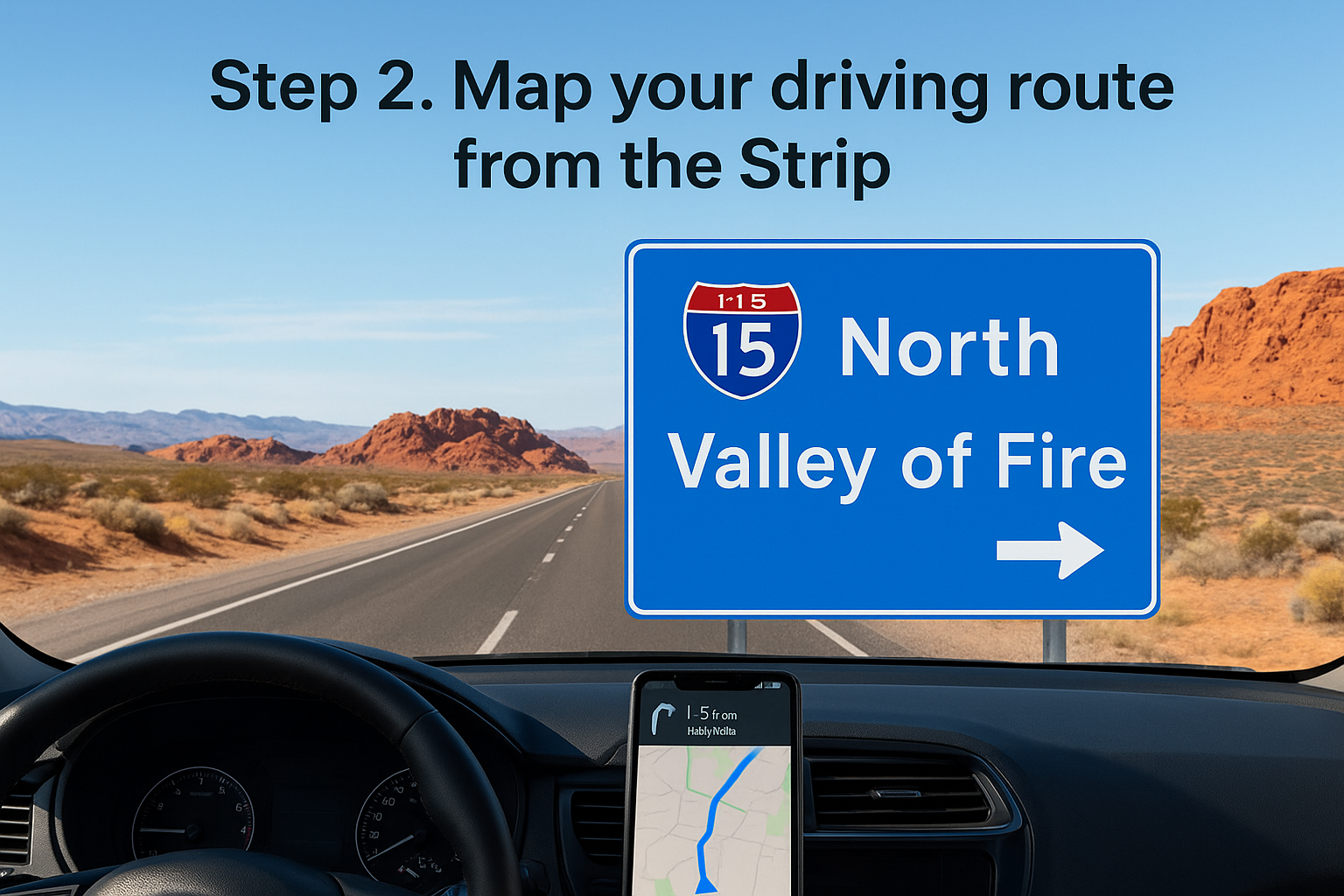
Getting from your hotel to Valley of Fire only requires one highway and one exit, but knowing the details ahead of time keeps you from second-guessing yourself at 65 mph. Whether you’re starting at the Bellagio or a Fremont Street hotel, you’ll merge onto I-15 North and stay there for almost the entire drive. The route rarely changes regardless of where you start on the Strip, since every path funnels onto the same northbound highway within a few minutes.
Turn-by-turn directions
Here’s the exact sequence to follow once you’re in the car:
1. From the Strip, head to I-15 North (via Sahara Ave or Spring Mountain Rd)
2. Stay on I-15 North for approximately 33 miles
3. Take Exit 75 for Valley of Fire Hwy / NV-169
4. Turn right (east) onto Valley of Fire Highway
5. Continue about 15 miles until you reach the park's west entrance
6. Stop at the entrance station to pay the $15 vehicle fee
After exit 75, the highway narrows to two lanes and the scenery shifts fast, from flat scrubland to red rock within a few miles.
Landmarks to watch for
Instead of relying only on your GPS, watch for the Moapa Paiute Travel Plaza near exit 75, which is your last reliable stop for gas, snacks, and a bathroom before the park. Once you turn onto NV-169, you’ll pass through a stretch of open desert before the rock formations start appearing on the horizon, a good visual cue that you’re close. If you hit the town of Overton without seeing park signage, you’ve gone too far east and missed the west entrance turnoff.
If your GPS loses signal near the entrance, the exit 75 turnoff is your last reliable checkpoint before the park.
Confirming you’re on track
Most phone map apps handle this route without trouble, but service gets spotty once you’re inside the park boundaries, so screenshot your directions before you lose signal. According to the Nevada Division of State Parks, the west entrance near NV-169 is the primary access point for visitors coming from Las Vegas, and it’s the one nearly every guided tour uses as well.
Step 3. Time your departure for the best conditions
When you leave Las Vegas matters almost as much as how you get there. Departure timing shapes the light for photos, the traffic on I-15, and whether you’re hiking Fire Wave in comfortable temperatures or fighting the desert sun at its worst. Getting this right takes almost no extra effort, just a shift in your alarm clock.
Morning versus afternoon
Leaving the Strip between 7 and 8 a.m. gets you to the park as it opens, with soft light for photos and cooler temperatures for the hike out to Fire Wave or White Domes. Afternoon departures work fine for a shorter visit focused on drive-through viewpoints like the Beehives or Elephant Rock, but you’ll be walking in harsher heat and fighting harsher shadows if photography matters to you. Guided tours typically build their schedules around this early window on purpose, since the difference between 7 a.m. light and 1 p.m. light at Fire Wave is not subtle.
The hour you leave the Strip decides whether you’re photographing red rock in soft morning light or squinting through midday glare.
Seasonal considerations
Summer visits demand an earlier start than winter ones. From June through August, aim to be inside the park by 8 a.m. and plan to be done with any hiking before 11 a.m., since ground temperatures on the sandstone can climb well past the air temperature. Winter months, from November through February, give you more flexibility, with comfortable conditions lasting most of the day and sunset arriving early enough to catch dramatic color on the rock formations before you head back.
| Season | Recommended departure | Notes |
|---|---|---|
| Summer (Jun-Aug) | 6:30-7:30 a.m. | Finish hiking by 11 a.m., heat climbs fast |
| Spring/Fall | 7:30-9 a.m. | Comfortable most of the day |
| Winter (Nov-Feb) | 8-10 a.m. | Shorter days, sunset comes earlier |
Traffic and return timing
I-15 North rarely sees heavy congestion outbound from Las Vegas in the morning, but weekend traffic returning into the city between 3 and 6 p.m. can add 20 to 30 minutes to your drive back. Building in a buffer for that return stretch keeps you from feeling rushed at the end of what should be a relaxed day. If you’re on a scheduled tour, this timing is already handled, which is one less thing pulling your attention away from the scenery on the way home.
Step 4. Pack the essentials for the desert
Valley of Fire has no gas stations, no restaurants, and almost no shade, so what you throw in the car before leaving Las Vegas determines how comfortable your day actually is. Desert conditions don’t forgive poor planning the way a Strip hotel does, where you can always duck inside for AC or grab a bottle of water from the nearest shop. Once you’re past the Moapa Paiute Travel Plaza, you’re on your own until you’re back on I-15.
Water and food
Bring more water than feels necessary. A good rule is one gallon per person if you’re planning any hiking, since the dry heat pulls moisture out of you faster than you’ll notice until you’re already dehydrated. Pack snacks that don’t melt, like trail mix or granola bars, because anything chocolate-based turns to soup within twenty minutes in a hot car.
Sun protection
The sandstone reflects sunlight in a way that makes sunburn sneak up on you even on mild days. Pack these before you leave your hotel room:
- Sunscreen, SPF 30 or higher, reapplied every two hours
- A wide-brim hat or ball cap
- Sunglasses with UV protection
- A lightweight long-sleeve shirt for midday sun
- Lip balm with SPF
The desert sun does more damage on a mild 85-degree day than most people expect, because there’s no shade to slow it down.
Footwear and clothing
Leave the sandals at the hotel. Sturdy shoes matter here because the trails to Fire Wave and White Domes cross loose sand, uneven rock, and the occasional sharp edge where sandstone has crumbled. Closed-toe sneakers or light hiking shoes handle the terrain without twisting an ankle or filling your shoes with sand every ten steps.
Car essentials
Before you merge onto I-15, double check your vehicle is ready for a round trip with no services along the way.
Car checklist before leaving the Strip:
- Full tank of gas (no stations inside the park)
- Phone charger or portable battery
- Printed or downloaded map, since signal drops near the entrance
- $15 cash or card for the entrance fee
- Small first aid kit
- Extra water stored in the trunk, not just the cabin
If you’re on a guided tour, most of this is already handled. Vehicles carry water, the entrance fee is built into your ticket, and the driver knows the route without relying on a signal that might drop the moment you need it most.
Step 5. Plan your route once you’re inside the park
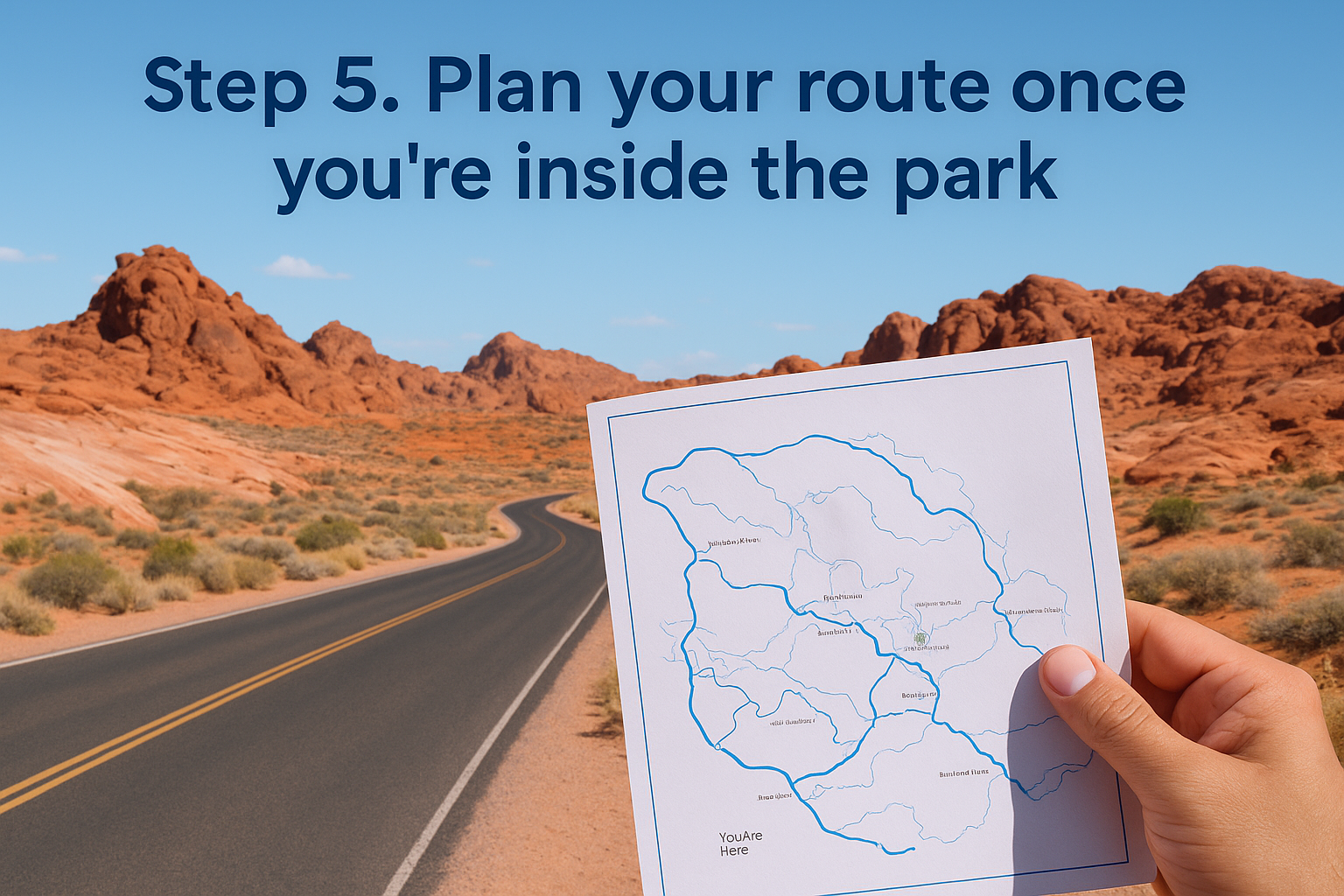
Getting through the entrance station is only half the puzzle. Once you’re inside, Valley of Fire spreads across 46,000 acres of dirt roads and pullouts, and without a plan you’ll either miss the best stops or burn your whole afternoon driving in circles. Park navigation here works best when you treat it like a short road trip within your road trip, with a clear order of stops instead of a wander-and-hope approach.
The main loop to follow
Most visitors run the same basic sequence, starting at the west entrance and working east toward the visitor center before circling back. Follow this order to hit the highlights without backtracking:
1. West entrance station (pay fee, grab a park map)
2. Beehives pullout, a quick 5-minute stop for photos
3. Visitor center, restrooms and exhibits, good rest point
4. Turn onto White Domes Road
5. Fire Wave trailhead (1.5 mile round trip hike)
6. White Domes loop trail (1 mile round trip hike)
7. Rainbow Vista pullout on the way back
8. Elephant Rock, near the east entrance, short walk from parking
This order keeps your longer hikes in the middle of the day’s cooler stretch and saves the quick photo stops for when you’re already tired from walking.
Where to spend your limited time
If you’ve only got three hours, skip the east entrance loop entirely and focus on White Domes Road. Fire Wave is the single stop worth prioritizing over everything else, since the swirled red and white sandstone doesn’t exist anywhere else in the park, or arguably anywhere else in Nevada.
If you only see one thing in Valley of Fire, make it Fire Wave, everything else is a bonus.
Signal and safety inside the park
Cell service disappears almost entirely past the visitor center, so download offline maps before you lose signal, not after. Stick to marked trails, since summer heat and hidden drop-offs near White Domes have caught unprepared hikers off guard more than once. Guides on organized tours already know which pullouts get crowded by 11 a.m. and adjust the order on the fly, which is one more reason a scheduled trip often covers more ground than a solo drive-and-guess approach.
A quick recap before you hit the road
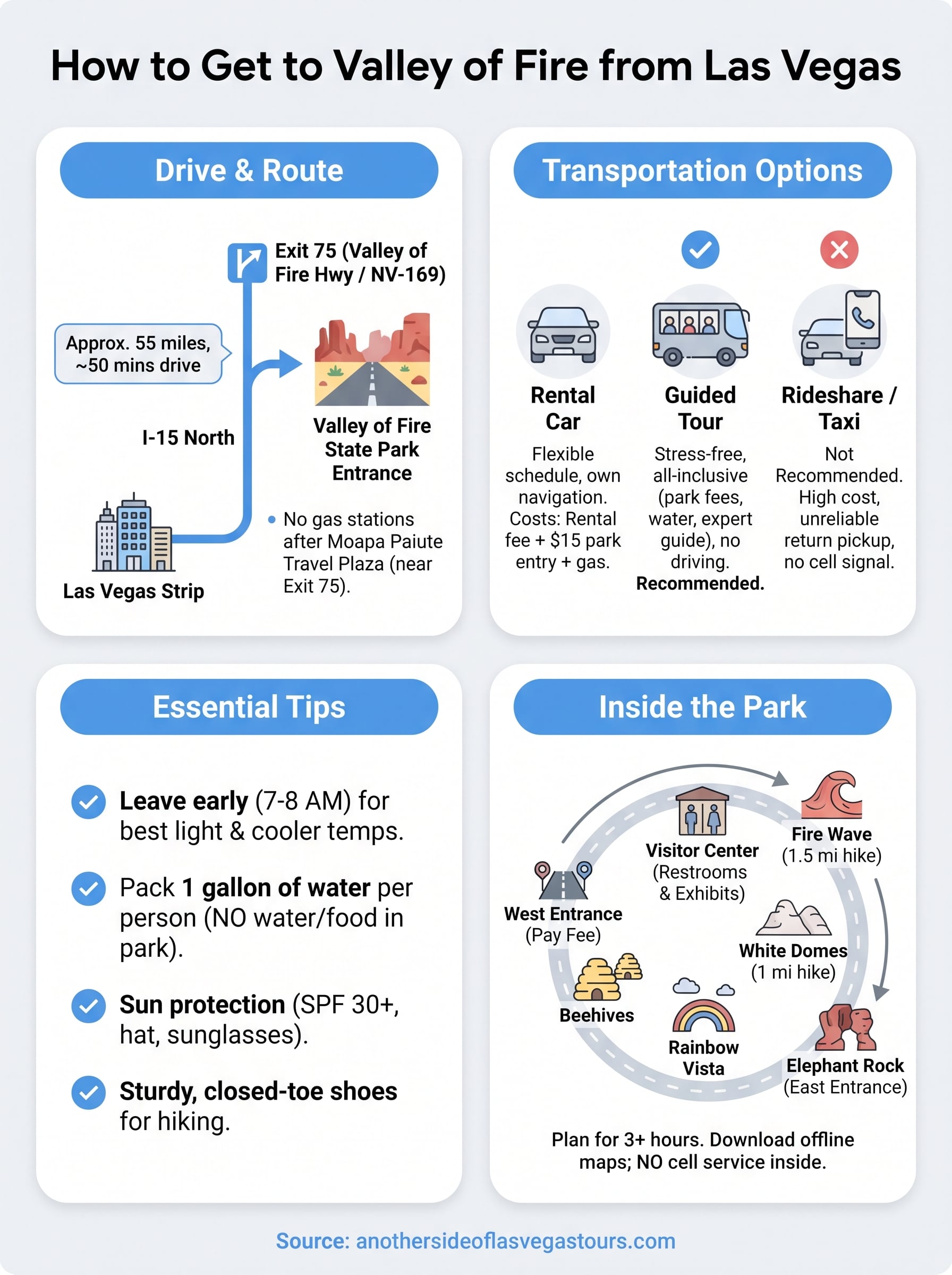
Getting from Las Vegas to Valley of Fire really is this simple: one highway, one exit, roughly 50 minutes. Rent a car and follow I-15 North to exit 75, or skip the navigation altogether and let a guide handle the driving while you focus on Fire Wave and White Domes. Either way, leave early, pack more water than you think you need, and give yourself at least three hours once you’re inside the park.
The red rock here doesn’t wait for you to figure out logistics on the fly, so plan the drive the way you’d plan any part of your trip worth doing right. If you’d rather trade the exit signs and midday heat for a driver who already knows which pullouts matter, check out our Valley of Fire tours and let someone else handle the road while you handle the camera.