Most people think of Las Vegas as a city that appeared overnight, a neon mirage rising from the desert with no real past behind it. That assumption misses a lot. The story of Las Vegas history and culture stretches back well before the first casino opened its doors, rooted in railroad towns, water rights, and frontier ambition that shaped the modern city we know today.
From its founding as a dusty rail stop in 1905 to its transformation into a global entertainment capital, Las Vegas has reinvented itself more times than almost any American city. Its culture reflects that constant evolution, a mix of mob-era mythology, midcentury glamour, immigration, artistic reinvention, and a community identity that runs far deeper than the Strip. Understanding how these layers built on each other changes the way you see the city, whether you’re standing on Fremont Street or driving through the neighborhoods most visitors never reach.
That layered history is exactly what we explore at Another Side Tours. Our guides walk guests through the real story behind the landmarks, the decisions, the characters, and the turning points that built Las Vegas from the ground up. This article covers that full arc: from the earliest settlements and railroad days through the rise of gambling, organized crime’s grip on the Strip, the Rat Pack era, and the cultural shifts that continue shaping the city right now. Whether you’re planning a visit or just curious, consider this your starting point for seeing Las Vegas as more than a destination, as a place with a genuine, complicated, and fascinating past.
What Las Vegas history and culture covers
Las Vegas history and culture covers more ground than most visitors expect. At its core, it’s the story of how a remote desert valley became one of the most recognized cities on earth, but the details involve water rights, railroad economics, federal land policy, immigration, and organized crime in ways that connect directly to what you see walking the Strip today. None of these elements exist in isolation. Each decision, from where the railroad placed its depot to which investors built which hotels, created conditions that shaped everything that followed.
Understanding this history also means recognizing that Las Vegas has reinvented its identity multiple times in roughly a century: as a railroad service town, as a construction hub during the Hoover Dam era, as the mob’s preferred entertainment investment, and finally as a globally recognized corporate entertainment brand. Each version of the city left marks that the next version built on rather than erased.
The layers of Las Vegas history don’t disappear when a building gets demolished. They survive in street layouts, neighborhood names, and the stories local guides still tell.
The geography that made Las Vegas possible
The Las Vegas Valley sits in the Mojave Desert, and for most of human history that location looked like a liability. What changed everything was a reliable water source: artesian springs that Indigenous peoples used for centuries, and that Spanish explorers named "Las Vegas," meaning "the meadows," when they passed through in 1829. Without that water, no railroad stop, no construction camp, and no gambling town would have been viable.
Geography shaped the city’s later identity in a legal sense too. Nevada’s state laws gave Las Vegas something its neighbors in California, Utah, and Arizona couldn’t offer: legal gambling, accessible divorce, and minimal regulatory interference. Location and law combined to create conditions no other American city could replicate, which is a significant reason the entertainment industry concentrated here rather than anywhere else.
The cultural layers that tourism and migration built
Tourism and migration changed what Las Vegas looked like at street level. Workers arrived in waves: first to build the Hoover Dam in the 1930s, then to staff the hotels and casinos opening through the 1940s and 50s, and again as the service industry expanded through the late 20th century. Las Vegas has one of the fastest-growing Latino populations of any major American city, and its food, arts, and community life reflect that alongside contributions from African American, Filipino, and Southeast Asian communities that shaped specific neighborhoods far from the resort corridor.
That cultural depth gets missed when visitors stay exclusively on the Strip. The full picture involves those neighborhoods, those histories, and those people. Our guides at Another Side Tours spend real time in these corners of the city precisely because the Strip alone gives you only a fraction of the story.
A timeline from springs to a railroad town
The story of Las Vegas history and culture starts long before any casino or hotel broke ground. The valley’s timeline runs through Indigenous occupation, Spanish exploration, Mormon settlement, and a railroad land auction that created the city’s original street grid in a single afternoon. Each stage left something behind that the next generation built on, which is why knowing the sequence gives you a sharper read on the city you walk through today.
From Indigenous territory to Spanish maps
The Southern Paiute people lived in and around the Las Vegas Valley for centuries, relying on the natural springs that made permanent settlement possible in an otherwise harsh desert. When Spanish trader Rafael Rivera crossed the valley in 1829, he was the first non-Indigenous person documented in the area. He noted those same springs and the grassland they supported, which gave the location its name. Explorer John C. Fremont followed in 1844, adding Las Vegas to American maps and federal awareness for the first time.
That water source, not gambling or entertainment, was the original reason anyone stopped in the Las Vegas Valley at all.
Mormon missionaries built a small fort at Las Vegas in 1855, attempting to establish a supply station along the route between Salt Lake City and Southern California. The effort lasted only two years before they abandoned it, but the site confirmed that permanent settlement was possible here if the logistics worked out.
The railroad auction that founded a city
The San Pedro, Los Angeles and Salt Lake Railroad reached the valley in 1905, and on May 15 of that year, the company auctioned off 1,200 lots to buyers gathered in the desert. That single event created Las Vegas as a legal municipality, complete with a street plan, property records, and a population almost overnight. The railroad needed a service stop with water access between Los Angeles and Salt Lake City, and the natural springs made this valley the practical choice.
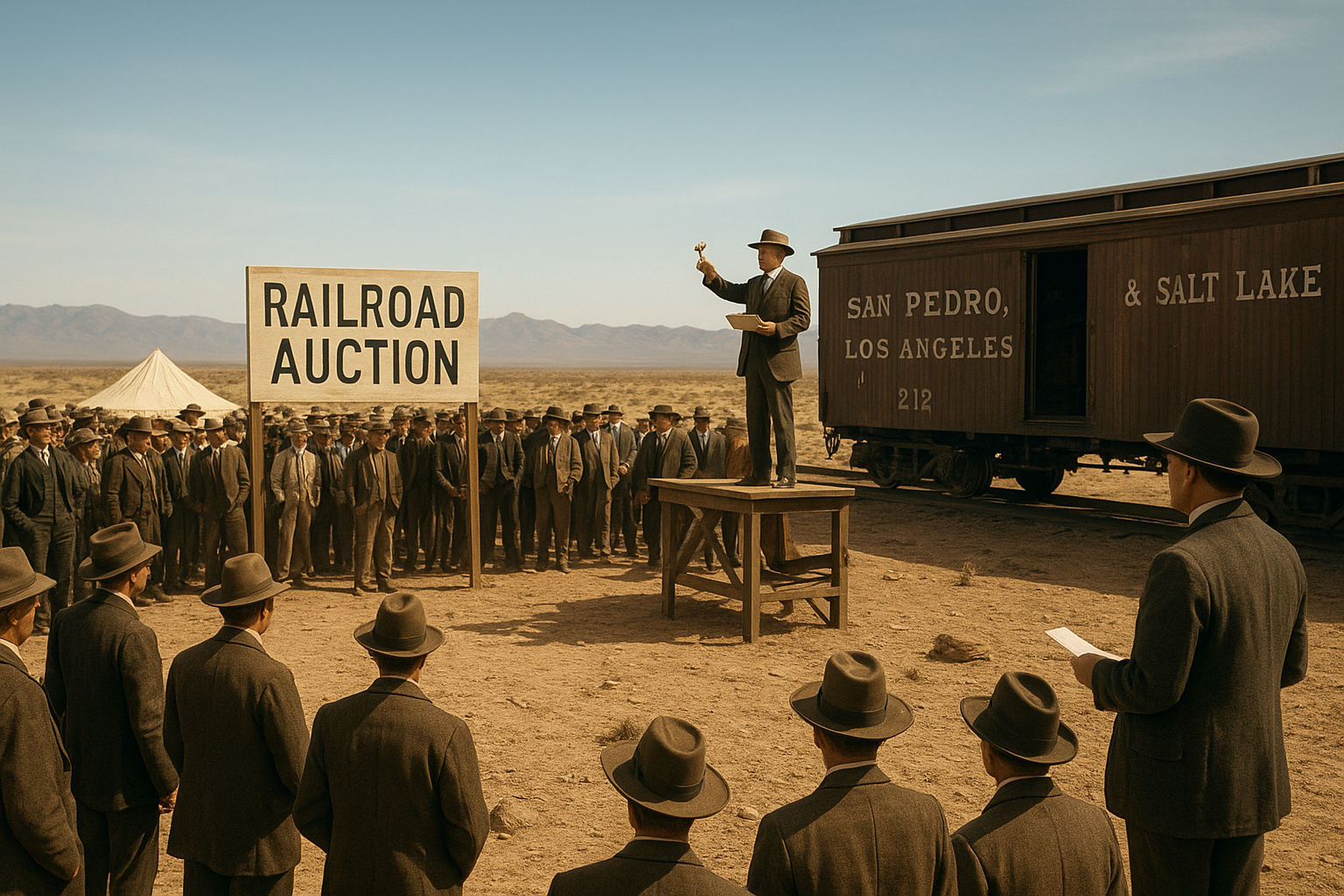
Within a few years, hotels, saloons, and supply businesses had filled in the original grid, giving Las Vegas its first real commercial identity as a railroad service town.
How gambling, the Strip, and the mob shaped Vegas
Legal gambling came to Nevada in 1931, and that single legislative decision redirected the entire arc of Las Vegas history and culture. The state needed revenue during the Great Depression, and loosening gambling restrictions offered a fast solution. What followed over the next three decades transformed a small railroad service town into the entertainment capital of the world, largely through investment from people who had very specific reasons to operate outside normal financial systems.
Nevada’s 1931 gambling law opened a door no other state would touch
When Nevada legalized casino gambling, Las Vegas had roughly 5,000 residents and no infrastructure for large-scale tourism. The law created an opportunity, but someone still needed capital to build on it. Early downtown casinos like the Golden Gate Hotel and Casino opened along Fremont Street and drew a modest regional crowd, but the real transformation waited for outside money and ambition to arrive in the form of organized crime.
The 1931 gambling law didn’t build Las Vegas overnight. It created the conditions that made everything else possible once the right investors showed up.
Organized crime financed the resort model that still defines the Strip
Bugsy Siegel opened the Flamingo Hotel in December 1946 at a location south of downtown that would become the Las Vegas Strip. The concept was different from anything Fremont Street offered: a luxury resort that combined gambling, entertainment, and high-end hospitality under one roof. The idea took time to prove profitable, and Siegel was killed before it did, but the model survived him and defined every major casino that followed.
Mob-connected investors including Meyer Lansky and the Chicago Outfit funded subsequent properties through the 1950s and into the 1960s. They ran the counting rooms, skimmed profits, and reinvested enough to keep building. The federal government’s Nevada Gaming Control Board, established in 1955, began pushing back, but corporate ownership didn’t fully replace organized crime’s grip until Howard Hughes and then larger hotel corporations arrived in the late 1960s and 1970s. What those mob-era operators left behind was the physical blueprint for resort-scale Las Vegas that corporate developers inherited and expanded.
How neon, entertainment, and tourism created identity
The casino model gave Las Vegas an economic engine, but neon signage, live entertainment, and deliberate tourist marketing gave it a face the entire world could recognize. Through the 1950s and 60s, the city made a series of decisions, some commercial and some cultural, that turned a desert gambling town into a genuine brand. That identity didn’t happen accidentally. It required visual design choices, entertainment bookings, and hospitality investments that were as calculated as any business strategy.
The neon lights on Fremont Street weren’t decoration. They were the city’s marketing department working in plain sight.
The Rat Pack and the entertainment blueprint
Frank Sinatra, Dean Martin, Sammy Davis Jr., Peter Lawford, and Joey Bishop performed regularly at the Sands Hotel through the late 1950s and early 60s, and their presence did something no advertising campaign could replicate. They made Las Vegas feel like the center of American popular culture. If you wanted to be where the excitement was, Las Vegas was the answer, and that perception attracted a broader audience than gambling alone ever could.
The Rat Pack also forced hotel operators to treat entertainment as a primary draw rather than a side feature to keep gamblers in their seats. That shift changed how resorts were built, how acts were contracted, and how Las Vegas positioned itself in national media coverage for decades afterward.
Neon signs and the visual language of Las Vegas
The Fremont Street neon corridor became the city’s most recognizable image during the postwar decades, designed by firms like Young Electric Sign Company (YESCO) whose work defined the aesthetic of las vegas history and culture in the public imagination. Those large-format signs were functional advertising, but they also created an atmosphere that photographs and film reproduced endlessly, making the visual identity of Las Vegas inseparable from its tourism appeal.
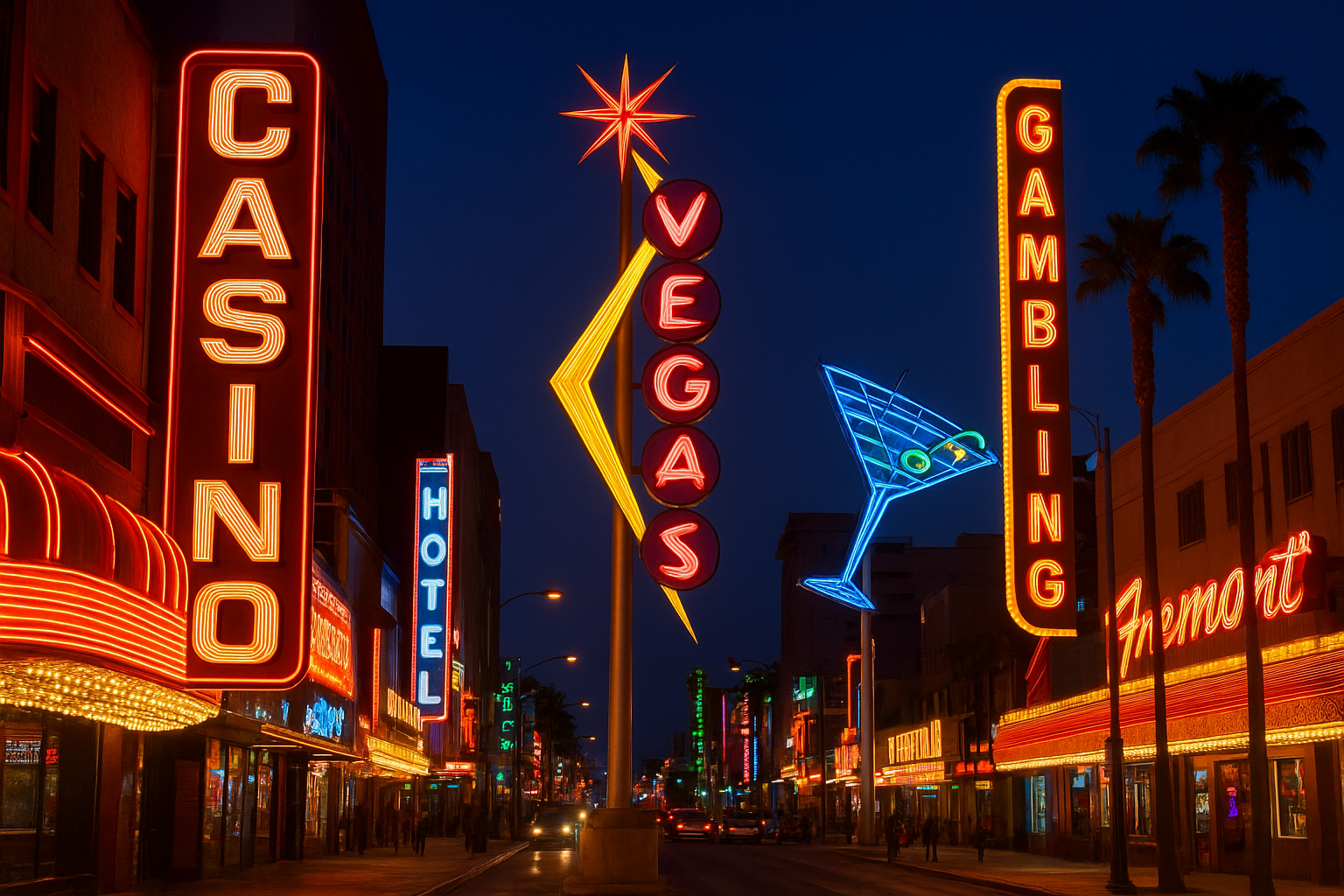
Tourism infrastructure expanded rapidly to match this reputation, with more hotel rooms, showrooms, and airport capacity built through the 1960s and 70s. Each addition reinforced the cycle: more visitors meant more investment, and more investment meant a bigger, more recognizable city.
Las Vegas culture today beyond the casino floor
The Las Vegas most visitors experience covers roughly four miles of resort corridor, but the city’s actual cultural life extends far beyond that strip of hotels and casinos. Las Vegas history and culture in the present tense means a metropolitan area of over two million people with distinct neighborhoods, a serious arts community, a diverse food scene, and local institutions that have nothing to do with gambling. If you only ever walk between resort properties, you miss the city that actually exists around them.
What most visitors call "Las Vegas" is really just the part of the city that was designed specifically for them to see.
The Arts District and creative neighborhoods
The 18b Arts District sits just west of downtown and functions as the creative hub of the city. Local galleries, independent restaurants, and working studios occupy repurposed buildings in a neighborhood that residents built without much tourist infrastructure in mind. First Friday events draw a monthly crowd that skews heavily local, giving you a direct look at how Las Vegas residents actually socialize and engage with their city outside of resort culture.
Several other neighborhoods carry their own distinct identities. The Historic Westside holds the strongest roots of Black Las Vegas, including the legacy of the city’s segregation-era entertainment scene along the Westside’s Jackson Street, where performers like Sammy Davis Jr. had to stay because the Strip hotels that booked them refused to let them sleep there.
Food, community, and the people who built the city
Las Vegas has one of the most diverse populations in the American West, and that shows up most clearly in its food and community life. Authentic Vietnamese restaurants in the east valley, Mexican bakeries near downtown, and Filipino markets on the west side reflect the immigrant communities that staffed and built the resort industry for decades while maintaining their own distinct cultural presence.
Your understanding of this city sharpens significantly when you spend time in these corners. Guided tours that go beyond the Strip give you direct access to the context, the stories, and the people that shaped modern Las Vegas from the ground up.
Bringing it all together
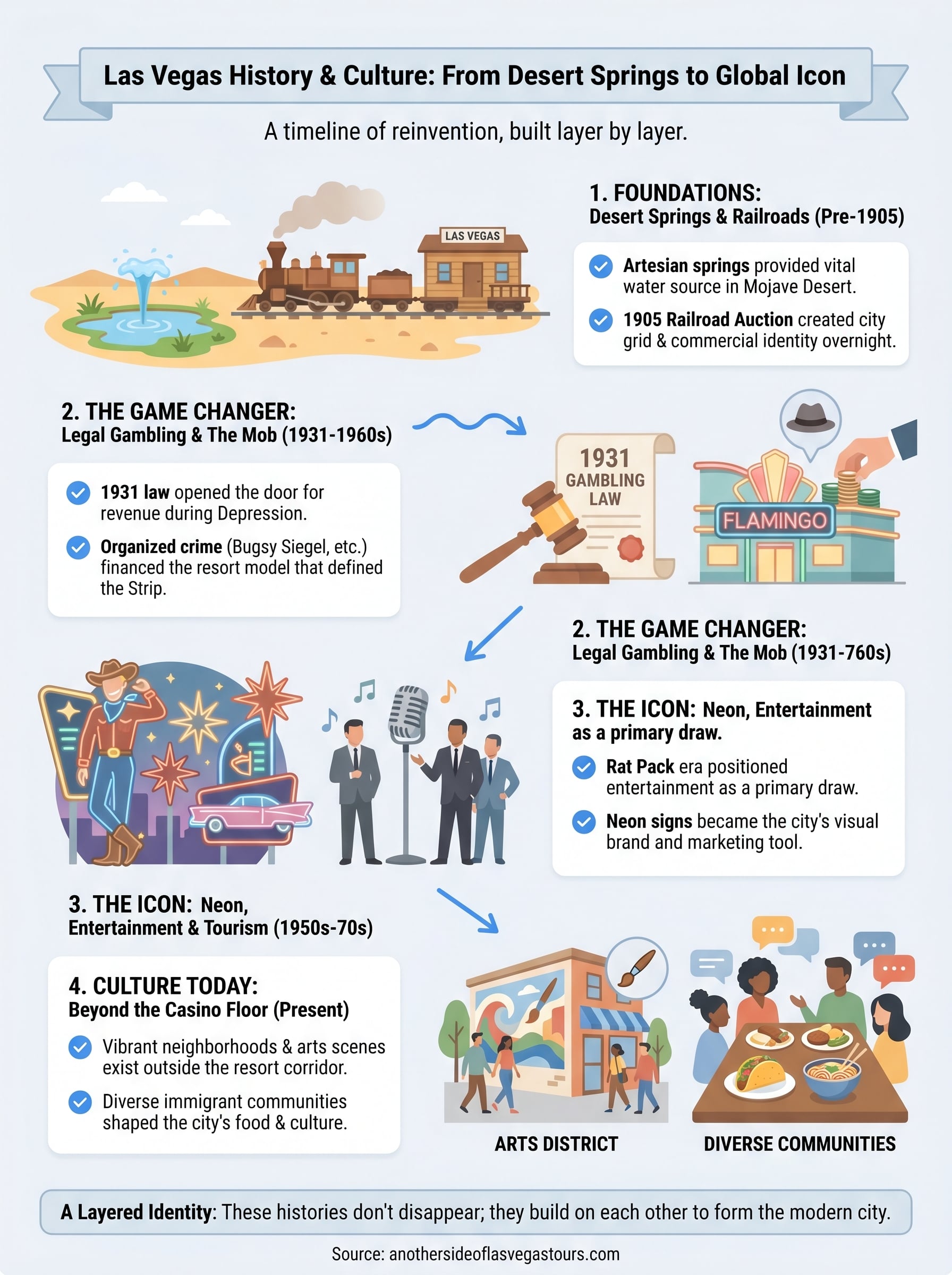
Las Vegas history and culture runs deeper than most visitors realize before they arrive. The city grew from desert springs and railroad economics through mob financing, neon branding, and waves of immigration that each left a permanent mark. Those layers don’t disappear when new buildings go up. They shape the neighborhoods, the street names, and the stories that explain why this particular city became what it is.
Seeing that full picture requires more than walking the resort corridor. The real Las Vegas shows up in its history, its communities, and the context that connects the past to what you’re standing in front of right now. Every landmark carries a story that goes back further than its current sign suggests. If you want a guide who can bring that context to life on the ground, explore our private Las Vegas tours and experience the city the way people who actually know it do.