
Valley of Fire State Park sits about an hour northeast of the Las Vegas Strip, and it looks like nothing else in Nevada. Red sandstone formations, some over 150 million years old, rise from the desert floor in shapes that shift color with the sunlight. If you’re figuring out how to visit Valley of Fire during a Vegas trip, you’re making a solid call, it’s one of the best day trips in the region and absolutely worth the drive.
But a good visit takes a little planning. You’ll need to know what the entrance fees are, which hikes match your fitness level and timeframe, and whether a half-day or full-day itinerary makes more sense for your schedule. Skip the planning, and you might end up stuck at an overcrowded trailhead at noon in triple-digit heat with no water and no shade. That’s not the memory you’re after.
At Another Side Tours, we’ve guided over a million tours in and around Las Vegas since 2007, and Valley of Fire is one of the places we know best. Our guides take visitors out there regularly, so the recommendations in this article come from real, repeated experience on the ground, not a quick Google search.
This guide covers everything you need: current fees and reservations, driving directions from the Strip, the best hikes and viewpoints, and ready-to-use itineraries for both half-day and full-day visits. Whether you’re planning a self-guided drive or considering a guided tour, you’ll leave this page with a clear plan.
Quick facts to know before you go
Before you map out your route or lace up your hiking boots, get these basics locked down. Knowing entrance fees, park rules, and seasonal conditions in advance saves you from surprises at the gate or on the trail. Valley of Fire is a state park, not a national park, so different rules and fee structures apply than what you might expect from a place like the Grand Canyon.
Entrance fees and passes
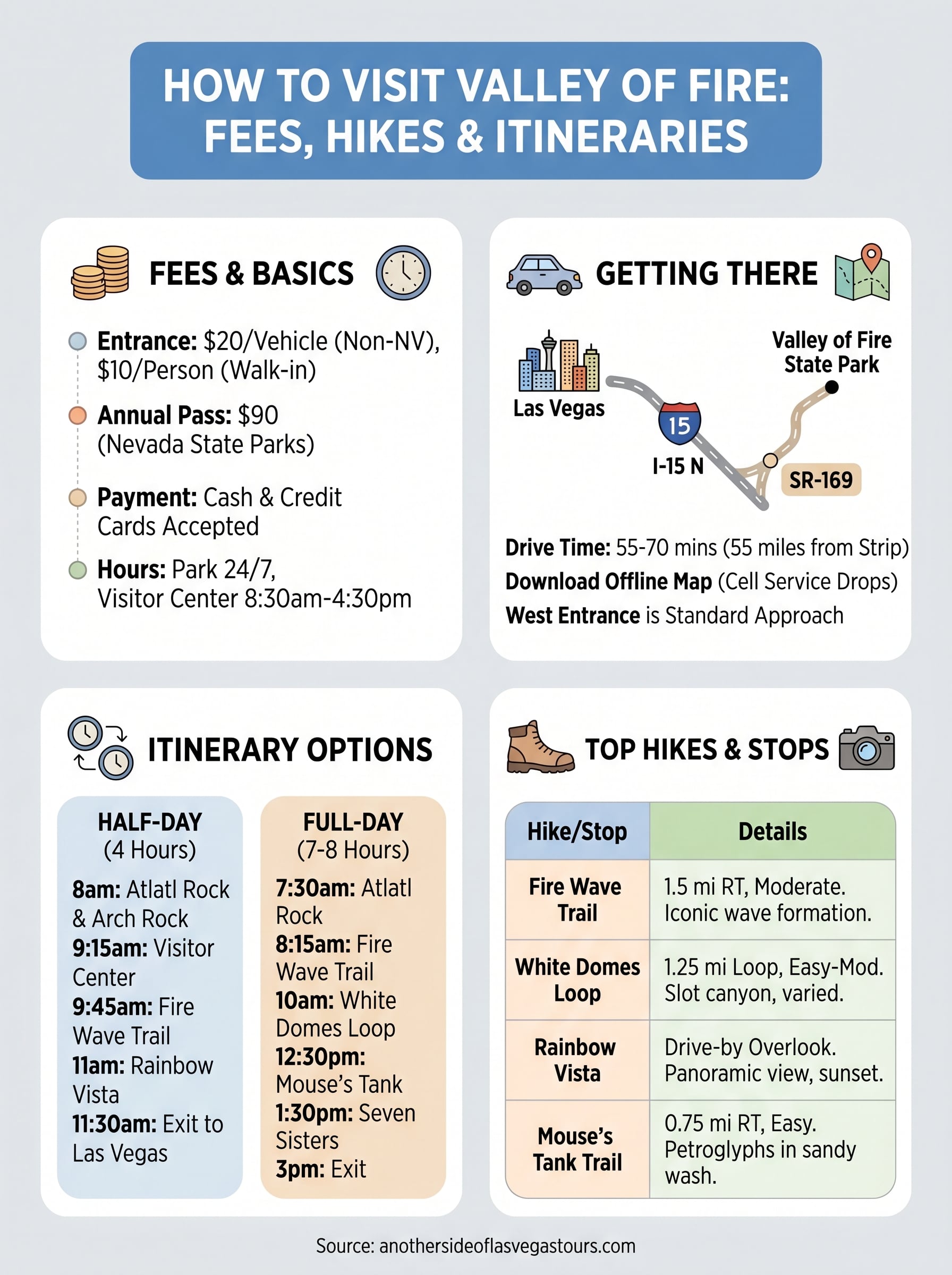
Non-Nevada residents pay $20 per vehicle to enter Valley of Fire State Park. Nevada residents pay $15. Motorcycles are $10, and walk-in visitors pay $10 per person. There is no annual pass specific to Valley of Fire, but the Nevada State Parks Annual Day Use Permit costs $90 and covers entry at all participating state parks in Nevada. If you’re planning to visit multiple parks during your trip, that pass pays for itself quickly.
The entrance fee is collected at the park entrance station. Both credit cards and cash are accepted, so you don’t need to stop for an ATM on the way. No advance ticket purchase is required for general day use entry, and no timed-entry reservations currently exist for most of the park.
If you’re visiting on a holiday weekend in spring or fall, arrive before 9 a.m. The parking lots at popular trailheads fill quickly, and rangers sometimes restrict entry when capacity is reached.
Park hours and best time to visit
Valley of Fire is open 24 hours a day, year-round. The visitor center, located near the center of the park, runs from 8:30 a.m. to 4:30 p.m. daily. Stop there if you want printed trail maps, ranger recommendations, or background on the park’s geology and ancient petroglyphs.
Spring (March through May) and fall (September through November) are the best seasons to visit. Temperatures stay in the 70s and 80s°F during those months, making hikes comfortable and the sandstone light ideal for photography. Summer is genuinely dangerous. Temperatures regularly climb above 110°F between late June and August, and most trails offer almost no shade. If a summer visit is unavoidable, go before 8 a.m. or after 5 p.m. and keep exposed hiking to a minimum.
What to bring with you
Packing right makes a real difference when planning how to visit Valley of Fire, especially in warmer months. The park has no food vendors and limited water stations, so bring more water than you think you need. The general rule is at least one liter per person per hour of hiking in spring or fall, and significantly more in summer heat.
Here’s a practical packing checklist for a half-day or full-day visit:
- Water: 2-3 liters per person minimum in mild weather, more in summer
- Sun protection: sunscreen, sunglasses, and a wide-brim hat
- Footwear: closed-toe shoes with grip, not sandals on rocky terrain
- Snacks: the nearest town, Overton, is about 15 miles from the park
- Camera or phone: formations photograph best in early morning or late-afternoon light
- Entrance fee payment: cash or card for the gate
- Fully charged phone: cell service is unreliable once you’re inside the park
Pets are technically allowed on leash but banned from most trails and all indoor facilities. Desert temperatures make it unsafe for animals during most of the year, so leaving your dog at home is the smarter call unless you’re visiting on a cool morning in late fall or early spring.
Plan your trip from Las Vegas
Valley of Fire sits 55 miles northeast of the Las Vegas Strip, which translates to roughly 50 to 70 minutes of drive time depending on traffic and your starting point. Figuring out how to visit Valley of Fire from Las Vegas is straightforward once you know the route, but a few logistical details are worth confirming before you leave your hotel.
Getting there by car
From the Strip, take I-15 North toward Mesquite, then exit onto Nevada State Route 169 (the Valley of Fire Highway). Follow that road east until you reach the park entrance. Your GPS will handle this reliably, but download an offline map using Google Maps before you leave, since cell signal drops significantly once you’re past the highway and inside the park.

The drive on SR-169 through the park itself is part of the experience. Pull over at designated scenic areas as you go, and don’t rush straight to the trailheads.
Here’s a quick reference for the drive from common Vegas starting points:
| Starting Point | Estimated Drive Time | Approximate Miles |
|---|---|---|
| Las Vegas Strip | 55-70 minutes | 55 miles |
| Downtown Fremont Street | 50-65 minutes | 50 miles |
| Henderson | 60-75 minutes | 58 miles |
| Airport (Harry Reid) | 55-70 minutes | 54 miles |
Parking and entry at the gate
Most visitors enter through the west entrance off SR-169, which puts you closest to major stops like Atlatl Rock, Arch Rock, and the visitor center. There is a second entrance via Northshore Road from the south if you’re coming from Boulder City or Lake Mead, but for Las Vegas visitors, the west entrance is the standard approach.
Parking lots at popular trailheads are small by most standards, especially at White Domes and Fire Wave. On weekends from March through May, lots fill up before 10 a.m. Arrive early or plan to wait. Do not park on the road shoulder where signage prohibits it; rangers do issue citations.
Gas up in Las Vegas before you leave. The nearest gas station is in Overton, roughly 15 miles from the park, and it’s out of your way on most routes from Vegas. Starting the drive with at least half a tank keeps you from making an unplanned detour on the return trip.
Pick the right itinerary for your time
How much time you have shapes everything about how to visit Valley of Fire. A half-day trip from Las Vegas works well if you’re pressed for time or combining the park with another stop. A full day gives you room to slow down, explore lesser-visited trails, and spend real time at the visitor center without feeling rushed. Both options deliver a strong experience, but they call for different plans.
Half-day itinerary (4 hours)
A half-day visit works best if you arrive by 8 a.m. and plan to leave by noon, before afternoon heat peaks and trailhead parking becomes a problem. You have enough time to hit the park’s most iconic spots without overextending. Stick to short trails and paved pullouts to keep the pace manageable.
Here’s a working half-day schedule:
| Time | Stop | Notes |
|---|---|---|
| 8:00 a.m. | West entrance, Atlatl Rock | Climb the stairs to see petroglyphs up close |
| 8:45 a.m. | Arch Rock area | Short walk, strong photo opportunity |
| 9:15 a.m. | Visitor Center | Pick up a map, see the exhibits |
| 9:45 a.m. | Fire Wave Trail | 1.5-mile round trip, moderate terrain |
| 11:00 a.m. | Rainbow Vista overlook | Drive-by scenic stop on the way out |
| 11:30 a.m. | Exit toward Las Vegas |
Fire Wave is the one stop most visitors regret skipping. If your time is short, prioritize this trail over everything else on the list.
Full-day itinerary (7 to 8 hours)
A full day lets you tackle the White Domes Loop, which is the park’s best all-around hike, and still have time to revisit any stops at a relaxed pace. Arrive between 7 and 8 a.m. to beat both the heat and the crowds, especially on spring weekends.
Here’s how to structure your full-day visit:
| Time | Stop | Notes |
|---|---|---|
| 7:30 a.m. | West entrance, Atlatl Rock | Start here while it’s cool |
| 8:15 a.m. | Fire Wave Trail | Do it early before full sun hits |
| 9:30 a.m. | Visitor Center | Refill water, check trail conditions |
| 10:00 a.m. | White Domes Loop | 1.25-mile loop with a slot canyon section |
| 11:30 a.m. | Shaded pullout for lunch | Bring your own food |
| 12:30 p.m. | Mouse’s Tank Trail | Petroglyphs along a sandy wash |
| 1:30 p.m. | Seven Sisters area | Explore at your own pace |
| 3:00 p.m. | Begin drive back to Las Vegas |
Both schedules assume mild weather, typically spring or fall conditions. In summer, cut any exposed hiking well before 10 a.m. regardless of how ambitious your original plan was.
Do the best scenic stops and hikes
Valley of Fire packs an unusual amount of variety into a relatively compact area. Scenic pullouts, short walks, and full hikes are spread across the park’s main road and side routes, which means you can structure your visit around your fitness level and available time. Knowing which stops to prioritize helps you figure out how to visit Valley of Fire without wasting hours backtracking or doubling up on similar terrain.
Top scenic stops for drivers and photographers
If you’re traveling with people who prefer not to hike, the main park road delivers real scenery from your car window at multiple designated pullouts. These aren’t just parking lots with a view, several of them put you within a short walk of striking formations with no trail required.

Here are the stops worth building your route around:
- Rainbow Vista: A broad overlook with panoramic views of layered red and white rock. Best photographed in late afternoon when the light is low and warm.
- Cabins: Historic stone structures built in the 1930s by the Civilian Conservation Corps. Shaded and photogenic, with context boards explaining the history.
- Elephant Rock: A drive-by formation near the east entrance that genuinely looks like its name. Takes about five minutes and requires almost no walking.
- Seven Sisters: A cluster of red sandstone domes that reward the short walk from the parking area.
Rainbow Vista is one of the most underrated stops in the park. Most visitors rush past it on the way to Fire Wave, but the view from that overlook is wider and more dramatic than anything you’ll see from the trailheads.
Best hikes by difficulty
Most visitors have time for two or three trails, so picking the right ones based on distance and exertion matters. The table below breaks down the park’s most worthwhile hikes.
| Trail | Distance | Difficulty | What to Expect |
|---|---|---|---|
| Fire Wave | 1.5 mi round trip | Moderate | Open sandstone terrain with a striking wave formation at the end |
| White Domes Loop | 1.25 mi loop | Easy-moderate | Slot canyon section, varied rock colors, shaded sections |
| Mouse’s Tank | 0.75 mi round trip | Easy | Sandy wash lined with petroglyph panels |
| Petroglyph Canyon | 0.5 mi round trip | Easy | Dense petroglyph concentration, mostly flat |
White Domes Loop is the single best hike in the park for first-time visitors. It covers multiple terrain types in a short distance and includes a narrow slot canyon section that most people don’t expect to find in the desert.
Avoid heat trouble and other common mistakes
Most visitors who have a bad time at Valley of Fire don’t run into trouble on the trail itself, they run into trouble because they underestimated the sun. Heat-related illness can set in fast in this environment, and the exposed sandstone radiates warmth back at you even when the air temperature feels manageable in the morning. Knowing what actually causes problems helps you figure out how to visit Valley of Fire without turning a scenic day into a medical situation.
Manage the heat before it becomes a problem
The most common heat mistake is starting hikes too late in the morning. Parking lots fill up and visitors arrive at 10 a.m. or 11 a.m. thinking they have plenty of time left, but trail conditions are already deteriorating by then. Aim to be on exposed trails before 9 a.m. in spring and fall, and before 8 a.m. if temperatures are forecast above 90°F.
If you start feeling dizzy or nauseous on a trail, stop moving immediately, find shade, and drink water slowly. Do not try to push through to the endpoint.
Dehydration often sneaks up on people because the dry desert air evaporates sweat before you feel it building up. You may not feel thirsty while your body is already losing fluid at a significant rate. Drink water on a schedule, roughly every 20 to 30 minutes while hiking, rather than waiting until you feel the urge.
Watch for these other common trip mistakes
Heat is the biggest risk, but several other planning errors consistently trip up first-time visitors. These are easy to avoid once you know to look for them.
- Skipping the offline map download: Cell service fails inside the park. Download Google Maps offline before you leave your hotel.
- Arriving without a payment method: The entrance station takes both cash and card, but having a backup payment option prevents delays at the gate.
- Wearing sandals on rocky trails: Fire Wave and White Domes involve uneven sandstone. Closed-toe shoes with grip are not optional on those routes.
- Leaving pets in a parked vehicle: Interior car temperatures can exceed 140°F in summer. Leave animals at home.
- Packing too many stops into one day: Three to four well-chosen stops beats seven rushed ones. Build buffer time between locations rather than filling every hour with a scheduled activity.
Wrap it up and plan your next tour
Knowing how to visit Valley of Fire puts you well ahead of most visitors who show up without a plan and end up rushing through the park in the midday heat. You now have the fees, the driving route, a solid itinerary for whatever time you have, and a clear picture of which hikes are worth your energy. That’s everything you need to make the trip work.
If you’d rather skip the logistics and let someone else handle the driving, route planning, and on-the-ground knowledge, a guided tour is worth considering. Our guides have spent years out there and know the spots that don’t show up on most maps. You get more out of the park in less time, with no guesswork involved. Check out our Valley of Fire private tours and see what a guided visit looks like.