
About an hour northeast of the Strip, Nevada’s oldest and largest state park sits waiting with 40,000 acres of red sandstone that looks like it belongs on another planet. A valley of fire day trip from las vegas is one of the best ways to break up a Vegas itinerary, no flight required, no full-day commitment, and the payoff is unreal.
But here’s the thing: showing up without a plan usually means missed trailheads, wrong turns, and spending half your time in a car instead of standing in front of formations that took 150 million years to form. The park is bigger than most people expect, and not every stop is worth your limited time. That matters when you’re working with a single day away from the Strip.
This guide covers the full picture, drive times, the best stops in order, hike recommendations by difficulty, and what to bring. We built it from the same firsthand knowledge our guides at Another Side Tours use when leading guests through southern Nevada’s natural landmarks. Whether you book a guided tour with us or plan a self-drive trip, you’ll leave with a clear, practical itinerary that makes every hour count.
Valley of Fire basics for first-timers
Valley of Fire State Park sits about 55 miles northeast of Las Vegas in the Mojave Desert, just off Interstate 15 near Overton, Nevada. The park gets its name from the Aztec sandstone formations that glow orange and red in direct sunlight, the result of iron oxide deposits that built up over hundreds of millions of years. When people plan a valley of fire day trip from las vegas, they often picture a quick drive to one scenic overlook. In reality, you’re getting a park with multiple distinct zones, a full visitor center, several trailheads, ancient rock art sites, and formations that shift in color and texture as you move through them.
What the park actually looks like
The landscape is not uniform. You’ll move between narrow slot canyons, open desert flats, and towering sandstone domes that dwarf everything around them, with petroglyphs carved by the Ancestral Puebloans showing up in places most visitors walk right past. The colors change throughout the day as well. Early morning light pulls out a deep, saturated red, midday sun washes things out considerably, and late afternoon brings the orange and pink tones that dominate most photos you’ve probably seen. If you’ve only seen pictures taken in one type of light, the park will look different when you show up. That’s not a bad thing, but it does matter for planning what time you arrive.
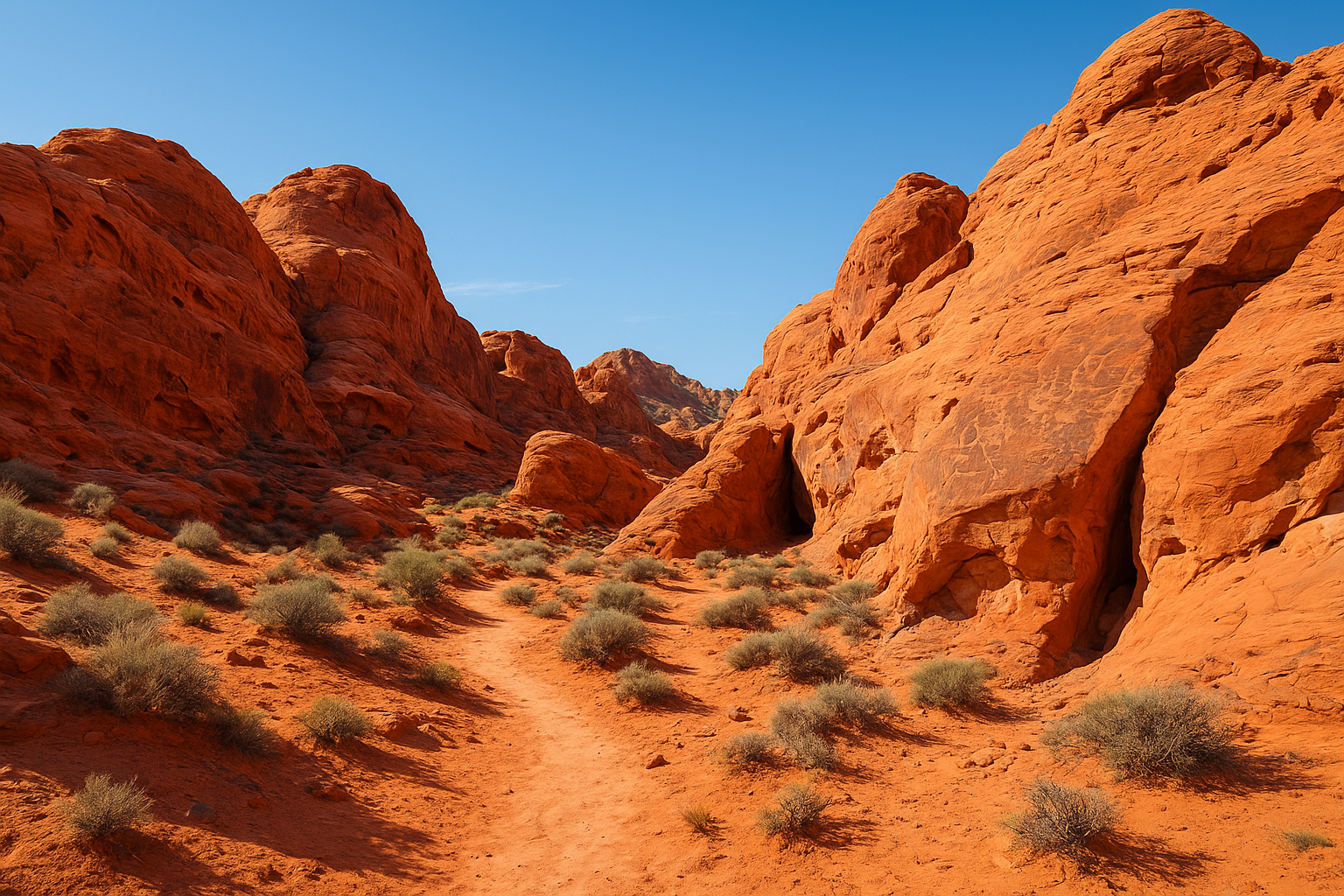
The most photographed spots in the park, like Elephant Rock and the Fire Wave, sit at opposite ends of the main road, so plan your route before you start walking.
Entry fees, hours, and the basics
Nevada State Parks charge $15 per vehicle for day entry, which covers every person in your car. The park stays open year-round from sunrise to sunset, with the main visitor center operating from 8:30 a.m. to 4:30 p.m. You pay at the entrance station on the way in, and both cash and card are accepted. Here’s a quick reference for what to expect:
| Item | Detail |
|---|---|
| Day use fee | $15 per vehicle |
| Annual pass | $75 (Nevada State Parks) |
| Park hours | Sunrise to sunset |
| Visitor center hours | 8:30 a.m. to 4:30 p.m. |
| Cell service | Minimal to none inside the park |
| Pets | Allowed on leash on trails |
No gas stations exist inside the park, so fill your tank before leaving Las Vegas or stop in Overton on the way in. The nearest town with a full range of services sits about 15 minutes east of the park entrance, so do not count on finding anything once you’re inside.
When to go for the best experience
Spring (March through May) and fall (September through November) give you the most comfortable conditions for moving around the park on foot. Summer temperatures regularly reach 110°F or above, which makes extended hiking genuinely dangerous between 10 a.m. and 4 p.m. If a summer visit is your only option, plan to be on the trail no later than 7 a.m. and back at your vehicle before the heat peaks. Winter is actually quite good temperature-wise, with daytime highs typically landing in the 50s and low 60s, though some shaded areas and elevated trail sections can ice over after cold nights. Check the Nevada State Parks website or call the visitor center before heading out in January or February.
How to get there from Las Vegas
Getting to Valley of Fire from Las Vegas is straightforward once you know the route. The drive takes roughly 55 to 75 minutes depending on traffic leaving the city and which entrance you use. Most visitors doing a valley of fire day trip from las vegas leave by 7 a.m. to beat both the outbound traffic and the peak heat, and that early start pays off significantly once you’re inside the park.
The drive and turn-by-turn route
From the Strip, take I-15 North toward Mesquite for about 35 miles, then exit at Exit 75 for Logandale and Overton. Follow Nevada State Route 169 west for roughly 15 miles until you see the park entrance signs on your right. The west entrance on SR-169 is the most common entry point and puts you closest to the main visitor center and the majority of the park’s key stops. If you’re coming from the north end of Las Vegas or from Henderson, the route is nearly identical since I-15 is your main artery either way.
Do not rely on GPS inside the park. Download an offline map before you leave, because cell service drops out almost immediately after the entrance station.
Here’s a quick summary of the drive broken into legs:
| Leg | Route | Approximate time |
|---|---|---|
| Strip to I-15 North | Surface streets to on-ramp | 10-15 min |
| I-15 North to Exit 75 | Interstate driving | 30-35 min |
| Exit 75 to park entrance | SR-169 West | 15-20 min |
| Total | Combined | 55-75 min |
Where to park once you’re inside
Parking inside the park is free with your paid entry, and each major stop has a dedicated lot. The visitor center lot is the best place to start because the staff hands out printed trail maps and can tell you which trailheads are already busy that morning. From there, you drive between stops rather than walking the full length of the park road, which spans about 10 miles from the west to the east entrance. Arrive before 9 a.m. on weekends and you’ll find open spots at the popular lots for White Domes and Fire Wave without any issue. After 10 a.m., those same lots can fill completely.
The best one-day itinerary in the park
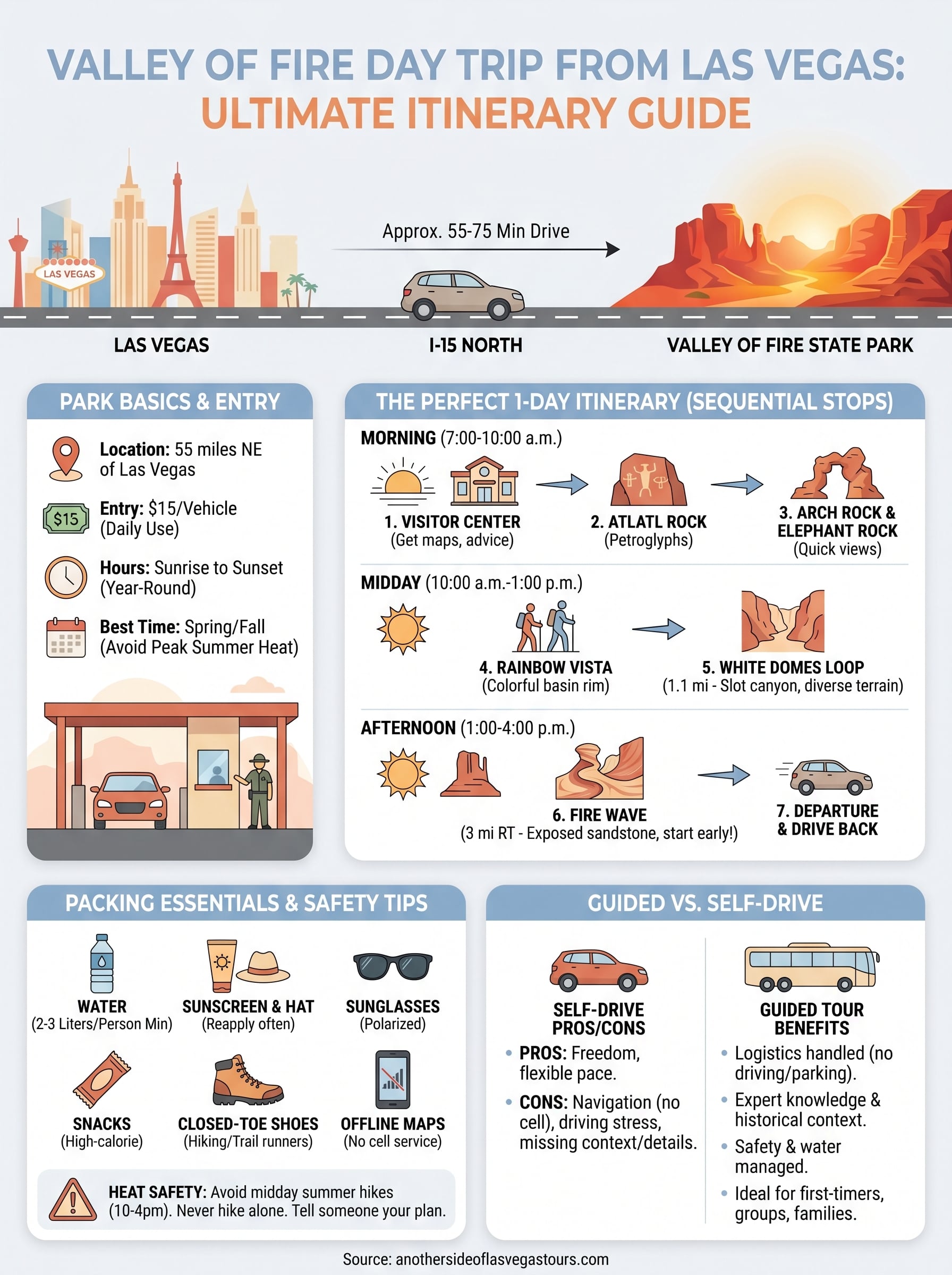
Running a valley of fire day trip from las vegas without a set order wastes more time than almost anything else. The park’s main road spans roughly 10 miles from the west entrance to the east, and the stops are spread out in a way that punishes backtracking. Follow this sequence and you’ll cover every major site, avoid the worst crowds at each stop, and still be back in Las Vegas well before dark.
Morning (7:00–10:00 a.m.): Visitor center and Atlatl Rock
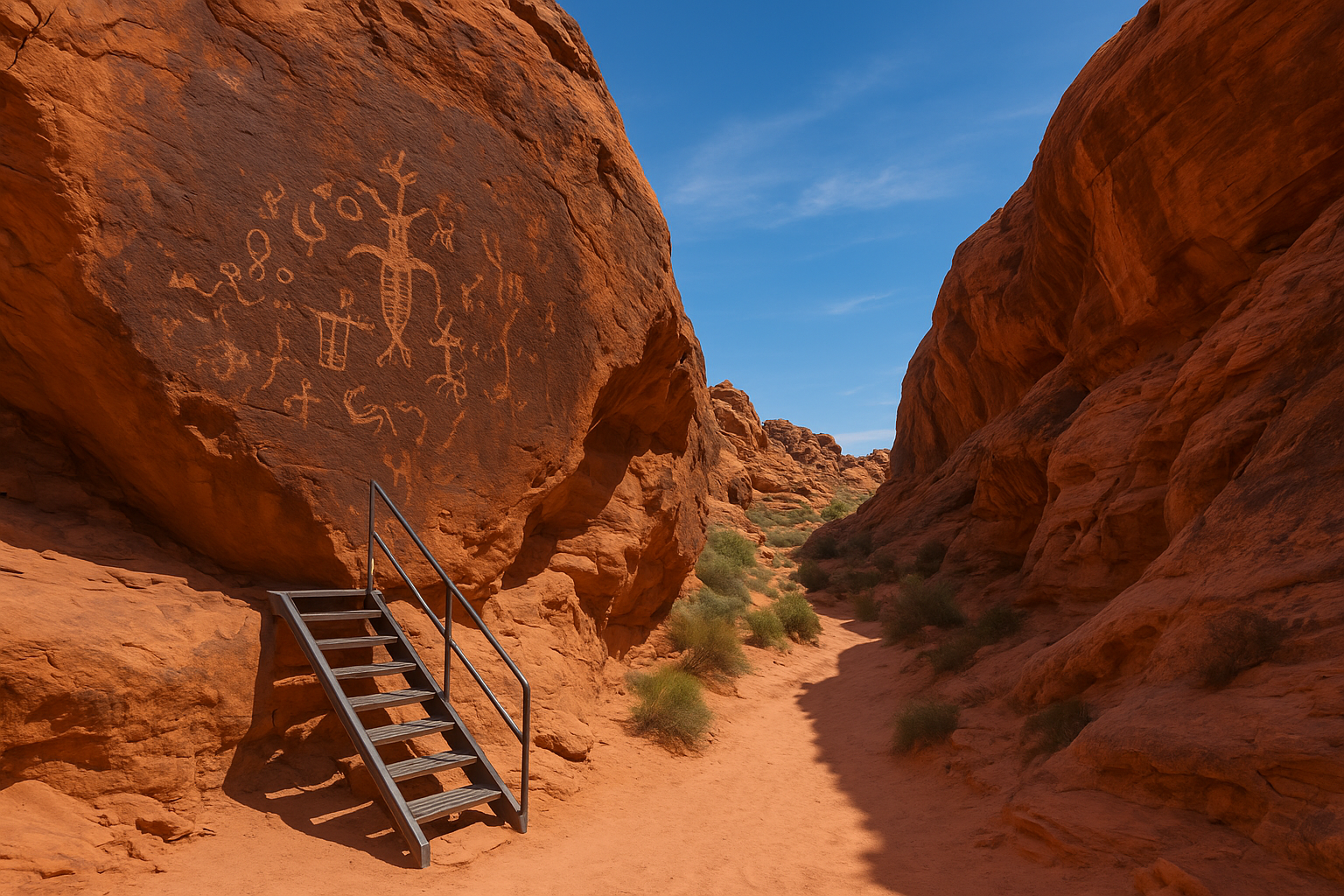
Pull into the visitor center parking lot first, grab a printed trail map from the front desk, and ask the ranger on duty which trails are open and which lots are already filling. From there, drive four minutes east to Atlatl Rock, where a metal staircase leads up to one of the best petroglyph panels in the entire park. Give yourself 30 to 45 minutes here before the tour buses start arriving around 9 a.m.
| Time | Stop | Drive from previous stop |
|---|---|---|
| 7:00 a.m. | Arrive at west entrance, pay fee | N/A |
| 7:10 a.m. | Visitor center | 5 min |
| 7:30 a.m. | Atlatl Rock petroglyphs | 4 min |
| 8:30 a.m. | Arch Rock and Elephant Rock | 3 min |
Midday (10:00 a.m.–1:00 p.m.): Rainbow Vista and White Domes
By 10 a.m., move toward Rainbow Vista, a short out-and-back walk that puts you on the rim of a wide basin filled with banded red, cream, and purple sandstone. After that, drive to the White Domes trailhead at the northeast end of the road. This 1.1-mile loop is the single most varied trail in the park, passing through a narrow slot canyon, open desert flats, and eroded sandstone ridges, all in under an hour.
If you skip every other stop on this list but hit White Domes, you will still leave with a solid sense of what makes this park worth the drive from Las Vegas.
Afternoon (1:00–4:00 p.m.): Fire Wave and the drive out
Fire Wave requires a 3-mile round-trip hike on fully exposed terrain, so starting it by 1 p.m. gives you enough time to move at a comfortable pace without pushing into the worst afternoon heat. The trailhead sits near the Seven Wonders parking area, about five minutes from White Domes by car. Plan to be back at your vehicle no later than 3:30 p.m., then head toward the west entrance and retrace SR-169 back to I-15 for the return drive to Las Vegas.

Hikes and stops you should not miss
The park has more named stops than you can realistically cover in a single day, so knowing which ones actually deliver on the experience matters. Focus on the four stops below and you’ll leave with a complete picture of what makes Valley of Fire one of the best day trips in the Southwest, without burning time on detours that don’t add much.
White Domes Loop
The 1.1-mile White Domes loop is the most complete trail in the park for first-timers. You’ll walk through a narrow slot canyon, cross open desert flats, and pass eroded sandstone walls that shift from cream to deep red within a few hundred feet of each other. The trailhead sits at the northeast end of the main park road, and the entire loop takes about 45 minutes at a comfortable pace.
| Trail | Distance | Difficulty | Estimated time |
|---|---|---|---|
| White Domes Loop | 1.1 miles | Easy to moderate | 45 min |
| Fire Wave | 3.0 miles RT | Moderate | 1.5 to 2 hrs |
| Mouse’s Tank | 0.75 miles RT | Easy | 30 min |
| Atlatl Rock | Short staircase | Easy | 20 to 30 min |
Fire Wave Trail
Fire Wave is the most visually striking hike in the entire park, covering 3 miles round trip over open, exposed sandstone with no shade from start to finish. The time you begin matters here. Start no later than 1 p.m. in spring or fall, and carry at least two liters of water per person before you step away from the trailhead parking area.
Fire Wave looks completely different depending on the light, so if you arrive at midday and the colors seem flat, give it 30 minutes and watch the shadows shift.
Atlatl Rock and Mouse’s Tank
Atlatl Rock holds one of the most accessible petroglyph panels in the American Southwest, reached by a short metal staircase bolted directly into the sandstone face. Spend time studying the individual carvings rather than just photographing them, then drive two minutes east to Mouse’s Tank, where a 0.75-mile round-trip wash trail passes additional petroglyphs on both canyon walls. If you are planning a valley of fire day trip from las vegas and you care about the Ancestral Puebloan history behind these carvings, pairing these two stops back-to-back gives you the clearest picture of who made them and why researchers believe they were placed here over a span of centuries.
What to pack and safety tips
Being prepared before you leave Las Vegas is the single most effective thing you can do to keep your valley of fire day trip from las vegas enjoyable rather than miserable. The desert environment inside Valley of Fire is unforgiving, and the distance from any gas station, pharmacy, or emergency services means a forgotten item is not a quick fix.
What to bring in your daypack
Pack everything you need before you leave your hotel. Water is non-negotiable, and the standard recommendation of one liter per person per hour of hiking is not an exaggeration in a desert environment. A 3-mile round-trip hike like Fire Wave means you should start with at least two liters per person in your bag before stepping away from the trailhead parking lot.
Here’s a practical packing list to go through before you leave:
- Water: 2 to 3 liters per person minimum
- Sunscreen: SPF 50 or higher, reapply every 90 minutes
- Hat: wide brim, not a baseball cap
- Sunglasses: polarized lenses cut the sandstone glare significantly
- Snacks: high-calorie, low-melt options like nuts, jerky, or bars
- Closed-toe shoes: trail runners or hiking boots, never sandals on rocky terrain
- Offline map: downloaded before you lose cell service at the entrance
- Small first aid kit: blister pads and bandages at minimum
- Light jacket: temperatures drop fast after 5 p.m., even in spring
The visitor center sells water bottles, but you should not count on them being stocked or the center being open when you arrive.
Heat and terrain safety
The sandstone surface heats up faster than the air temperature suggests, so trail conditions at 11 a.m. are meaningfully different from those at 8 a.m. even when the forecast shows moderate temperatures. Your shoes need grip and ankle support because the rock surface shifts between smooth, polished sections and jagged, uneven edges within a few feet of each other.
Never hike alone on Fire Wave or White Domes without letting someone know your plan and expected return time. Cell service is essentially zero inside the park, so any injury requires another person to go for help in person. Keep your group together, set a turnaround time before you start, and stick to it regardless of how close the next formation looks.
When a guided tour makes more sense
A self-drive valley of fire day trip from las vegas works well if you know the route, have reliable transportation, and feel comfortable navigating without cell service. But self-driving is not always the right call, and knowing when to book a guided tour saves you from a day that falls short of what the park can actually offer.
You’re unfamiliar with desert driving and navigation
Desert roads and park interiors behave differently from urban driving, and the complete loss of cell service the moment you pass the entrance station catches a lot of visitors off guard. If you rely on Google Maps for navigation, you will have no signal to fall back on once you’re inside the park. A guided tour handles routing, parking, and timing entirely, so you walk away from the vehicle and focus on what you’re looking at instead of figuring out where to go next.
If you have never driven in a remote desert environment before, a guided tour is the lower-risk option, especially if you’re visiting with family or an unfamiliar group.
You want context for what you’re seeing
The petroglyphs at Atlatl Rock and Mouse’s Tank are easy to walk past without understanding what you’re looking at. The same applies to the geological formations, the erosion patterns, and the ecological details that explain why the park looks the way it does. A trained guide turns those observations into a coherent story about 150 million years of geological and human history, which adds a level of depth that no trail marker can match.
You’re traveling with first-timers or a larger group
Coordinating multiple people through a park with no cell service, limited shade, and multiple trailheads requires more planning than most groups anticipate. With a guided tour, someone else manages the logistics, timing, water supply reminders, and turnaround calls. That matters significantly when you have children, older travelers, or anyone with limited hiking experience in your group.
Another Side Tours runs guided experiences to Valley of Fire and other southern Nevada landmarks using professional guides with firsthand knowledge of every stop in the park. You spend the day focused on the experience rather than the logistics. That’s a trade-off worth considering before you commit to driving yourself.
Wrap up and next steps
A valley of fire day trip from las vegas delivers one of the most visually distinct experiences in the American Southwest, and it fits cleanly into a single day if you plan your stops in order and leave Las Vegas early. The key variables that determine whether your trip goes well are your departure time, water supply, and knowing which trailheads are worth the walk before you step out of the car. Follow the itinerary in this guide and you will cover the park’s best stops without backtracking or wasted hours.
If you want someone else to handle the routing, timing, and context so you can focus entirely on the experience, we can help. Another Side Tours has been running guided trips through southern Nevada since 2007, with guides who know these stops from the ground up. Book a guided Las Vegas area tour and let us take care of the logistics while you take in the landscape.