
Valley of Fire State Park is one of the most striking day trips you can take from the Las Vegas Strip, ancient red sandstone formations, 2,000-year-old petroglyphs, and desert scenery that looks like it belongs on another planet. But before you start mapping it out, the first practical question is always how far is Valley of Fire from Las Vegas and how long it actually takes to get there. The short answer: roughly 50 miles northeast, depending on your starting point, with a drive time that typically lands between 50 minutes and just over an hour.
At Another Side Tours, we’ve been running guided tours from Las Vegas to surrounding natural attractions since 2007, including Valley of Fire. We know the routes, the traffic patterns, and the stops worth making along the way. That firsthand experience is baked into everything below.
This guide breaks down the exact mileage, the best routes to take, drive times based on where you’re leaving from, and what to factor in before you hit the road. Whether you’re driving yourself or considering a guided tour, you’ll have everything you need to plan the trip right.
What to know before you plan the drive
Before you focus on figuring out how far is Valley of Fire from Las Vegas and mapping directions, a few practical details about the park itself will shape your whole trip. Valley of Fire is Nevada’s oldest and largest state park, covering over 40,000 acres of Mojave Desert terrain. Knowing the basics upfront keeps you from arriving unprepared or scrambling to make decisions at the entrance gate when you could be spending that time on the trails.
Entry fees and park passes
The park charges a day-use fee to enter, and you pay it at the entrance station. As of the most recent fee schedule, the standard vehicle rate is $10 per vehicle for Nevada residents and $15 per vehicle for out-of-state visitors. If you plan to visit multiple Nevada state parks on the same trip, a Nevada State Parks Annual Pass covers entry at Valley of Fire. Check the current rates through the Nevada State Parks official site before you go so you are not caught off guard.
Here is a quick breakdown of what to expect at the gate:
| Visitor Type | Fee (Per Vehicle) |
|---|---|
| Nevada residents | $10 |
| Out-of-state visitors | $15 |
| Annual pass holders | Free (pass required) |
Hours and seasonal considerations
Valley of Fire is open year-round, but the visitor center keeps its own schedule and is not always staffed. The park has no set closing time for day visitors, though camping requires a separate permit and reservation. The best time to visit runs from October through April, when temperatures are comfortable for hiking and exploring. Summer months from June through August routinely push past 110°F, which makes long hikes dangerous and midday visits genuinely unsafe for most people.
If you visit between June and August, plan to arrive by 8 a.m. and leave before 11 a.m. to avoid the worst heat of the day.
What to bring before you leave Las Vegas
Water is the single most critical item you can bring. The park has no convenience stores, and the visitor center carries limited supplies. A reasonable baseline is one liter of water per person per hour you plan to spend outdoors, and more in summer. Pack everything you need before you leave the city, because once you are on the road there are very few stops between Las Vegas and the park entrance.
Your checklist before heading out:
- Sun protection: sunscreen rated SPF 30 or higher, a wide-brim hat, and UV-blocking sunglasses
- Closed-toe shoes: the sandstone trails are uneven and require stable footwear
- Food and snacks: no vendors operate inside the park, so pack a lunch or at minimum some trail snacks
- An offline map: cell signal drops significantly once you leave the main highway, and relying on live GPS navigation can leave you without directions when you need them most
- Payment method: the entrance station accepts both cash and card, but carrying a card is the safer default
Taking 20 to 30 minutes in Las Vegas to pull this list together before you leave makes the difference between a day that runs smoothly and one spent problem-solving in the desert.
Distance and drive time from Las Vegas
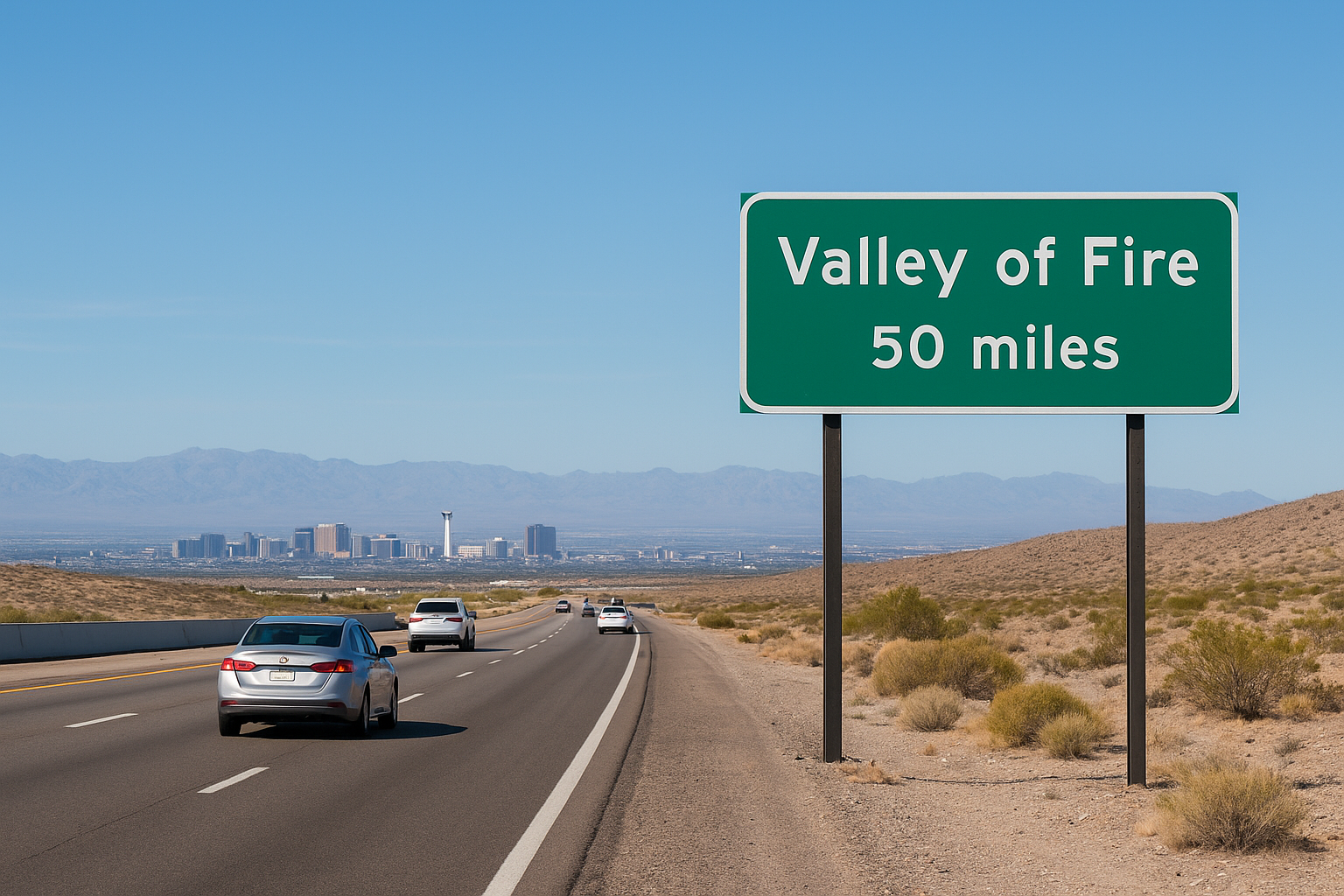
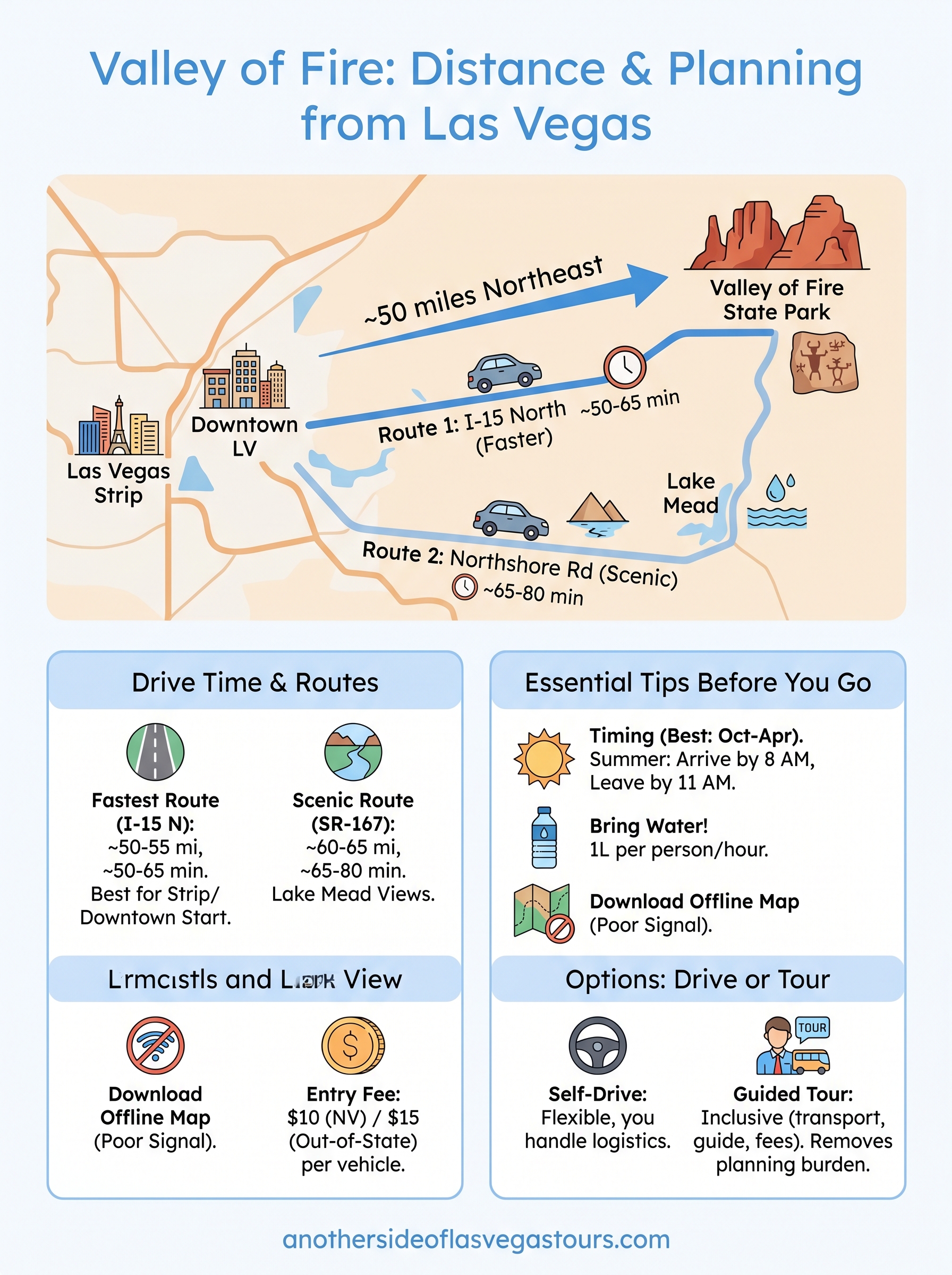
When people ask how far is Valley of Fire from Las Vegas, the answer depends on where in the city you start. The park entrance sits approximately 50 to 55 miles northeast of the Las Vegas Strip, and the drive takes most visitors between 50 minutes and 1 hour and 15 minutes under normal conditions. That range shifts based on your exact starting point, traffic through the city, and whether you stop along the way.
Mileage from common starting points
Your hotel location matters more than most people expect when calculating travel time. Leaving from the north end of the Strip cuts a few miles off compared to departing from the south end near Mandalay Bay. Downtown Las Vegas sits closer to the highway heading northeast, which also shaves time off the route. The table below gives you a straightforward look at what to expect.
| Starting Point | Miles to Park Entrance | Estimated Drive Time |
|---|---|---|
| South Strip (Mandalay Bay area) | ~58 miles | 1 hr 10 min – 1 hr 20 min |
| Mid-Strip (Caesars, Bellagio area) | ~53 miles | 1 hr – 1 hr 10 min |
| North Strip (Sahara, Resorts World) | ~50 miles | 55 min – 1 hr 5 min |
| Downtown Las Vegas | ~48 miles | 50 min – 1 hr |
Add 10 to 15 minutes to any of these estimates if you are leaving between 7 a.m. and 9 a.m. on a weekend, when traffic heading out of the city runs heavier than usual.
What affects your drive time
Traffic inside Las Vegas is the biggest variable on this trip, not the stretch of highway leading to the park. Once you clear the city and get onto I-15 North or Lake Mead Boulevard heading toward Northshore Road, the roads open up and you move quickly. The final approach into the park on Nevada State Route 169 is a two-lane road with no lights and minimal traffic, so that portion stays consistent regardless of the day or season. Build your timeline around getting out of Las Vegas smoothly, and the rest of the drive takes care of itself.
Pick the best route to Valley of Fire
Two main routes connect Las Vegas to the park, and which one you choose shapes the drive experience as much as the destination itself. Both routes are well-maintained and easy to follow, but they offer different scenery and slightly different drive times. Knowing the tradeoffs before you leave makes the decision straightforward.
Route 1: I-15 North to SR-169 (the standard route)
This is the most common way to reach Valley of Fire, and it works well if you are leaving from the Strip or Downtown. You take I-15 North out of the city, exit at Ute Road or SR-169 near Moapa, then follow SR-169 west directly into the park. The total drive sits right around 50 to 55 miles, and most of it moves fast once you clear city traffic. The final stretch on SR-169 cuts through open desert with rock formations beginning to appear on the horizon well before you reach the entrance gate.
If you are asking yourself how far is Valley of Fire from Las Vegas in practical terms, this route gives you the most direct answer: under 60 miles, under 70 minutes in most conditions.
Route 2: Northshore Road (the scenic route)
Northshore Road, officially Nevada State Route 167, runs along the northern edge of Lake Mead and feeds directly into the western entrance of Valley of Fire. To take this route, head east from Las Vegas on Lake Mead Boulevard, connect to Northshore Road, and follow it northeast until it meets SR-169 near the park. The drive adds roughly 10 to 15 minutes compared to the I-15 route, but the payoff is significant: you travel alongside Lake Mead with unobstructed water views before the landscape transitions into the red sandstone formations of the park.

Here is a side-by-side comparison to help you decide:
| Route | Approx. Miles | Drive Time | Best For |
|---|---|---|---|
| I-15 North to SR-169 | 50-55 miles | 50-65 min | Fastest option, Strip/Downtown start |
| Northshore Road (SR-167) | 60-65 miles | 65-80 min | Scenic drive, Lake Mead views |
Most first-time visitors take I-15 to the park and return via Northshore Road, which lets you experience both routes in a single day trip without backtracking.
Plan your timing for a day trip
Getting the timing right matters more than most people expect on a Valley of Fire day trip. The park is only about 50 miles from the Strip, but what you do inside it takes time, and arriving too late in the morning means competing with other visitors for parking at the most popular trailheads. Build your schedule around when you leave, how long you stay, and what you want to see, and the day runs smoothly from start to finish.
What time to leave Las Vegas
Leaving by 7:30 a.m. gives you the best combination of cooler temperatures and fewer crowds at the trailheads. In spring and fall, this timing lets you hike comfortably before the sun climbs high enough to make exposed rock surfaces punishing. In summer, an early departure is not optional. If you want to understand how far is Valley of Fire from Las Vegas in terms of daily planning, think of it this way: a 7:30 a.m. departure puts you at the entrance gate by 8:30 a.m. at the latest, giving you a full two to three hours of manageable heat before you need to wrap up.
Arriving before 9 a.m. on weekends also means you will find parking at Fire Wave and White Domes without circling the lot.
How long to spend at the park
Most visitors spend between three and five hours inside Valley of Fire, which gives you enough time to hit the key stops without rushing. A realistic breakdown looks like this:
| Stop | Time Needed |
|---|---|
| Visitor Center | 20-30 min |
| Atlatl Rock (petroglyphs) | 20-30 min |
| Fire Wave Trail | 1 hr (round trip) |
| White Domes Loop | 1.5 hrs (round trip) |
| Elephant Rock | 15-20 min |
You do not need to hit every stop on this list to have a complete visit. Pick two or three based on your group’s fitness level and how much time you have. Families with young kids tend to prioritize Atlatl Rock and Elephant Rock, while hikers usually go straight for Fire Wave or White Domes. Planning your stops in advance means you spend your time walking trails instead of debating in the parking lot.
Get there if you do not want to drive
Not everyone wants to handle the logistics of renting a car, navigating desert highways, and figuring out parking at a busy trailhead. If you would rather hand those details off, a guided tour is the most practical alternative for reaching Valley of Fire from Las Vegas. You get the same scenery without the planning burden, and a knowledgeable guide fills in the history and context that most self-guided visitors miss entirely.
Book a guided tour from Las Vegas
Guided tours handle everything from hotel pickup to park entry, which removes the biggest friction points from the trip. When you consider how far is Valley of Fire from Las Vegas and add in the logistics of navigating two-lane desert roads without cell service, having a guide who knows the route and the park well makes the day considerably smoother. Another Side Tours has run tours to Valley of Fire from Las Vegas since 2007, using professional guides who know which trails to prioritize, where to stop for the best photography, and how to pace the visit so you are not rushing through the highlights.
A guided tour also keeps you on schedule, which matters if you have dinner reservations or an evening show back in Las Vegas.
Here is what a typical guided Valley of Fire tour covers compared to a self-guided visit:
| Factor | Self-Guided | Guided Tour |
|---|---|---|
| Transportation | You arrange and pay for it | Included |
| Navigation | Your responsibility | Guide handles it |
| Park knowledge | Whatever you research beforehand | Expert narration throughout |
| Parking logistics | You find spots at each trailhead | No concern |
| Entry fee | Paid at the gate | Often bundled |
What to look for when choosing a tour
Pick a tour that clearly lists what is included: transportation, guide time, entry fees, and the specific stops on the itinerary. Avoid operators who are vague about the route or who group Valley of Fire into an overcrowded bus with 40 other visitors. Smaller group sizes mean more access to the guide and a better overall experience on the trails. Check that the company has verifiable reviews on Google or TripAdvisor before you book, and confirm the pickup logistics with your hotel concierge so you are ready at the right time.
Common questions and quick answers
Visitors planning a trip to Valley of Fire tend to run into the same handful of questions once they understand how far is Valley of Fire from Las Vegas and start working through the details. The answers below cut straight to what you need to know without making you dig through multiple sources.
Is one day enough time to see the park?
Yes, one day is enough for most visitors if you plan your stops in advance. The park covers over 40,000 acres, but the main attractions cluster along a single road that runs through the center of the park. You can cover the visitor center, Atlatl Rock, Fire Wave, and Elephant Rock in a focused four-to-five-hour visit without feeling rushed. If you want to add White Domes, build in an extra 90 minutes.
Do you need a reservation to enter Valley of Fire?
No reservation is required for day visitors entering by vehicle. You pay the entry fee at the gate and drive in. The exception is camping: overnight spots at Atlatl Rock Campground and Arch Rock Campground require advance reservations, which you can make through the Nevada State Parks reservation system. Day hikers and sightseers have no booking requirement.
If you are visiting on a holiday weekend between March and May, arrive before 9 a.m. to avoid the gate backup that builds once the park fills up.
What is the easiest way to navigate inside the park?
Download an offline map before you leave Las Vegas, because cell signal becomes unreliable once you turn off the main highway. The park’s main road runs east to west and connects the majority of trailheads, so navigation is simpler than most visitors expect. The visitor center near the western entrance hands out a free paper map, and picking one up when you arrive takes 30 seconds and solves any remaining confusion about which pullout leads to which trail.
Can you see petroglyphs without hiking far?
Atlatl Rock has a short staircase that leads directly to one of the best petroglyph panels in the park, so you do not need to be an experienced hiker to see them. The walk from the parking area to the top of the stairs takes roughly five to ten minutes and is accessible for most fitness levels.
Make your Valley of Fire plan
You now have everything you need to answer how far is Valley of Fire from Las Vegas and build a day trip that actually works. The park sits roughly 50 miles northeast of the Strip, the drive takes under 70 minutes on either main route, and the best visits happen when you leave early, carry enough water, and pick your stops before you arrive. That combination turns a decent outing into a genuinely memorable one.
If you would rather skip the logistics entirely, a guided tour removes every friction point from the equation. Another Side Tours has run private Valley of Fire tours from Las Vegas since 2007, with professional guides who know the park well enough to take you straight to the highlights without wasted time. Check the full details and book your spot at Private Valley of Fire Tours and make the most of your time in the desert.