The history of Las Vegas starts long before the neon lights and mega-resorts that define it now. It begins in 1905, with a dusty railroad auction in the middle of the Mojave Desert. From that single land sale, a city grew, shaped by frontier ambition, organized crime, Cold War spectacle, and an almost stubborn reinvention every few decades.
Most visitors walk the Strip without knowing that mobsters built its first iconic casinos, that nuclear bombs were once a tourist attraction, or that the city nearly went bankrupt before corporations turned it into what it is today. These aren’t footnotes, they’re the reason Las Vegas looks, feels, and operates the way it does. Understanding them changes how you see every block, every landmark, and every old sign still standing downtown.
At Another Side Tours, we’ve spent nearly two decades helping visitors connect with these stories on the ground, through guided experiences across the Strip, Downtown, and beyond. This article walks through the key milestones that built Las Vegas, from its 1905 founding through the Mob era, the corporate takeover, and the city you’ll find today.
Las Vegas before 1905
Before the casinos, before the railroad, and before the neon signs, the Las Vegas Valley was a stretch of Mojave Desert crossed by traders and used by indigenous communities who understood its most valuable feature: water. The springs beneath the valley floor made it livable in one of North America’s harshest climates, and that water shaped every chapter of early settlement here. When you walk the streets of Downtown Las Vegas today, you are standing on ground that supported human life for centuries before anyone thought to build a casino on it.
The Paiute People and the Valley Springs
The Southern Paiute people lived in and around the Las Vegas Valley for centuries before any European explorer arrived. They built their lives around the natural artesian springs that surfaced near what is now Downtown Las Vegas, growing crops, hunting, and trading along routes that extended across the wider Great Basin. Their knowledge of desert survival was sophisticated, and their presence in this region represents the oldest continuous human relationship with the land the city now sits on.
The valley’s name itself reflects that early settler recognition of green life in an otherwise dry expanse: "Las Vegas" is Spanish for "the meadows."
When Spanish and Mexican traders began moving through the region in the early 1800s, they followed paths the Paiute already knew well. The Old Spanish Trail, which connected Santa Fe to Los Angeles, passed through the valley and brought a new wave of transient travelers who noted the springs and the relative shelter the basin provided.
American Explorers and Mormon Settlement
American explorer John C. Fremont passed through in May 1844, mapping the area and recording the springs in notes that later drew attention from settlers heading west. His reports added the Las Vegas Valley to the growing American geographic record at a time when the entire Southwest was shifting from Mexican to U.S. control.
The first permanent American settlers arrived in 1855, when the Church of Jesus Christ of Latter-day Saints sent missionaries from Salt Lake City to establish a fort near the springs. The mission lasted only until 1857, when poor harvests and tensions with local Paiute communities forced them to abandon it. A rancher named Octavius Gass took over the old fort site in the 1860s and built a working ranch, which eventually passed to Archibald Stewart, whose widow, Helen Stewart, managed it into the early 1900s.
By the time the railroad arrived, the land that would become Las Vegas had already passed through centuries of Paiute stewardship, Spanish exploration, Mormon settlement, and cattle ranching. That layered pre-1905 history is the foundation the rest of the city was built on, and it gives every landmark you visit here a deeper context than most visitors ever realize.
1905 to 1930: a railroad town takes shape
The San Pedro, Los Angeles and Salt Lake Railroad reached the Las Vegas Valley in 1905, and the moment it did, everything changed. The railroad needed a service stop with water and fuel along its route between Salt Lake City and Los Angeles, and the valley’s natural springs made it the obvious choice. On May 15, 1905, the Union Pacific, which controlled the line, auctioned off lots in a new town called Las Vegas to buyers gathered in an open field under the desert sun.
The 1905 Land Auction
That single-day auction sold over 1,200 lots in a matter of hours, drawing buyers who saw real opportunity in a railroad-backed settlement. Bidders came from across the region, and lots went fast. The sale established Las Vegas as a platted town with defined streets, a post office, and a built-in reason to exist: serving the railroad and the miners working in nearby camps like Tonopah and Goldfield.
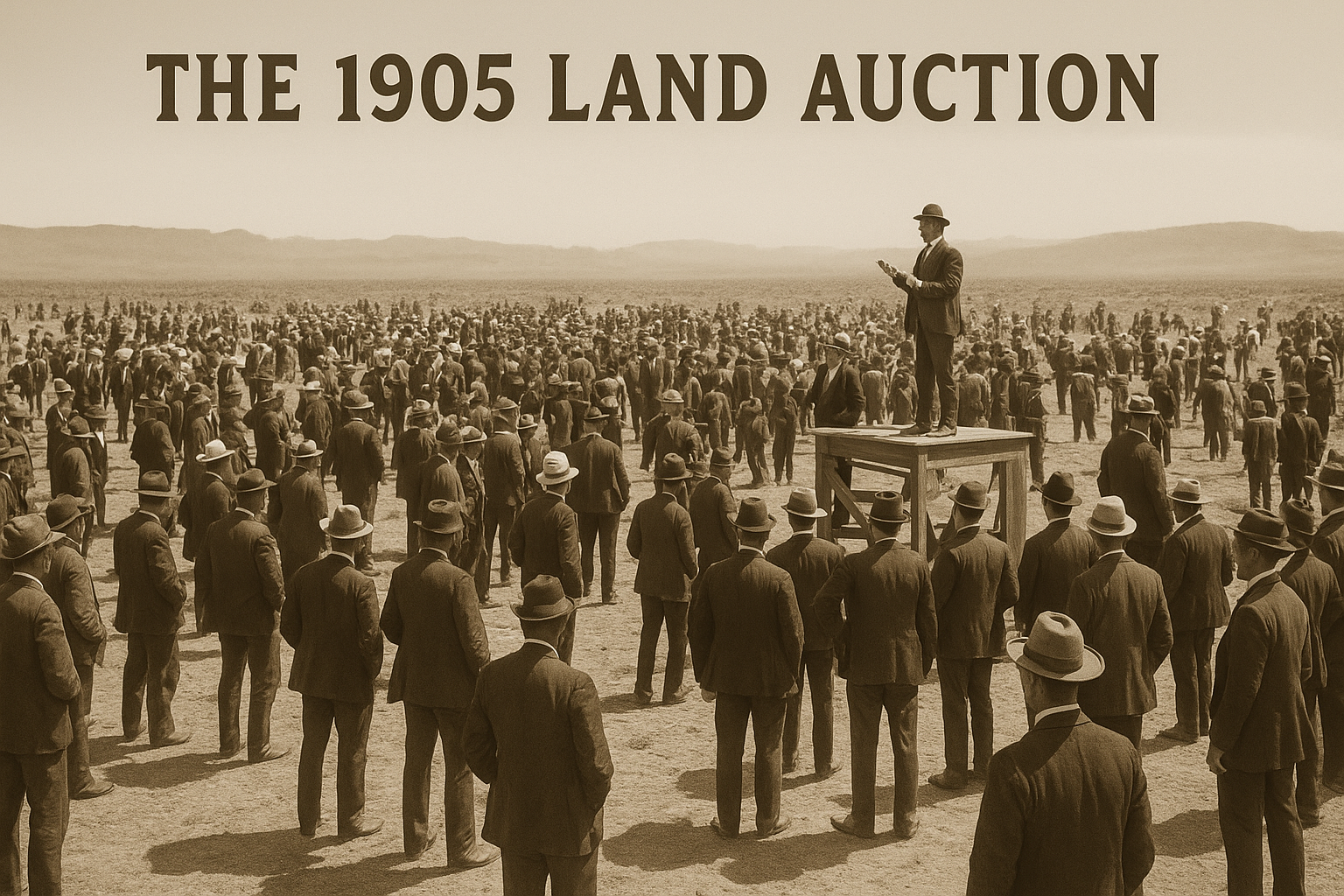
The 1905 auction is the fixed point in the history of Las Vegas that everything else is measured against, marking the moment a water stop became a proper town.
Saloons, Gambling, and Block 16
The early town organized itself quickly around the needs of railroad workers and miners. Block 16, a designated zone near the tracks, became the center of saloons, gambling dens, and other services the railroad company preferred kept off the main streets. Gambling was technically illegal in Nevada at the time, but enforcement was loose, and the activity thrived openly. By the late 1920s, Las Vegas held a small but stable population, a functioning school, and a local economy tied almost entirely to the railroad. If you walk through Downtown Las Vegas today, you are standing within a few blocks of where Block 16 once operated.
1931 to 1945: dams, divorce, and legal gambling
The year 1931 was the most consequential single year in the history of Las Vegas up to that point. Within months, Nevada legalized casino gambling, loosened its divorce laws to attract out-of-state residents, and broke ground on Hoover Dam, one of the largest construction projects in American history. Each of those three decisions sent a different wave of people into the valley, and together they turned a quiet railroad town into something with real economic momentum.
Legal Gambling and the Divorce Trade
Nevada’s legislature passed the Wide Open Gambling Act in March 1931, making Nevada the only state where casino gambling was fully legal. Las Vegas moved fast, with licensed casinos opening downtown within weeks. Around the same time, the state reduced its divorce residency requirement to six weeks, drawing thousands of Americans who wanted to end marriages without the lengthy legal battles required elsewhere. Hotels, ranches, and guest houses filled with people waiting out their six weeks, spending money on food, entertainment, and gambling the entire time.
That combination of legal gambling and easy divorce created two separate income streams that fed the local economy through the entire decade.
Hoover Dam and a New Workforce
Construction on Hoover Dam began in 1931 and employed over 5,000 workers at its peak, with thousands more living in Boulder City, just 30 miles southeast of Las Vegas. Workers rode into Las Vegas on weekends, spending their wages in the downtown casinos and bars. When the dam finished in 1935, the infrastructure it left behind, including new roads and a reliable regional power supply, made large-scale development in the valley possible for the first time. That power grid would eventually light every sign on the Strip you see today.
1946 to 1979: the Strip, the mob, and glamor
The postwar boom transformed the history of Las Vegas in ways that no railroad or dam ever could. Returning soldiers had money to spend, cars were everywhere, and Highway 91 running south of Downtown gave developers a wide-open stretch of land outside city limits, which meant fewer regulations and no city taxes. That strip of highway became the Las Vegas Strip, and what got built along it over the next three decades turned a small desert city into a global name.
Bugsy Siegel and the Flamingo
New York mobster Benjamin "Bugsy" Siegel opened the Flamingo Hotel on December 26, 1946, and the moment he did, he set a template that every resort on the Strip would follow for the next 30 years. The Flamingo was built on the idea that people would pay more for luxury surroundings, big-name entertainment, and a glamorous atmosphere than for a basic gambling hall. Siegel was murdered in 1947 before he could see it succeed, but the model he pushed survived him.
The Flamingo’s opening night flopped badly, but within months it turned a profit, proving that luxury and gambling worked together in a way that downtown sawdust-floor casinos never achieved.
Mob-connected investors from Chicago, New York, and Cleveland poured money into properties along the Strip through the 1950s and 1960s. The Sands, the Desert Inn, the Sahara, and the Riviera all opened during this period, each competing to book bigger acts and offer more lavish rooms.
Howard Hughes and the Shift Away from Mob Control
By the late 1960s, the mob’s grip on the Strip began to loosen. Howard Hughes arrived in 1966, bought multiple casino properties, and demonstrated that legitimate corporate money could own and operate Las Vegas hotels at scale. Nevada’s Corporate Gaming Act of 1969 formalized that shift, allowing publicly traded companies to hold gaming licenses and setting the stage for everything that came next.
1980 to today: megaresorts and a new identity
Corporate money transformed the history of Las Vegas after 1980 in ways that reshaped the entire American casino industry. The city moved away from mob-connected glamor toward something bigger, louder, and far more calculated: theme-park-scale resorts designed to pull in families, conventions, and international visitors all at once.
The Megaresort Era
Steve Wynn opened The Mirage in 1989, and that single property changed what a Las Vegas casino was supposed to be. It cost over $600 million to build and featured a volcano out front, tropical interiors, and exotic animals on display. The scale shocked the industry and proved that extravagance itself was a profitable business model. Within a few years, properties like Excalibur, MGM Grand, and Luxor followed, each trying to outdo the last on spectacle and square footage.
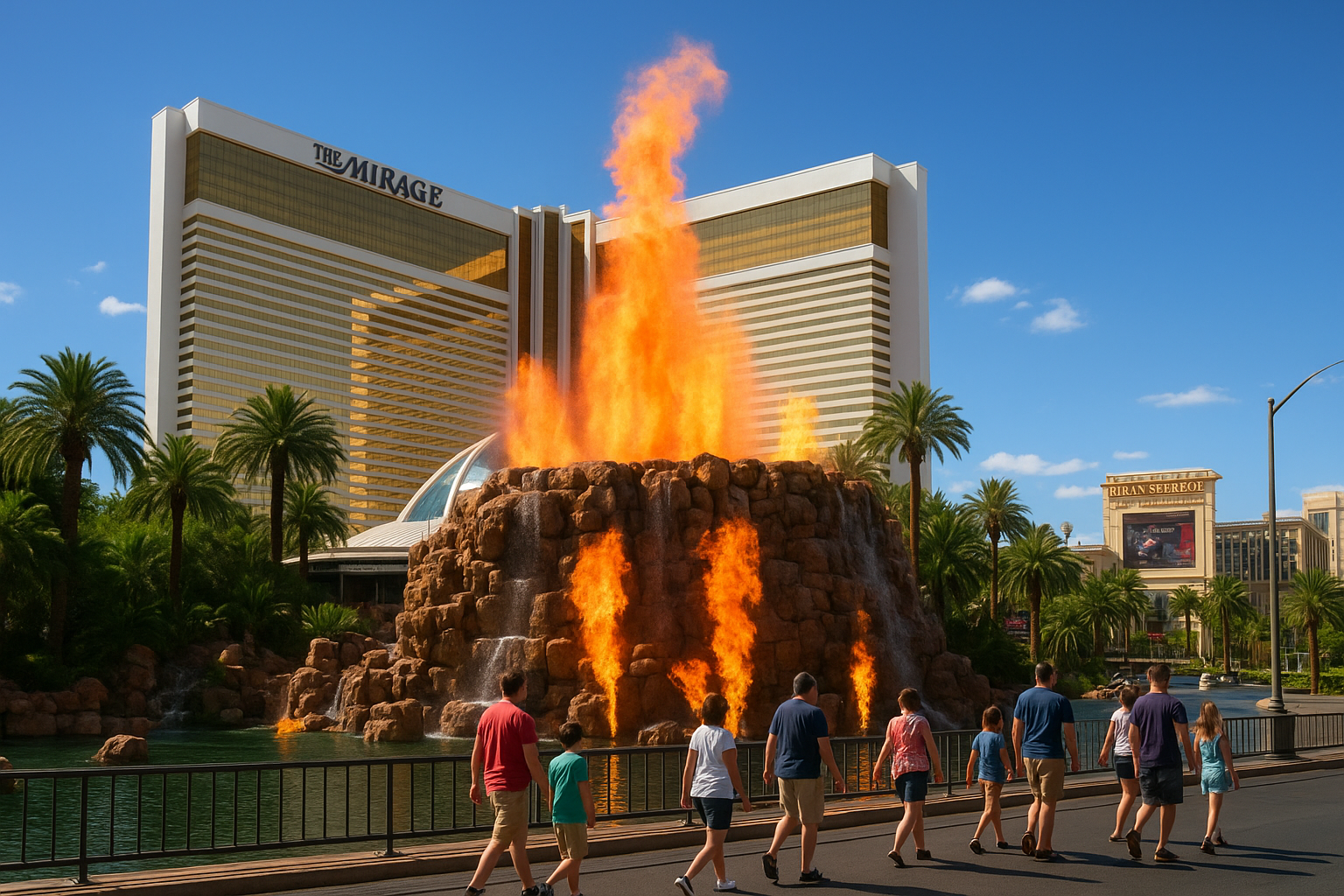
The Mirage’s opening marked a permanent shift in Las Vegas development: every resort built after it competed on experience, not just gambling.
Las Vegas Today
The economic crash of 2008 hit Las Vegas harder than almost any other American city, with construction halted mid-project and casino revenues dropping sharply. Recovery was slow but real, and it pushed the city to diversify further, adding professional sports franchises, major concert venues, and an expanded convention industry that now draws millions of visitors who may never sit at a slot machine.
Your Las Vegas today hosts the NFL’s Raiders, the NHL’s Golden Knights, and Formula 1 races on a street circuit running past the casinos. Gambling is still there, but it now shares the city with a tourism economy broad enough that no single industry defines it. The Strip you walk today reflects decisions made across more than a century, from a railroad auction in 1905 to a global entertainment brand still growing in every direction.
Putting it all together
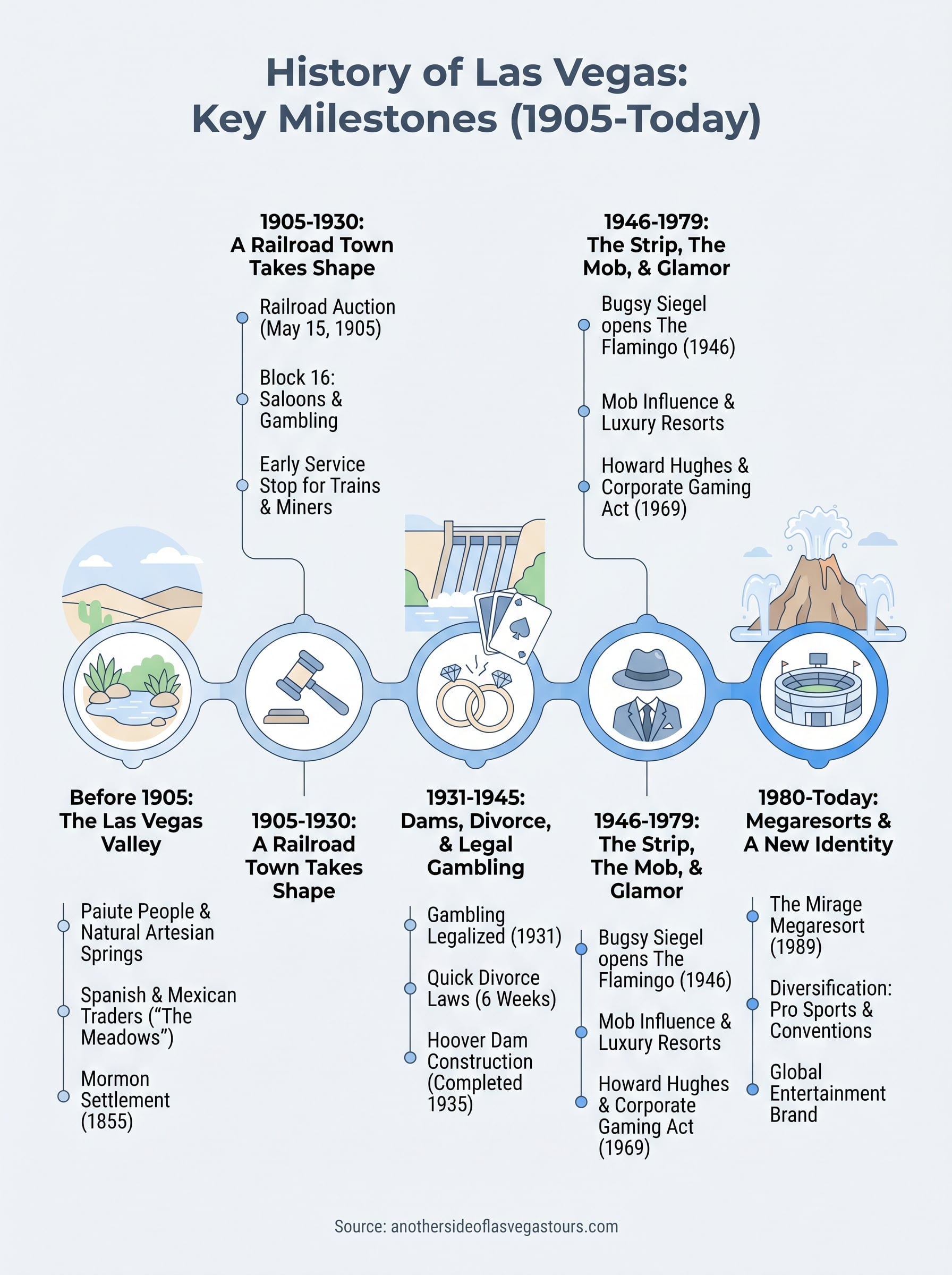
The history of Las Vegas is not a single story. It is a chain of decisions, each one building on the last, from Paiute water sources to railroad auctions to mob money to corporate megaresorts. Every layer left something behind, and you can still find those traces if you know where to look.
Walking the Strip or stepping into Downtown gives you a surface view of the city. Knowing the context turns that walk into something else entirely. You start to see why certain streets run the way they do, why certain buildings stand where they stand, and why Las Vegas keeps reinventing itself instead of settling into what it already is.
Another Side Tours has spent nearly two decades helping visitors connect with that deeper story. If you want to experience it yourself, explore our private Las Vegas tours and see the city the way its history actually shaped it.