The four-mile stretch of Las Vegas Boulevard that millions visit each year started as an empty two-lane highway cutting through the Mojave Desert. Las Vegas Strip history spans nearly a century of reinvention, from the first roadside casino in 1941 to the mega-resorts and themed towers that define the skyline today. Every building, every neon sign, every implosion along the way tells a story about ambition, risk, and constant transformation.
Understanding that history changes how you see the Strip. The fountains at Bellagio, the pyramid at Luxor, the Venetian’s canals, none of it is random. Each landmark reflects a specific era, a specific bet someone made on what Las Vegas could become. Knowing the timeline gives you context that turns a walk down the boulevard into something far more interesting than just sightseeing.
At Another Side Tours, our guides share these stories every day on our Las Vegas Strip tours, connecting the dots between decades of change that most visitors never learn about. This article walks through that full timeline, from dusty desert road to the global entertainment capital standing today, so you can appreciate what you’re really looking at next time you’re out there.
What the Las Vegas Strip is and where it is
The Las Vegas Strip is a 4.2-mile segment of Las Vegas Boulevard South that runs through the unincorporated communities of Paradise and Winchester in Clark County, Nevada. Most people assume it sits inside the city of Las Vegas, but technically it does not. The majority of the iconic hotel-casinos along the boulevard fall outside city limits, which has had real consequences for how the area developed, how it’s taxed, and how it’s governed. That detail alone is a small but telling piece of las vegas strip history that most visitors never know.
The physical boundaries of the Strip
The Strip runs roughly from the Welcome to Fabulous Las Vegas sign at the south end, near the intersection of Las Vegas Boulevard and Russell Road, to the Stratosphere Tower (now called The STRAT Hotel) at the north end, near Sahara Avenue. Hotels like Mandalay Bay, Luxor, Excalibur, New York-New York, MGM Grand, Bellagio, Caesars Palace, The Venetian, Wynn, and Encore all sit within these few miles. If you walk the full length at a casual pace, plan on roughly 90 minutes each way without stops.
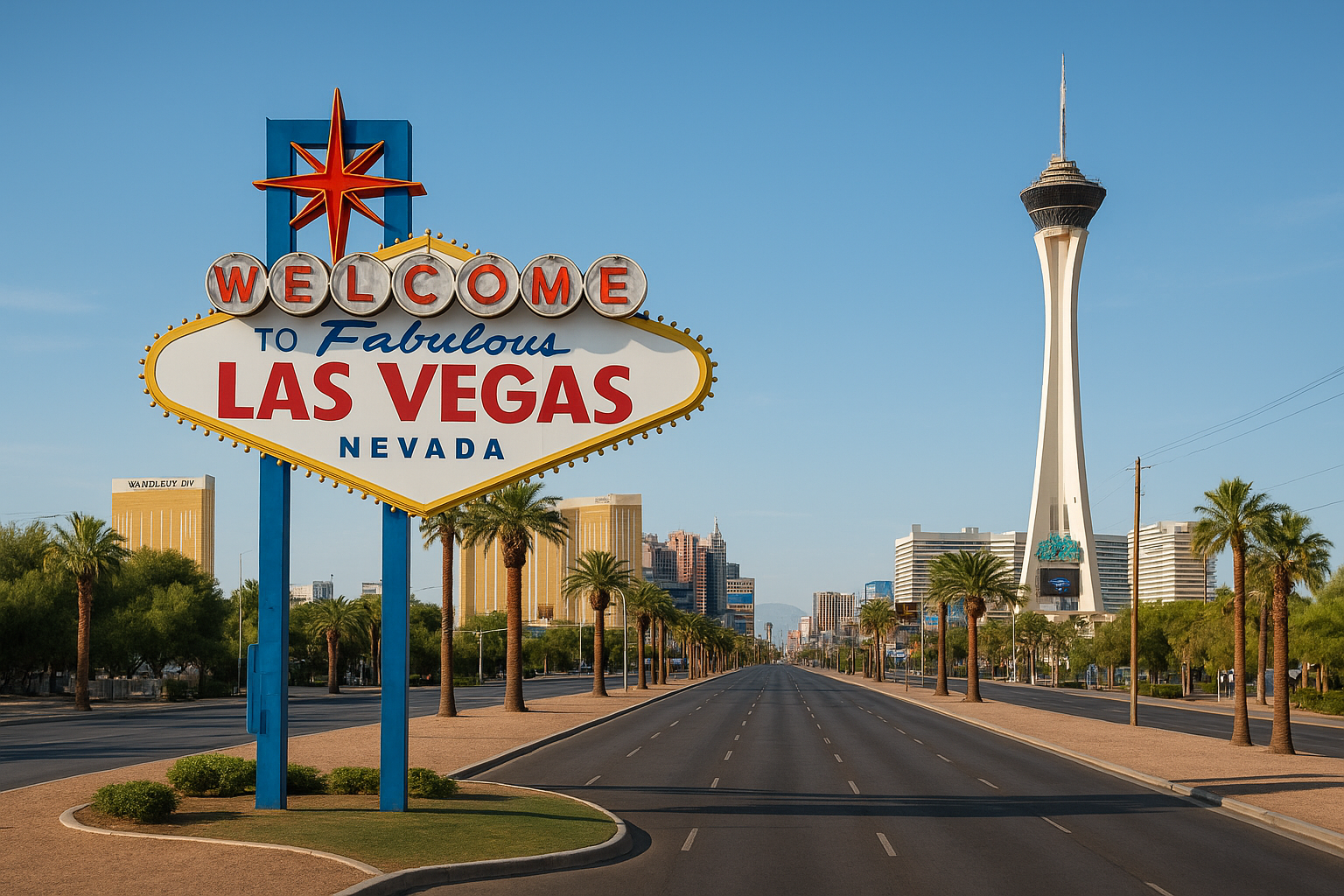
The Strip packs more hotel rooms into a single corridor than almost any other location on Earth, with over 65,000 rooms lining this stretch alone.
The boulevard itself is Las Vegas Boulevard South, but locals and visitors simply call it "the Strip." The road continues north and south beyond the Strip’s boundaries, but the term refers specifically to the high-density resort corridor. You’ll notice the character of the street changes sharply once you cross outside those informal boundaries in either direction.
How the Strip differs from downtown Las Vegas
Many first-time visitors conflate the Strip with downtown Las Vegas, but these are two distinct areas about four miles apart. Downtown sits further north, centered around Fremont Street, and represents the original gambling hub of the city. The Fremont Street Experience, the El Cortez, and the Golden Nugget are downtown landmarks, not Strip properties. Downtown developed first, and the Strip grew separately, largely as a response to county regulations that made it easier to operate casinos outside the city.
The two zones attract different types of visitors and offer different atmospheres. Downtown leans older, grittier, and more local in character, with lower table minimums and a history that predates anything on the boulevard. The Strip built its identity around spectacle, scale, and themed resort experiences that were designed to hold your attention for days at a time. Your experience in each area will feel noticeably different, even though both are central to understanding the full picture of Las Vegas as a destination.
The scale that defines it
The sheer concentration of large-scale resort hotels on the Strip makes it unlike any other entertainment district in the world. Properties like the MGM Grand hold over 5,000 rooms in a single building. The Venetian and Palazzo complex covers more than 7,000 rooms and suites. Understanding the physical scale of the Strip matters when you start exploring how it got this way, which is exactly what the rest of this timeline covers.
Why the Strip grew where it did
The Strip did not emerge in its current location by accident. Geography, politics, and regulation all pushed casino development south along Las Vegas Boulevard rather than into the city core. To understand las vegas strip history, you need to understand why entrepreneurs deliberately built outside city limits and what that decision unlocked for them.
County jurisdiction made the difference
Clark County, Nevada, governed the land south of the city, and county licensing rules were significantly looser than those inside Las Vegas proper. City officials held tighter control over gambling permits, zoning, and operating hours within city limits. Developers who wanted more freedom to build large-scale casinos without fighting city hall simply drove a few miles south and set up on county land instead.
That regulatory gap between city and county jurisdiction shaped the entire layout of modern Las Vegas, concentrating resort development in a corridor that technically sits outside the city.
Tax structures also favored unincorporated land, where property assessments and local fees ran lower than inside city limits. For investors already taking on enormous financial risk, reducing operating overhead wherever possible made the math work better. The county’s lighter touch gave early casino builders room to experiment with scale and amenity packages that city regulators might have restricted.
The road that connected everything
Highway 91, which later became Las Vegas Boulevard South, ran directly through this county-controlled land and connected Los Angeles to Las Vegas in a single drivable route. Before commercial air travel became common, most visitors to Las Vegas arrived by car from Southern California. Placing casinos directly on that highway meant capturing travelers the moment they arrived, before they could decide where to stop.
The Los Angeles market represented millions of potential customers within a day’s drive. Developers understood that visibility from the road translated directly into foot traffic, and foot traffic translated into revenue. The Strip’s location was not just politically convenient, it was a deliberate bet on the primary travel corridor of the era.
Timeline: early roots before the megaresorts
The las vegas strip history you see celebrated today rests on a foundation built by a handful of gamblers and entrepreneurs who took enormous financial risks on undeveloped desert land decades before anyone imagined what the corridor could become. Understanding those early moves explains almost everything that followed.
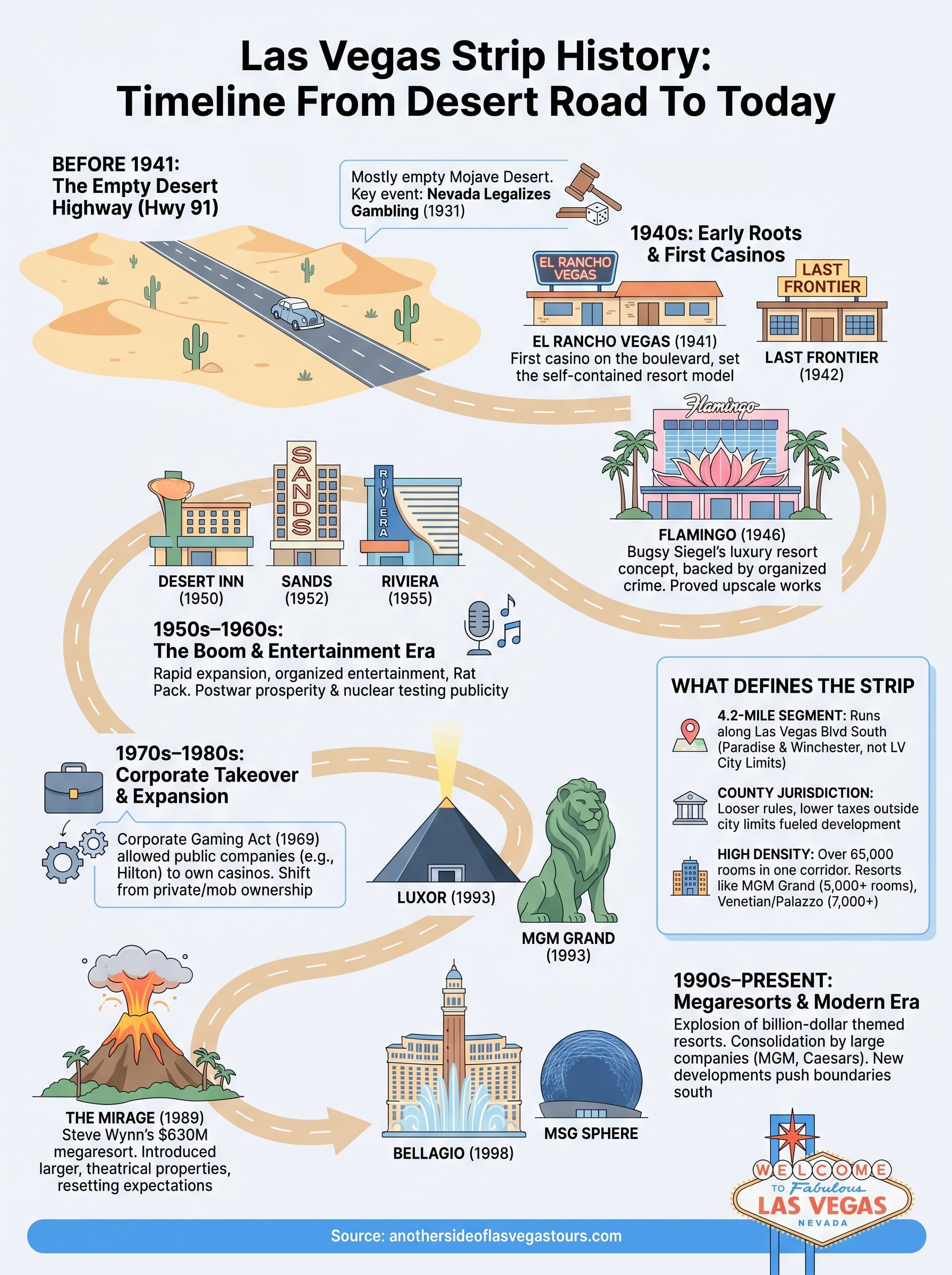
Nevada legalizes gambling in 1931
Nevada passed wide-open gambling legislation in March 1931, making it the only state in the country where casino gambling was fully legal. That single legislative act set the entire trajectory for what would happen along Highway 91 over the next 90 years. Lawmakers paired the gambling bill with a six-week residency requirement for divorce, turning Nevada into a destination for two completely different types of visitors at the same time.
The 1931 gambling bill did not create Las Vegas overnight, but it created the legal framework that made every casino on the Strip possible.
Reno and downtown Las Vegas captured most of the early action from that legislation. The Strip corridor sat mostly empty for another decade, waiting for the right combination of vision, capital, and nerve.
The first casino on the boulevard
Thomas Hull opened El Rancho Vegas in April 1941, placing it directly on Highway 91 at what is now the corner of Las Vegas Boulevard and Sahara Avenue. Hull chose the county land deliberately, and his low-rise resort model combined a hotel, casino, pool, and restaurant under one roof in a way that downtown properties had never attempted. Guests could arrive by car, park easily, and stay on the property for days without needing to go anywhere else.
The formula worked immediately. The Last Frontier followed in 1942, confirming that Hull had identified a real demand rather than a lucky accident. Both properties borrowed heavily from a Western ranch aesthetic that appealed to the road-tripping Californians who made up most of their customer base at the time. These two modest roadside resorts established the self-contained resort model that every major Strip property still uses today.
Timeline: 1940s–1960s the Strip takes shape
The decade following El Rancho Vegas produced the most consequential chapter in las vegas strip history, transforming a quiet desert highway into a recognizable entertainment corridor. Organized crime money, Hollywood glamour, and postwar prosperity collided on this stretch of boulevard during the 1940s and 1950s, producing the template that modern resort developers still follow.
Bugsy Siegel and the Flamingo
Benjamin "Bugsy" Siegel opened the Flamingo in December 1946, and the project changed everything about how people imagined Las Vegas could look. Backed by organized crime figures including Meyer Lansky, the Flamingo brought a level of luxury to the desert that nothing else on the corridor had attempted. Siegel envisioned a Miami-style resort with genuine elegance, not a roadside motel with slot machines.
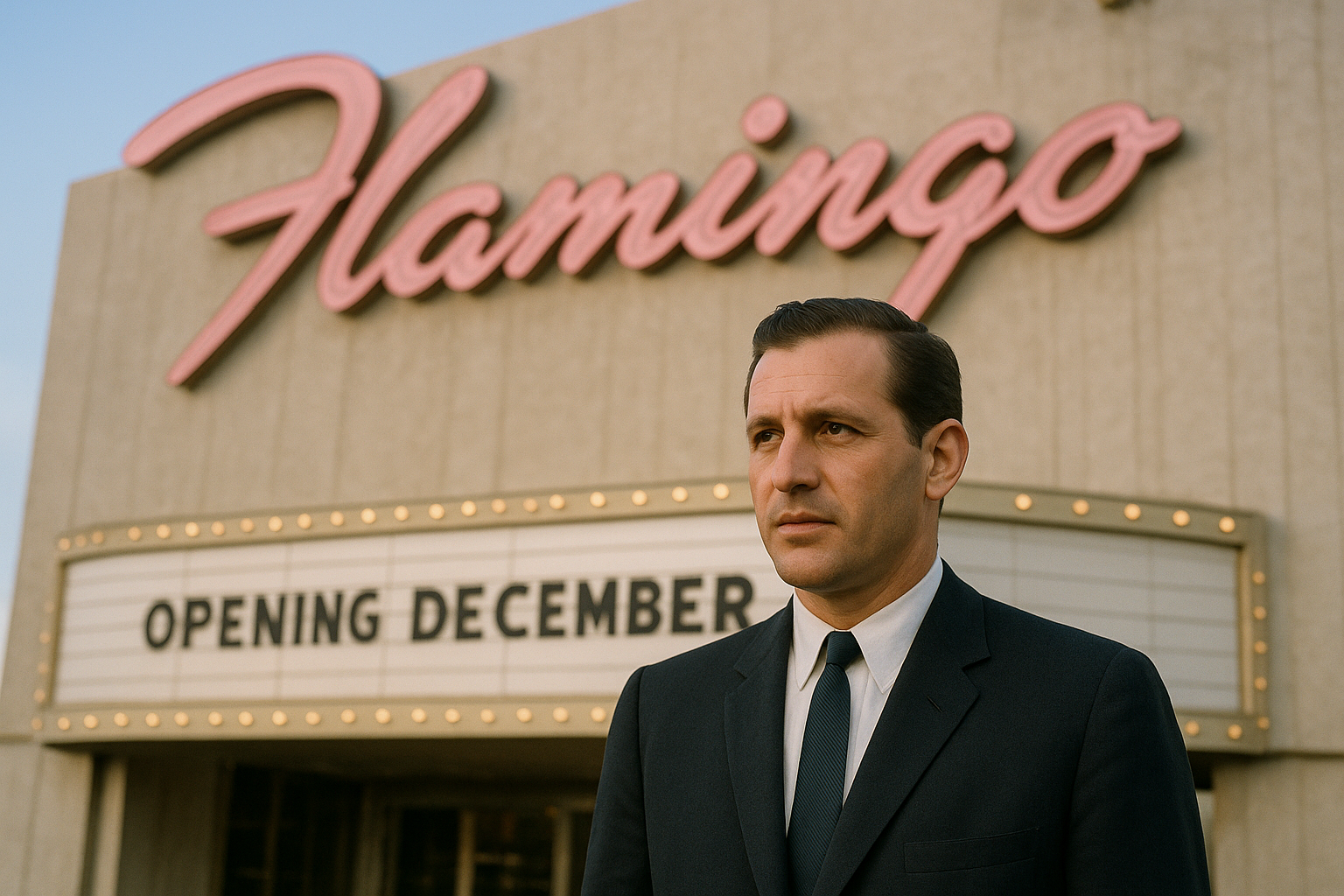
The opening was rocky. Cost overruns spiraled past $6 million, Siegel was murdered in June 1947, and the property nearly closed within months. New management steadied it, and the Flamingo turned profitable by late 1947, proving that upscale resort-casino experiences could work in the Nevada desert. Every luxury property built on the Strip since then owes something to that proof of concept.
The Flamingo’s early struggles and eventual success set the risk-and-reward pattern that defined Strip development for the next 70 years.
The 1950s boom and the arrival of organized entertainment
Through the 1950s, new properties opened in rapid succession, each trying to outdo the previous one on scale or spectacle. The Desert Inn opened in 1950, the Sands in 1952, the Riviera in 1955. The Sands became the most culturally significant of these, hosting Frank Sinatra and the Rat Pack through the late 1950s and early 1960s and cementing Las Vegas as a place where major entertainment talent performed regularly.
Television helped spread the Strip’s image nationally, and nuclear testing at the Nevada Test Site northwest of the city drew additional press coverage that kept Las Vegas in the news throughout the decade. By 1960, the Strip already had more square footage dedicated to gambling and entertainment than any other corridor in North America.
Timeline: 1970s–today reinvention and expansion
The 1970s marked a turning point in las vegas strip history, shifting control of casino properties from individual operators and mob-connected investors to publicly traded corporations. Nevada’s Corporate Gaming Act of 1969 made it legal for corporations to hold gambling licenses without requiring every shareholder to obtain individual approval, opening the door for Wall Street money to enter Las Vegas on a large scale.
The corporate takeover and the 1980s buildup
Howard Hughes had already started buying Strip properties in the late 1960s, and that pattern accelerated through the 1970s. Companies like Hilton Hotels entered the market, bringing professional management structures that replaced the old ownership models. By the 1980s, most major Strip properties operated under corporate ownership, and investment in renovation and expansion became more systematic and predictable.
That corporate shift made Las Vegas more stable but also more competitive, since hotels now had to justify their performance to shareholders rather than private backers.
Steve Wynn’s opening of the Mirage in 1989 reset expectations entirely. The Mirage cost over $630 million to build and introduced a new standard for resort amenities, including an atrium, a dolphin habitat, and a volcano that erupted nightly. It proved that bigger and more theatrical properties could generate enough revenue to justify enormous construction costs.
The 1990s megaresort explosion
The Mirage triggered a wave of billion-dollar resort openings through the 1990s. Excalibur, Luxor, MGM Grand, Treasure Island, Monte Carlo, New York-New York, Bellagio, and Mandalay Bay all opened within roughly a decade. Each property tried to deliver a total destination experience, keeping guests on-site with multiple restaurants, entertainment venues, and retail options.
2000s to today: consolidation and new ambitions
Large hospitality companies like MGM Resorts International and Caesars Entertainment consolidated ownership of multiple properties, reducing head-to-head competition between separate owners along the same corridor. More recently, new developments like the MSG Sphere and the Raiders’ Allegiant Stadium have pushed the Strip’s gravity further south, and you can see that ongoing growth firsthand on any visit today.
A quick way to experience it in person
Reading about las vegas strip history gives you a solid foundation, but walking the boulevard with someone who knows the stories behind every building turns that knowledge into something you actually feel. Every block holds a layer of history that most visitors walk past without noticing, from the footprint of a demolished casino to the architectural choices that signal a specific decade of development. Knowing what stood there before, and why it changed, makes the entire stretch more engaging.
Our guided Strip tours give you that context without requiring you to spend hours researching before you arrive. Your guide connects the timeline directly to what you see in front of you, pointing out details that only make sense once you understand how the corridor evolved. If you want that kind of experience on your next visit, check out our private Las Vegas tours and see what fits your schedule.