
Valley of Fire State Park sits about an hour northeast of the Las Vegas Strip, and it looks like another planet. Red sandstone formations twisted by 150 million years of wind and water, ancient petroglyphs carved by the Ancestral Puebloans, and wide-open desert views that make the neon glow of Vegas feel like a distant memory. If you’re searching for the best things to do at Valley of Fire, you’re already making a solid choice, this is one of the most stunning day trips from Las Vegas, period.
But with limited time and a park that covers nearly 40,000 acres, knowing where to focus matters. Some trails and overlooks are absolutely worth the stop. Others will eat your time without much payoff. At Another Side Tours, we’ve guided thousands of visitors through this park and know exactly which spots deliver. Our guides bring the context, the geology, the history, the photo angles, that turns a drive through red rocks into something you’ll actually remember.
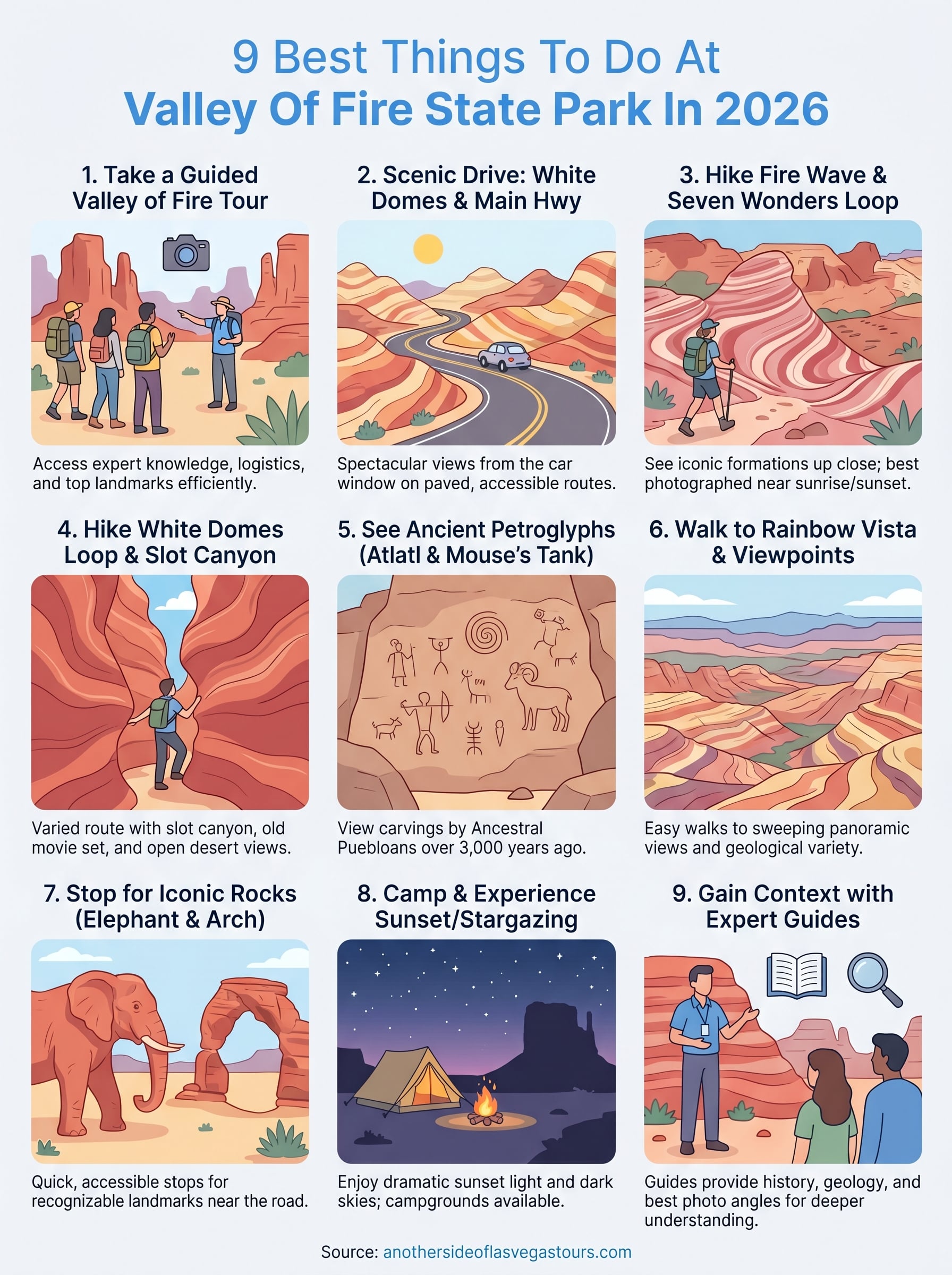
Here are nine things at Valley of Fire that are worth your time in 2026, whether you’re exploring on your own or joining us for a guided tour.
1. Take a guided Valley of Fire tour from Las Vegas
If you want to get the most out of Valley of Fire State Park without spending hours researching routes, trail conditions, and historical context, a guided tour is your smartest starting point. Another Side Tours runs dedicated Valley of Fire day trips from Las Vegas that cover the park’s top landmarks with a knowledgeable local guide who understands the geology, the Ancestral Puebloan history, and exactly where to stand for the most striking photos.
What you’ll see and do
On a guided tour, you’ll visit major landmarks like Rainbow Vista, Elephant Rock, the Atlatl Rock petroglyphs, and the Fire Wave formation, each with a guide explaining what makes the location significant. Your guide curates the route around the most rewarding stops and fills in the stories behind the red rocks so the landscape means something beyond its visual scale. You won’t burn time on spots that look impressive on a map but underwhelm in person.
A guided tour consistently covers more ground in less time than self-guided exploration, because your guide already knows parking logistics, current trail conditions, and the best timing for each stop.
Where it is and how to get there
Valley of Fire State Park sits roughly 55 miles northeast of the Las Vegas Strip via I-15 North and State Route 169. With Another Side Tours, transportation is included, so you skip the car rental, the desert navigation, and the stress of finding trailhead parking on a busy weekend.
If you drive independently, plan for a $15 per-vehicle entry fee for out-of-state vehicles and roughly one hour of driving each way from the Strip on standard roads.
Time, difficulty, and accessibility
Guided Valley of Fire tours from Las Vegas typically run 5 to 6 hours from pickup to drop-off. The physical demand is moderate, with most of the walking on paved paths and manageable uneven terrain between rock formations.
If you have specific mobility needs, contact the tour operator before booking to confirm which stops work for your group. Most major viewpoints are reachable without serious climbing or scrambling.
Safety, rules, and pro tips
One real advantage of joining a guided experience for the things to do at valley of fire is that your guide actively monitors heat, hydration, and shifting weather on your behalf. Guides also stay current on park regulations, including fire restrictions, drone prohibition zones, and which areas protect ancient petroglyphs from direct contact.
Bring at least two liters of water per person, wear closed-toe shoes, and apply sunscreen before you step out of the vehicle. Summer temperatures regularly exceed 110°F, making morning tours far more comfortable than afternoon departures.
2. Do the scenic drive on White Domes Road and the main highway
Not every great thing to do at Valley of Fire requires hiking boots. The park’s road system delivers spectacular desert scenery from your car window, and the scenic drive alone earns the trip from Las Vegas.
What you’ll see and do
White Domes Road runs through the northern section of the park and takes you past cream-colored sandstone formations that contrast sharply against the surrounding red rock. The main park highway connects the west and east entrances and threads through the most dramatic terrain in the park, including fire-red cliff faces, eroded valleys, and pull-offs with open desert views stretching toward Lake Mead.
Driving both routes back to back gives you a complete picture of the park’s geology without committing to a single long hike.
Where it is and how to get there
The main park highway begins at the west entrance off State Route 169 and runs roughly seven miles to the east entrance. White Domes Road branches north from near the Visitor Center. Both roads are paved and passable for standard passenger vehicles with no high-clearance requirement.
Time, difficulty, and accessibility
Driving both routes end to end takes 45 minutes to 1.5 hours depending on how many pull-offs you stop at along the way. This is one of the most accessible options in the park since the entire experience happens at road level with short walks to overlooks.
Safety, rules, and pro tips
Keep your speed below posted limits since wildlife, including desert tortoises and bighorn sheep, cross the road without warning. Bring water even for a car-based visit since roadside stops expose you to direct sun and heat fast.
3. Hike the Fire Wave and the Seven Wonders Loop
These two trails consistently rank among the best things to do at Valley of Fire for hikers who want more than a roadside view. Both routes reward the effort with close-up access to geological features you simply cannot see from a car window.
What you’ll see and do
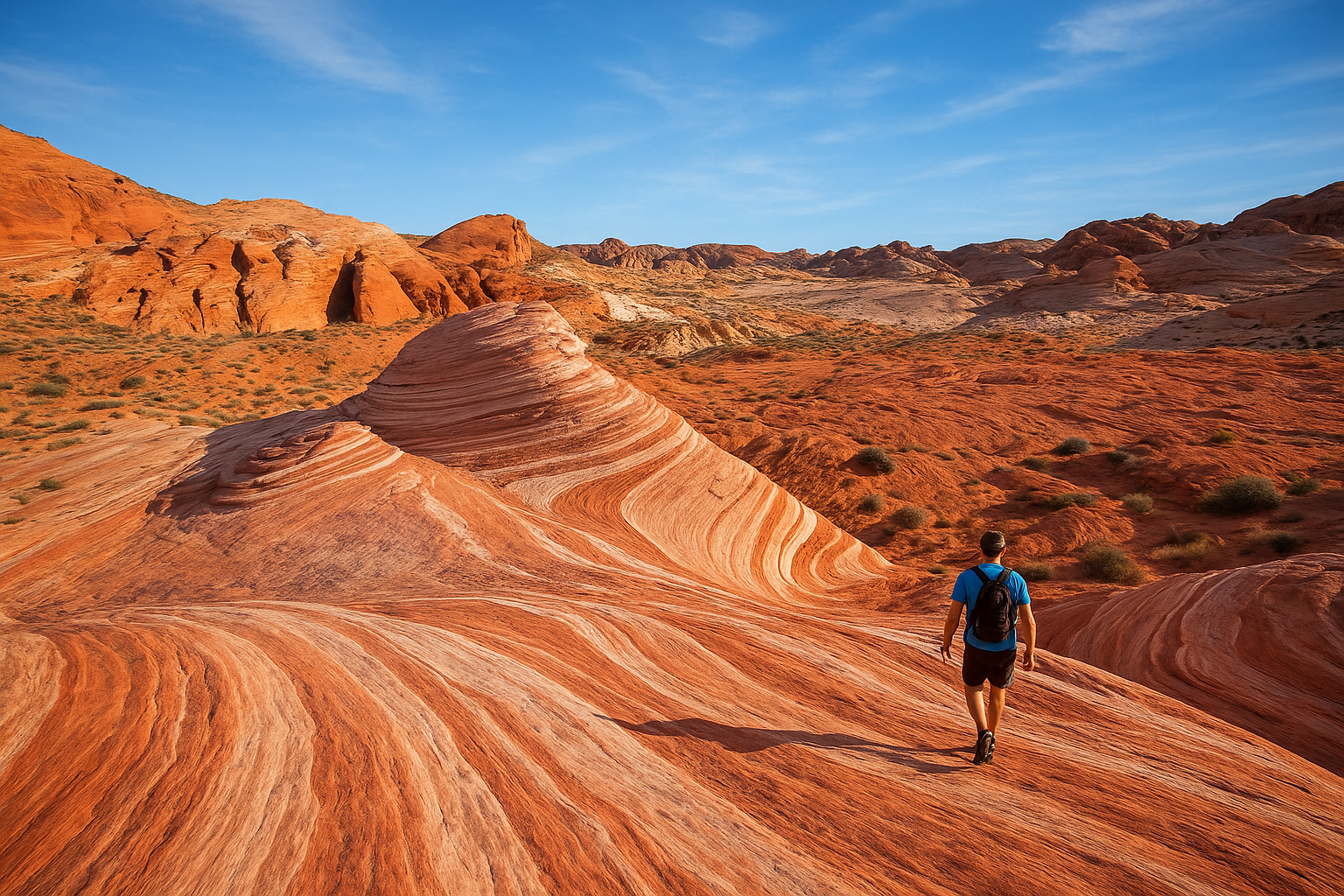
The Fire Wave is a rippled sandstone formation where swirling bands of red, pink, and white rock create the appearance of a frozen wave. It draws comparisons to the famous Wave in Arizona, but with far fewer permit restrictions. The Seven Wonders Loop connects several of the park’s most photogenic rock formations in a single route, giving you a condensed tour of the park’s highlights on foot.
The Fire Wave is best photographed in the hour after sunrise or before sunset, when low-angle light deepens the color contrast across the rock bands.
Where it is and how to get there
Both trailheads sit in the eastern section of the park, accessible via the main park highway. The Fire Wave trailhead is clearly marked near the eastern entrance. The Seven Wonders Loop starts from a separate pull-off nearby. Standard passenger vehicles handle both access roads without any issues.
Time, difficulty, and accessibility
The Fire Wave trail runs about 1.5 miles round trip and takes most visitors 45 to 90 minutes. The Seven Wonders Loop covers roughly 2.5 miles and adds an hour or more depending on your pace. Both trails involve uneven sandstone terrain with some route-finding required.
Safety, rules, and pro tips
Carry at least two liters of water per person on either hike since there is no shade on either route. Stay on marked paths to protect the fragile sandstone surface, and avoid touching the rock formations since skin oils cause long-term erosion damage.
4. Hike the White Domes Loop and slot canyon
The White Domes Loop ranks as one of the most varied things to do at Valley of Fire, packing slot canyon scrambling, ancient sand dunes, and open desert scenery into a single compact route. If you only have time for one hike in the park, this one delivers the widest range of terrain in the shortest distance.
What you’ll see and do
The loop takes you through a narrow slot canyon carved into red and white sandstone, past the ruins of an old movie set, and across open terrain with sweeping views of the surrounding formations. The contrast between the tight canyon walls and the open desert beyond makes this trail feel like two completely different hikes in one outing.
The slot canyon section is the standout stretch, narrow enough to touch both walls at once, and worth slowing down through for the best photos.
Where it is and how to get there
The White Domes trailhead sits at the northern end of White Domes Road, about five miles from the Visitor Center. Standard passenger vehicles reach the parking area without any difficulty.
Time, difficulty, and accessibility
The loop covers 1.25 miles and takes most hikers 45 to 75 minutes to complete. The terrain is uneven with some rocky scrambling through the canyon section, which makes it a moderate challenge for most visitors but manageable for anyone reasonably sure-footed.
Safety, rules, and pro tips
Carry plenty of water since the trail offers no shade on its open sections. Watch your footing through the slot canyon since the rock surface becomes slippery in spots. Avoid this trail during or after rain since flash flooding can move through narrow canyons quickly and without warning.
5. See ancient petroglyphs at Atlatl Rock and Mouse’s Tank
Visiting the petroglyphs at Atlatl Rock and Mouse’s Tank puts you face to face with rock art created by the Ancestral Puebloans and Basket Maker people over 3,000 years ago. These are among the most accessible and significant things to do at Valley of Fire for anyone interested in human history alongside the geological drama.
What you’ll see and do
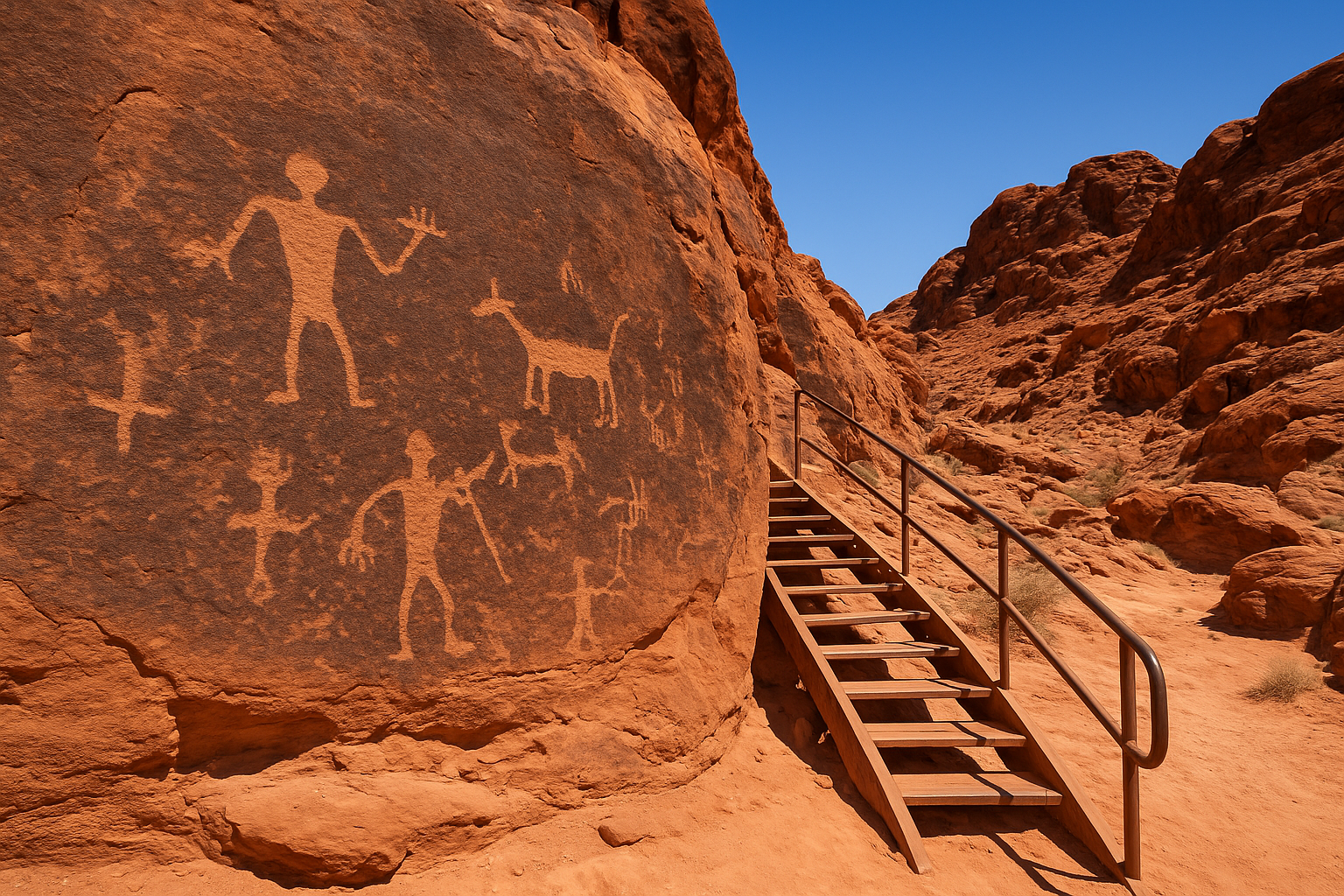
At Atlatl Rock, you climb a short staircase to reach a panel of carved images depicting humans, animals, and hunting tools called atlatls, which were spear-throwing devices used before the bow and arrow. Mouse’s Tank follows a short wash trail lined with petroglyph panels on both sides, leading to a natural rock basin that collected rainwater and sheltered a legendary Paiute outlaw named Mouse in the 1890s.
Both sites together give you a layered picture of who lived in this desert long before the first casino broke ground in Las Vegas.
Where it is and how to get there
Atlatl Rock sits near the Visitor Center on the main park highway and is clearly signed from the road. Mouse’s Tank trailhead is a short drive east along the same highway with its own dedicated parking area.
Time, difficulty, and accessibility
Both stops take 30 to 45 minutes each. The staircase at Atlatl Rock makes it less accessible for visitors with limited mobility, while Mouse’s Tank follows a flat sandy wash that works for most fitness levels.
Safety, rules, and pro tips
Never touch the petroglyph panels since skin oils accelerate erosion on the carved surfaces. Bring water for both stops since neither site offers shade during the middle of the day.
6. Walk out to Rainbow Vista and other big viewpoints
Rainbow Vista is one of the most rewarding things to do at Valley of Fire for visitors who want sweeping panoramic views without committing to a long or technical hike. The overlook delivers a wide desert canvas of layered red, orange, and pink rock stretching toward distant ridgelines, and it consistently produces strong photographs at any time of day.
What you’ll see and do
Rainbow Vista opens onto a sweeping view of the park’s multicolored sandstone formations from the end of a short walk out from its dedicated parking area. The color banding in the rock reflects different mineral compositions, with iron oxides responsible for the reds and oranges while manganese produces the lavender and purple tones scattered throughout the landscape.
This is one of the best spots in the park to step back and see the full geological scale of Valley of Fire in a single glance.
Where it is and how to get there
Rainbow Vista sits along the main park highway, roughly four miles from the east entrance. The parking area is well-marked and reachable by standard passenger vehicles with no special clearance needed.
Time, difficulty, and accessibility
The walk from parking to the viewpoint takes 10 to 15 minutes each way on a relatively flat, packed surface. Most visitors spend 30 to 45 minutes total at the stop, which makes it one of the most accessible viewpoints in the park for a wide range of fitness levels and group types.
Safety, rules, and pro tips
Bring sunscreen and at least one liter of water per person since the overlook is fully exposed to direct sun. Stay back from uneven rock edges near the viewpoint perimeter, especially when moving around to find better photo angles.
7. Stop for iconic rock formations like Elephant Rock and Arch Rock
Two of the most recognizable landmarks in the park require nothing more than a short walk from a parking area. Elephant Rock and Arch Rock are quick, rewarding stops that work for visitors of all ages and fitness levels, and both consistently earn their place on any list of things to do at Valley of Fire.
What you’ll see and do
Elephant Rock is a freestanding sandstone formation shaped unmistakably like a large elephant, complete with a defined trunk and body. It sits right off the road near the east entrance and ranks among the most photographed stops in the park. Arch Rock is a natural sandstone arch worn through by centuries of wind erosion that frames striking views of the surrounding desert through its opening.
Both formations are prime examples of how differential erosion sculpts soft sandstone into shapes that look deliberately carved over millions of years.
Where it is and how to get there
Both formations are easy to locate from the main park highway with no special navigation needed:
- Elephant Rock: Near the east entrance, visible and signed directly from the road
- Arch Rock: Inside the Arch Rock Campground area, reached via a short marked path
Time, difficulty, and accessibility
Each stop takes 15 to 30 minutes including the walk from the parking area. Both sites rank among the most accessible in the park and suit families with young children or visitors with limited mobility.
Safety, rules, and pro tips
Do not climb on either formation since the sandstone erodes quickly under foot traffic. Park rules prohibit scrambling on named rock formations, and rangers enforce this consistently. Bring water even for these brief stops since neither parking area offers shade.
8. Camp in the park or plan for sunset and stargazing
Staying past daylight is one of the most underrated things to do at Valley of Fire. Once the day-trippers leave and the desert cools down, the park transforms completely. Sunset light turns the red sandstone formations into something close to molten copper, and after dark, the skies fill with stars that are impossible to see from Las Vegas.
What you’ll see and do
The park operates two developed campgrounds, Atlatl Rock Campground and Arch Rock Campground, each offering sites with electrical hookups, water access, and restrooms. Even without camping, arriving in the late afternoon and staying for sunset delivers some of the most dramatic light the park produces all day. After dark, the park’s distance from city lights makes it one of the better spots in Nevada for naked-eye stargazing.
Sunset at Rainbow Vista or near the Fire Wave trailhead produces color in the rock that photographs look almost too saturated to be real.
Where it is and how to get there
Both campgrounds sit inside the park boundaries along the main highway and White Domes Road, reachable by standard passenger vehicles with no special clearance required.
Time, difficulty, and accessibility
Sunset visits require no physical exertion beyond reaching your chosen viewpoint. Camping reservations through the Nevada State Parks system open well in advance, so book early for spring and fall weekends, which fill quickly.
Safety, rules, and pro tips
Temperatures drop sharply after sunset even in summer, so bring a layer regardless of the afternoon heat. Keep all food secured since wildlife is active at night throughout the park.
Final take
Valley of Fire State Park packs more variety into a single day than most people expect. You get ancient petroglyphs, slot canyons, sweeping overlooks, and geological formations that took millions of years to build, all within an hour of the Las Vegas Strip. The things to do at Valley of Fire covered in this guide give you a solid framework for planning your visit, whether you have a half day or a full one.
That said, the park rewards people who arrive with context. Knowing why the rock turns that particular shade of red, or what the Ancestral Puebloans were depicting in those carved panels, makes every stop land differently. If you want that layer of depth without doing the research yourself, our guides handle it for you. Book a private Valley of Fire tour and spend your day actually experiencing the park instead of navigating it.