
Valley of Fire vs Red Rock Canyon comes down to scenery versus convenience. Choose Valley of Fire for the most dramatic red rock, the best short walks, and photos that look like another planet. Choose Red Rock Canyon if you are short on time, want longer hikes, or are visiting in summer. If you can spare a full day, you can see both.
Both are red sandstone country within a day trip of the Strip, but they are different places. Valley of Fire State Park, about 50 miles northeast of Las Vegas, is Nevada’s oldest state park and a compact maze of fiery Aztec sandstone. Red Rock Canyon National Conservation Area sits about 17 miles west of the Strip and wraps a 13-mile scenic loop beneath towering cliffs.
We have guided visitors to both since 2007, so this comparison comes from the road, not a map. Below you will find a side-by-side table, a decision guide, a hike comparison, season and crowd advice, and a plan for doing both.
Why the choice between the two parks matters
The choice matters because the two parks ask for different amounts of your time and reward different kinds of visitors. Valley of Fire vs Red Rock Canyon is a one-hour drive against a 25-minute drive, and a concentrated color show against a long mountain wall. Pick wrong and you either lose half a day or leave underwhelmed.

The two parks side by side
This table puts the practical facts in one place. Fees and reservation rules change, so confirm them on the official park pages before you go.
| Valley of Fire State Park | Red Rock Canyon NCA | |
|---|---|---|
| Distance from the Strip | About 50 miles northeast | About 17 miles west |
| Typical drive | About 1 hour | About 25 to 30 minutes |
| Managed by | Nevada State Parks | Bureau of Land Management |
| Main draw | Red and white sandstone, short walks, petroglyphs | 13-mile scenic loop, tall cliffs, longer hikes |
| Typical visit | 3 to 4 hours | 2 to 3 hours for the loop, a full day for hiking |
| Entry | Per-vehicle fee, no timed reservation | Per-vehicle fee, timed entry for the loop in peak season (roughly October through May) |
| Federal passes | Not accepted | America the Beautiful pass accepted |
Two rows matter most. Drive time decides how much of your day the trip eats, and timed entry decides whether you can show up on a whim. In peak season a Red Rock visit without a reservation can end at the gate, while Valley of Fire lets you arrive whenever you like.
Valley of Fire costs you an hour each way. Red Rock costs you a reservation.
What you actually see at each park
Valley of Fire puts its best features in a small area. Elephant Rock, the Beehives, the petroglyphs at Atlatl Rock, the striped Fire Wave and the White Domes are all a short drive apart along Mouse’s Tank Road and the main park road. The color is saturated, with reds, oranges, pinks and whites often in the same rock face.
Red Rock works on a bigger scale. The Calico Hills near the entrance are the reddest stretch, and farther around the loop the cliffs shift to tan, cream and gray. Expect scale and variety instead of constant fire. Overlooks like High Point and Red Rock Overlook show how far the escarpment runs, and the park is a favorite with climbers and road cyclists.
How to choose the right park for your trip
Choose the park that matches how much time you have and what you want to do when you get out of the car. Both are worth visiting. If you can only pick one for a first trip, Valley of Fire gives you more visual payoff per hour on site, and Red Rock gives you more payoff per hour in the car.
Match the park to what you want
Use this list as a quick filter.
- First visit, one half-day, big photos: Valley of Fire.
- Kids or mixed fitness levels: Valley of Fire, where most highlights are under two miles round trip.
- Serious hiking, scrambling or climbing: Red Rock Canyon.
- A late start or a flight to catch: Red Rock Canyon, which is close enough for a morning or afternoon.
- Visiting in summer: Red Rock Canyon, and go early.
- Already heading toward Lake Mead, Hoover Dam or Utah: Valley of Fire fits that route better.
Our straight recommendation
If you have five or six hours and one park, go to Valley of Fire. The Fire Wave, Mouse’s Tank Road and the formations near the park’s east side deliver the red-rock scenery most people imagine when they search for this trip. It is worth the drive.
If you have under four hours total, or you want a proper hike, go to Red Rock Canyon. You can be on a trail within half an hour of leaving the Strip, which no other major red rock site near the city can match.
One park for scenery, the other for time: the right answer depends on which you have less of.
Valley of Fire vs Red Rock Canyon hikes
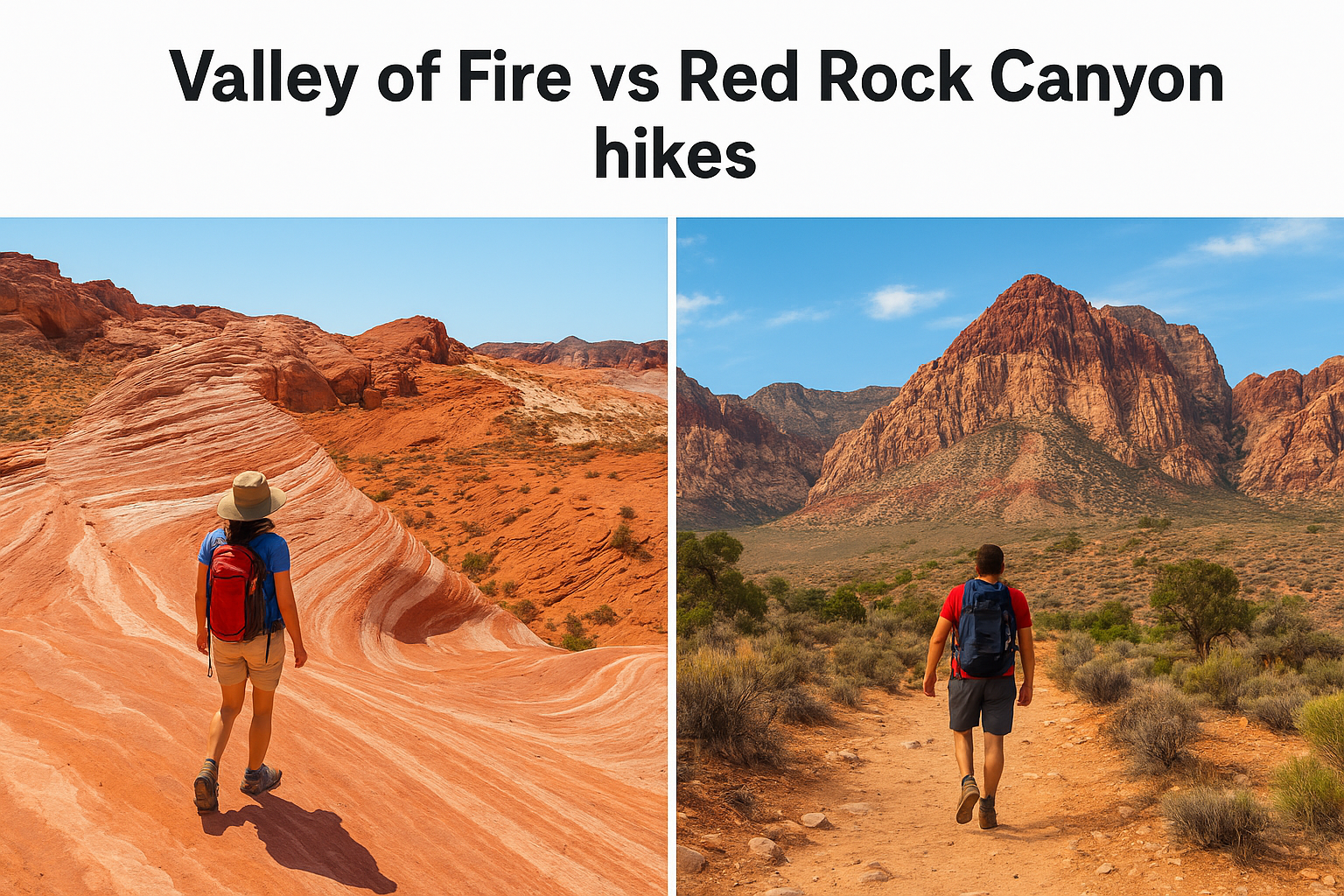
Valley of Fire offers short, scenic walks, and Red Rock Canyon offers longer, more demanding hikes. Red Rock has more total trail mileage, with dozens of trails, while Valley of Fire’s walks are shorter but lead to more distinctive destinations.
Hike comparison at a glance
Distances below are approximate round-trip figures. Check current trail conditions before you set out.
| Hike | Park | Distance | Difficulty |
|---|---|---|---|
| Mouse’s Tank | Valley of Fire | About 0.7 miles | Easy |
| Fire Wave | Valley of Fire | About 1.5 miles | Easy to moderate, sandy in places |
| White Domes loop | Valley of Fire | About 1.25 miles | Easy to moderate, includes a slot canyon section |
| Calico Tanks | Red Rock Canyon | About 2.5 miles | Moderate, some scrambling |
| Pine Creek Canyon | Red Rock Canyon | About 3.7 miles | Moderate |
| Turtlehead Peak | Red Rock Canyon | About 5 miles | Strenuous, steep and exposed |
The pattern is clear. Valley of Fire’s best hikes can be stacked into one morning, while Red Rock’s best hikes each take a real chunk of the day.
What each park does best for hikers
Valley of Fire suits people who want a reward every twenty minutes. You can walk the Fire Wave, drive to the White Domes, and still have time for Elephant Rock. Sand makes even short trails slower than they look, so wear shoes with grip.
Red Rock suits people who want to be tired at the end. Turtlehead Peak climbs to views over the whole Las Vegas valley, and Pine Creek Canyon offers shade and a change in vegetation. If your group includes a strong hiker and a casual walker, Valley of Fire keeps both happy, and Red Rock splits them up.
Valley of Fire hikes are short and spectacular. Red Rock hikes are longer and earned.
Weather, crowds and entry rules by season
Cooler months are best for both parks, and summer decides the matter in Red Rock’s favor. From roughly October through April, temperatures at either park are comfortable for walking. In summer, Valley of Fire vs Red Rock Canyon stops being a close call.
Heat and the best time to go
Valley of Fire sits in an exposed basin with little shade, and summer highs regularly top 100°F. Park managers can close trails during extreme heat, so check the park’s current notices before you drive out. Red Rock sits higher than the Strip, so it usually runs a few degrees cooler, but it is still a desert.
If you visit in summer, start at sunrise, carry at least a liter of water per person for every hour you plan to hike, and be off the trail by late morning. Neither park has gas stations or restaurants inside, so fill the tank and pack food before you leave the city.
Crowds, parking and reservations
Red Rock’s scenic loop usually requires a timed entry reservation during peak season, roughly October through May, so book ahead on the official site and arrive inside your window. Once you are on the loop you can stay as long as you like, but leaving and re-entering is not guaranteed.
Valley of Fire has no reservation system, but its parking lots are small. The lots at the Fire Wave and White Domes fill by mid-morning on weekends and holidays. Arrive early or on a weekday and you will often have the formations nearly to yourself. Cell coverage can be patchy at Valley of Fire, so download your map before you leave.
The best crowd strategy at both parks is the same: arrive early and go midweek.
How to see both parks without a rushed day
You can see both in one long day, but it works only with an early start and a tight plan. The drive between them is well over an hour, so expect roughly four hours at each park at most, with a lot of driving in between.
A one-day plan for both
Start at Valley of Fire at opening time, when the light is soft and the lots are empty. Walk the Fire Wave, drive Mouse’s Tank Road, and stop at Elephant Rock. Then head back toward Las Vegas and book a mid-afternoon Red Rock entry window for the scenic loop. The cliffs glow in late light, and the loop is easy to finish in two hours.
In cooler months this plan is comfortable. In summer it is not, so choose one park instead.
Driving yourself or booking a guide
If you rent a car, you control the pace, but you handle the reservation, the fuel and the navigation. Skip rideshare for these trips, since pickups from either park are unreliable. A private guide solves the logistics, adds geology and history you would not get on your own, and lets you linger where you want. We run private Valley of Fire tours with hotel pickup, and a custom tour can combine Red Rock, Valley of Fire and a stop like Hoover Dam.
Two common mix-ups
Red Rock Canyon near Las Vegas is not the Red Rock Canyon State Park in California, which is a different park hundreds of miles away. And Red Rock Canyon is not a substitute for the Grand Canyon. The Grand Canyon is a mile deep and far larger, so plan it as its own trip.
Do both in one day only if you start early and the weather is mild.
Which park should you pick?
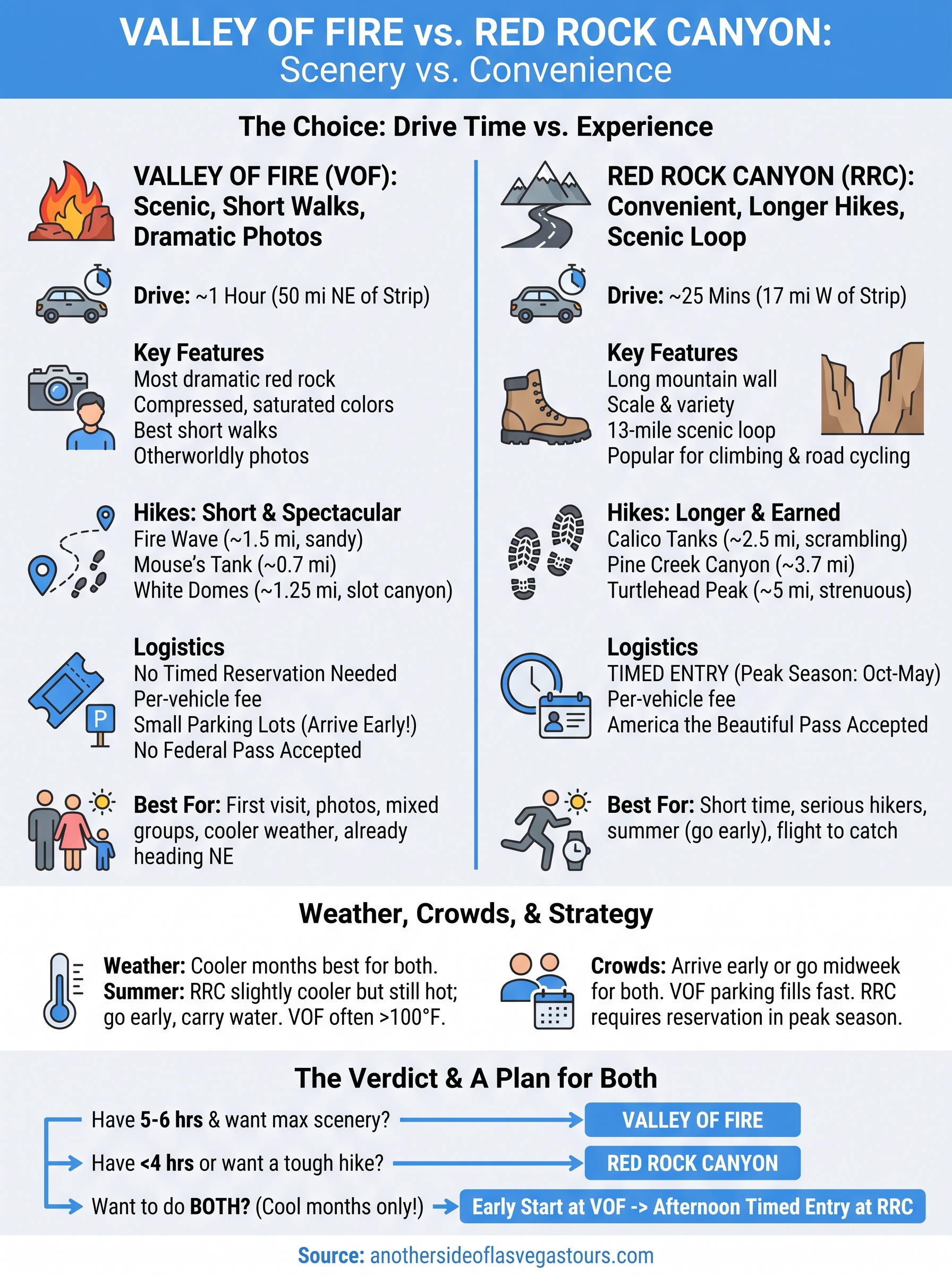
Pick Valley of Fire if you want the most striking red rock, short and rewarding hikes, and you can spare an hour each way. Pick Red Rock Canyon if you are short on time, want a harder hike, or are visiting in summer. Do both only with an early start and a booked Red Rock entry window.
If you would rather not manage the drive, the reservations or the heat, let a local guide handle it. You can book a private Valley of Fire day trip and spend your energy on the Fire Wave instead of the road.