
You’re standing in your hotel room looking at a map, trying to figure out if how far is Zion National Park from Las Vegas actually works for a day trip. It’s a fair question, since Vegas gets marketed as a gateway to the Grand Canyon and Hoover Dam, but Zion doesn’t always make that same list even though it’s one of the most striking parks in the Southwest.
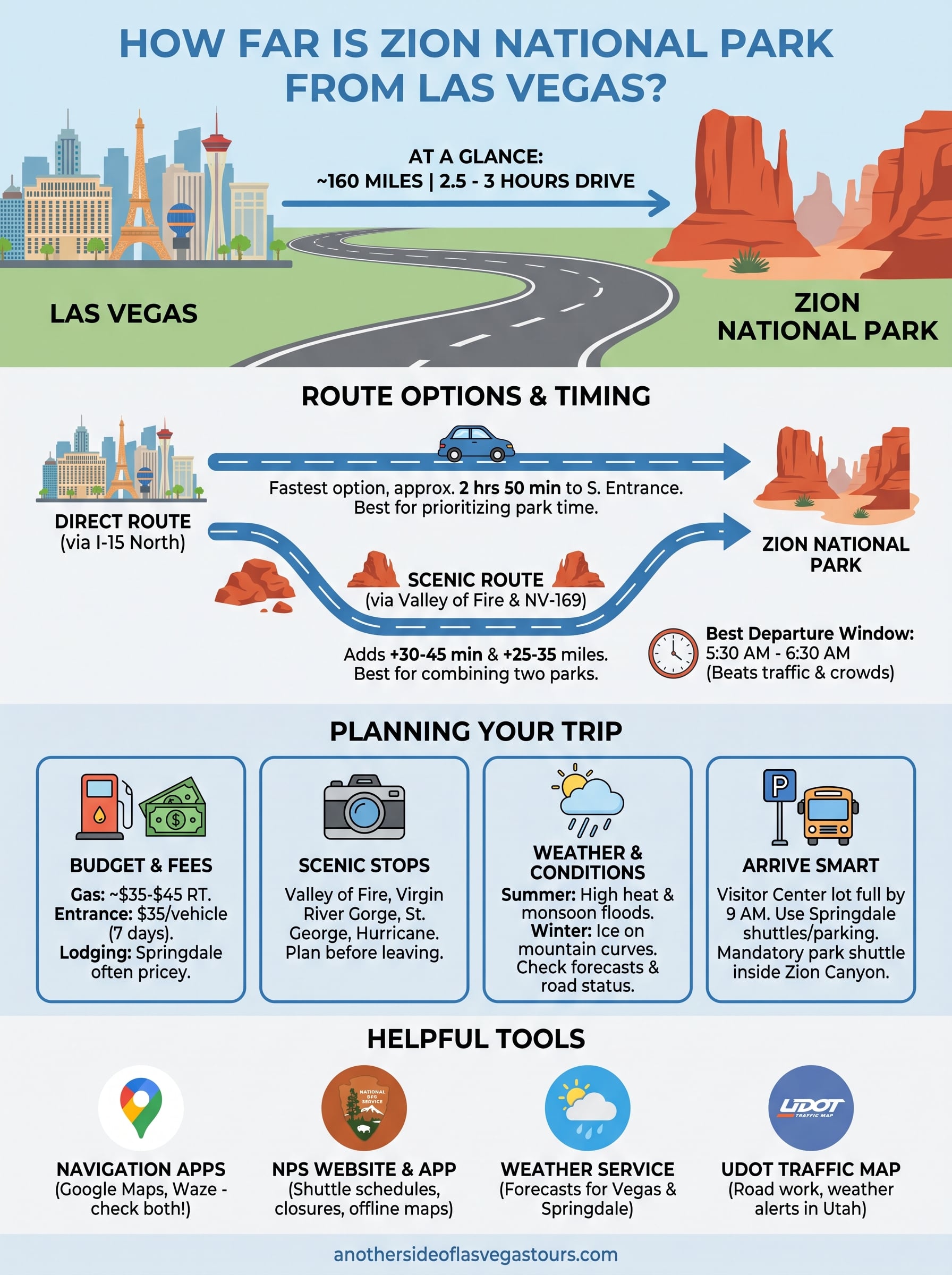
Here’s the short answer: Zion sits roughly 160 miles northeast of Las Vegas, and you’re looking at about 2.5 to 3 hours of driving depending on your route and how much traffic you hit leaving the city. That distance puts it within reach for a long day trip, though an overnight stay lets you actually enjoy the canyon instead of rushing back for dinner reservations.
In this guide, we’ll break down the exact route options, including the fastest highway path versus the more scenic drive through Utah’s back roads, plus realistic timing considerations for stops, park entry, and traffic on I-15. We’ll also cover what to expect once you arrive, so you can decide whether this trip fits your schedule or if you’re better off pairing it with other nearby stops like the much shorter drive to Valley of Fire.
Zion National Park distance and drive time at a glance
Getting a straight answer on Zion’s distance from Las Vegas takes more digging than it should, since most travel sites give you a vague range instead of real numbers. From the Las Vegas Strip to Zion Canyon Visitor Center, you’re covering 158 to 172 miles depending on which entrance you use and which highway you take out of the city. That translates to a driving window of 2 hours 40 minutes to 3 hours 15 minutes under normal conditions, not counting stops for gas, snacks, or that one scenic overlook everyone pulls off for.
The numbers you need
Breaking down the trip by starting point and destination gives you a clearer picture than a single average number ever could. Here’s how the major routes compare:
| Starting Point | Destination | Distance | Drive Time |
|---|---|---|---|
| Las Vegas Strip | Zion Canyon Visitor Center | 168 miles | 2 hrs 50 min |
| Las Vegas Strip | Zion East Entrance (Mt. Carmel) | 172 miles | 3 hrs 5 min |
| Harry Reid Airport | Zion Canyon Visitor Center | 165 miles | 2 hrs 45 min |
| Downtown Las Vegas | Springdale, UT | 160 miles | 2 hrs 40 min |
Springdale sits right outside the park’s south entrance, which is why most drivers treat it as the practical finish line rather than the visitor center itself. If you’re staying off the Strip in Henderson or Summerlin, add or subtract 10 to 15 minutes depending on which side of town you’re on.
Plan on three hours behind the wheel each way, and Zion becomes a realistic day trip instead of a gamble.
Why the drive feels longer (or shorter) than expected
Traffic on I-15 north of Las Vegas is the biggest wildcard in this equation. Weekend mornings between 8 and 10 a.m. see a steady stream of drivers heading the same direction you are, especially during summer when Zion’s visitation peaks. Construction zones near the Utah-Nevada border have also become a recurring headache in recent years, sometimes adding 15 to 20 minutes to what should be a straightforward stretch. Checking the Nevada Department of Transportation’s travel alerts before you leave can save you from an unpleasant surprise.
Speed limits work in your favor for most of the trip, though. Long sections of I-15 through the Arizona strip and into Utah run at 80 mph, which is faster than you’ll find on most interstates in the country. That stretch alone can shave 15 to 20 minutes off your total time compared to routes with lower posted limits. Once you exit onto UT-9 toward the park, expect slower speeds through Hurricane and La Verkin, small towns with reduced limits and the occasional stoplight.
Day trip vs overnight
Whether you attempt this as a Zion day trip from Las Vegas or build in an overnight stay depends on how much time you actually want inside the park versus in the car. A day trip gives you roughly 5 to 6 hours at Zion if you leave Vegas by 6 a.m. and plan to be back by midnight, which is enough time to hike Riverside Walk, catch the shuttle up Zion Canyon, and grab a meal in Springdale. Yet six hours barely scratches the surface if you’re hoping to tackle Angels Landing or The Narrows, both of which demand a half day on their own.
Zion’s popularity has made lodging in Springdale tight and pricey, so booking ahead matters if you decide to stay over. An overnight trip also opens up early morning access to the park before tour buses and shuttle lines pile up, which changes the entire experience. If you’re weighing Zion against a shorter outing, our team at Another Side Tours can help you compare it with closer options like the quick hop out to Red Rock Canyon or the Valley of Fire before you commit a full day to the drive.
Step 1. Choose your route from Las Vegas
Before you punch an address into your phone, decide what kind of drive you actually want. Vegas to Zion National Park breaks down into two realistic paths: the fast interstate shot straight up I-15, or a slower back-road option through Valley of Fire and Overton that trades speed for scenery. Neither route is wrong, but picking the right one changes your whole day.
The direct route via I-15
Most drivers take I-15 North the entire way, crossing into Arizona for a brief 29-mile stretch through the Virgin River Gorge before entering Utah near St. George. This route is the fastest option on the map, and it’s also the one Google Maps defaults to when you search Las Vegas to Zion. You’ll exit onto UT-9 near Hurricane, then wind through La Verkin and Springdale before reaching the park’s south entrance. Gas stations and fast food line the interstate the whole way, so you’re never far from a bathroom break or a coffee refill.
Stick to I-15 if your priority is time in the park, not time on the road.
The scenic route through Valley of Fire
Drivers with a few extra hours often swap the highway for NV-169 through Valley of Fire State Park, then reconnect with I-15 near Mesquite. This path adds roughly 30 to 45 minutes to your total trip, but it runs through red rock formations that rival anything you’ll see later in Zion itself, and it ranks among the most photogenic drives leaving Las Vegas. It’s a smart pick if you’re combining destinations rather than racing to a single one.
| Route | Extra Distance | Extra Time | Best For |
|---|---|---|---|
| Direct via I-15 | None (baseline) | None (baseline) | Day-trippers on a tight schedule |
| Scenic via Valley of Fire | +25 to 35 miles | +30 to 45 minutes | Travelers who want two parks in one day |
Mixing routes on the way back
Returning drivers sometimes flip the script, taking I-15 up to Zion in the morning and looping back through Valley of Fire at sunset when the light hits the sandstone best. Combining both directions this way turns a single destination trip into a two-park day without adding much complexity to your route. If you’re still deciding between a self-guided drive and a structured outing, Another Side Tours runs guided trips into Valley of Fire State Park that pair well with a Zion trip planned for another day.
Step 2. Decide when to hit the road
Timing your departure matters almost as much as picking a route, since the same 160-mile drive can feel completely different depending on when you leave. Leaving Las Vegas at the wrong hour turns a 3-hour trip into something closer to 4, especially once you factor in Zion’s own entrance lines during peak season. Getting this piece right is often the difference between a smooth day trip and one that eats into your evening plans.
The best departure window
Most seasoned drivers leave Vegas between 5:30 and 6:30 a.m., which clears the city before rush hour and gets you into Zion before the park’s shuttle lines stretch past the visitor center. Arriving early also means better luck with parking at the main lot near the south entrance, which fills by 9 a.m. during summer weekends. If you’re not a morning person, pushing departure to 7:30 or 8 a.m. still works, but expect a busier park and a tighter window before sunset forces you back on the road.
Leave before sunrise and you’ll beat both the Vegas traffic and the Zion crowds in one move.
Weekday versus weekend traffic
Weekdays consistently beat weekends for this drive, since I-15 north of Las Vegas carries noticeably less regional traffic on Tuesdays through Thursdays. Saturdays and Sundays bring a steady stream of Utah and Arizona residents making their own day trips to Zion, which backs up both the highway and the park entrance itself. Here’s how the timing typically plays out:
| Day/Time | Drive Conditions | Park Crowds |
|---|---|---|
| Weekday, early morning | Light traffic | Moderate |
| Weekday, midday | Light to moderate | Busy |
| Weekend, early morning | Moderate traffic | Busy |
| Weekend, midday | Heavy traffic | Very busy |
Seasonal timing shifts everything
Summer heat changes the calculation too, since temperatures in the canyon regularly hit 100 degrees by early afternoon. Fall and spring departures give you more flexibility, since a 9 a.m. start still lands you in comfortable hiking weather, which is one reason those months top any season-by-season look at when to visit Zion. Winter trips flip the script entirely, with shorter daylight hours meaning you’ll want to leave by 7 a.m. at the latest to avoid driving UT-9’s mountain curves after dark. If you’d rather skip the calendar math altogether, booking a guided outing through Another Side Tours takes the timing decisions off your plate entirely.
Step 3. Budget for gas, fees, and lodging
Money matters as much as time when you’re calculating how far Zion National Park is from Las Vegas, since the 320-mile round trip adds up fast once you factor in fuel, park fees, and a possible overnight stay. Knowing these numbers ahead of time keeps you from getting surprised at the entrance gate or scrambling for a hotel room at 4 p.m.
Fuel costs for the round trip
Gas prices along I-15 run close to the national average, though stations in Mesquite and St. George tend to be cheaper than anything you’ll find on the Strip. A standard sedan getting 30 miles per gallon burns roughly 10.5 gallons for the 320-mile round trip, which lands somewhere between $35 and $45 depending on current prices. Larger SUVs or rental vans should budget closer to $55 to $65 for the same distance.
Entrance fees and passes
Zion charges a standard entrance fee at the gate, and knowing your options before you arrive saves a few minutes of decision-making at the booth.
| Pass Type | Cost | Valid For |
|---|---|---|
| Private vehicle | $35 | 7 days |
| Motorcycle | $30 | 7 days |
| Individual (foot/bike) | $20 | 7 days |
| America the Beautiful annual pass | $80 | 12 months, all national parks |
If you’re already planning a trip out to the Grand Canyon or other national parks this year, the annual pass pays for itself after two visits.
A single national parks annual pass covers Zion, the Grand Canyon, and nearly every other federal park you’ll visit this year.
Lodging if you stay overnight
Springdale hotels book up fast and charge accordingly, with summer rates for a basic room often starting around $180 to $250 a night. Options thin out the closer you get to the park entrance, so travelers on a budget sometimes stay in Hurricane or St. George instead, where rates drop by $40 to $60 but add 15 to 20 minutes to your morning drive. Comparing this cost against a day trip’s gas and time tradeoff helps decide which approach actually fits your budget.
Skipping the guesswork
Guided tours fold most of these variable costs into one upfront price, which some travelers prefer over tracking gas receipts and comparing hotel listings. If a packaged trip sounds easier than managing the math yourself, you can compare the best Zion tours leaving Las Vegas to see what transportation and planning cost in one booking.
Step 4. Plan scenic stops along the way
Stretching that 160-mile drive with a few well-chosen stops turns a straight shot into an actual road trip, and it doesn’t have to cost you much time if you plan the stops before you leave rather than pulling off on a whim. Scenic pull-offs along I-15 and UT-9 give you a reason to stretch your legs, and several of them offer views that rival what you’ll see once you’re inside the park itself.

Virgin River Gorge
Right after you cross into Arizona, I-15 cuts through the Virgin River Gorge, a narrow canyon carved by the river that’s easy to miss if you’re not watching for it. There’s no dedicated overlook, but the highway itself runs low enough through the rock walls that you get a real sense of the terrain without leaving your lane. Drivers with extra time sometimes park at one of the rest areas just past the gorge to snap photos before continuing north toward St. George.
A five-minute pull-off at the right overlook does more for a road trip than another hour of driving ever will.
St. George and Hurricane
St. George works as a natural halfway point, with enough gas stations, coffee shops, and fast food to cover any last-minute needs before the final stretch into Utah’s back roads. Hurricane, about 20 minutes further, marks your turn onto UT-9 and makes a good spot for a quick bathroom break before the twisting drive into Zion Canyon. Both towns sit close enough to the interstate that stopping costs you 10 minutes at most.
Quick-reference stop list
Here’s a rundown of the stops most drivers find worth the detour, roughly in order from Las Vegas:
- Valley of Fire State Park (if taking the scenic route): red rock formations and short hikes, 30 to 45 minutes off route
- Virgin River Gorge overlook: brief photo stop, 5 to 10 minutes
- St. George: gas, food, and last-chance shopping, 15 to 20 minutes
- Hurricane: final bathroom break before UT-9, 5 to 10 minutes
Weighing detours against your schedule
Working these stops into your day trip means leaving Vegas a little earlier than the bare minimum, especially if you’re also aiming for a full afternoon inside the park. Guided options solve this trade-off automatically, since a driver who knows the route can time the stops without cutting into your park hours, which is exactly how the day trips through Another Side Tours are built.
Step 5. Prepare for weather and road conditions
Weather along the Las Vegas to Zion route swings harder than most drivers expect, since you’re climbing in elevation and crossing three states in under three hours. Zion Canyon sits around 4,000 feet, well above Vegas’s valley floor, which means temperature and conditions can shift dramatically between where you start and where you park. Checking forecasts for both ends of the drive, not just your destination, keeps you from getting caught off guard by a storm that never touched the Strip.
Summer heat and monsoon storms
July and August bring flash flood warnings to southern Utah with little notice, and Zion closes trails like The Narrows the moment water levels spike. Afternoon monsoon storms typically build fast between 1 and 4 p.m., so an early departure from Vegas isn’t just about beating crowds, it’s about finishing your hike before the sky turns. Highway visibility can also drop fast during a monsoon cell on I-15 near St. George, so easing off cruise control during a downpour beats pushing through at 80 mph.
A flash flood warning means turn around, not push forward, no matter how close you are to the trailhead.
Winter ice and mountain curves
Winter flips the risk from heat to ice, particularly on UT-9 as it climbs toward the park entrance through Hurricane and La Verkin. Snow rarely sticks on I-15 itself, but the elevation gain near Zion Canyon can leave patches of ice on shaded curves well after Vegas streets have dried out completely. Slowing down through this stretch and giving yourself extra following distance matters more than usual, since guardrails are sparse in a few of the tighter turns.
Checking conditions before departure
Building a quick pre-drive checklist saves you from discovering a closure 100 miles into the trip:
- Check the National Park Service’s Zion conditions page for trail and road closures
- Review Utah’s UDOT traffic map for construction or weather alerts on UT-9
- Glance at the extended forecast for both Las Vegas and Springdale, not just one or the other
- Pack an extra layer even in summer, since canyon mornings run cooler than the drive over
Guides who run this route regularly build these checks into their planning automatically, which is part of why a booked trip through Another Side Tours removes one more variable from a drive that already has plenty.
Step 6. Arrive smart and beat the crowds
Getting to the south entrance is only half the battle, since Zion’s parking situation turns ugly fast once the main lot fills up. The park runs a mandatory shuttle system through most of the year, meaning your car doesn’t actually go into Zion Canyon at all. Knowing this ahead of time changes how you plan your last 30 minutes of driving, since circling for a spot near the visitor center wastes exactly the daylight you drove three hours to use.

Parking and shuttle logistics
Springdale offers several paid lots within walking distance of the shuttle stop, which beats waiting for a spot to open inside the park itself. Here’s how the options typically break down:
- Zion Canyon Visitor Center lot: free, but full by 9 a.m. on summer weekends
- Springdale town shuttle lots: paid, usually $20 to $25 for the day, rarely full
- Springdale street parking: limited, best for early arrivals before 8 a.m.
Riding the free town shuttle from Springdale into the park adds maybe 10 minutes but saves you the frustration of hunting for a legal spot.
Timing your arrival at the gate
Hitting the entrance gate before 8 a.m. keeps your line short and your parking odds decent, especially between May and September when visitation peaks. Showing up at 11 a.m. instead often means a 20 to 30 minute wait just to get through the booth, on top of whatever time you lose finding parking afterward. Distance from Vegas to Zion National Park matters less than what time you actually roll up to that gate.
Arriving by 8 a.m. buys you more usable park time than any shortcut on the drive itself.
Beating the crowds once inside
Once you’re through the gate, the shuttle line at the visitor center becomes the next bottleneck, particularly for anyone heading up-canyon toward The Narrows or Angels Landing. Riders who arrive before 9 a.m. typically board within 10 minutes, while afternoon arrivals sometimes wait 45 minutes or longer during peak season. Splitting your day so you tackle the busiest trailheads first, then save easier stops like the Human History Museum for early afternoon, keeps you moving instead of standing in line, and it helps to know which Zion viewpoints and trails are worth your hours before you board. Travelers who’d rather skip this logistics puzzle entirely often let a guide handle the timing, which is exactly the kind of planning built into day trips run through Another Side Tours.
Helpful tools for planning your drive
A handful of apps and websites make this trip far easier to plan than piecing together directions on your own, and most of them are free. Getting comfortable with a couple of these tools before you leave Las Vegas beats troubleshooting a closed road or a full parking lot once you’re already committed to the drive.
Navigation and traffic apps
Google Maps handles the Las Vegas to Zion route well enough for basic turn-by-turn directions, but it doesn’t always flag construction zones on I-15 near the Utah-Arizona border in real time. Waze tends to catch these updates faster since it relies on crowdsourced reports from drivers already on the road, which matters most during peak summer travel when delays pop up without warning. Running both apps side by side for a few minutes before departure gives you a more complete picture than trusting either one alone.
Two apps checked before you leave beat one app trusted blindly at mile marker 30.
Park-specific planning resources
The National Park Service’s Zion website posts current shuttle schedules, trail closures, and entrance wait times, and it’s worth bookmarking rather than searching fresh every time. The NPS app also lets you download offline maps for the canyon, which matters since cell service inside Zion is spotty at best. Checking this site the morning of your trip, not the night before, catches any last-minute changes to shuttle hours or seasonal closures.
Weather and road condition checks
A quick glance at the National Weather Service forecast for both Las Vegas and Springdale rounds out your pre-drive checklist, since conditions can differ sharply between the two. Combine that with the UDOT traffic map mentioned earlier and you’ve covered the two biggest variables on this route: weather and road work.
Booking and reservation tools
| Tool | Best For |
|---|---|
| Recreation.gov | Timed-entry passes, permit lotteries for popular trails |
| NPS Zion app | Offline maps, shuttle schedules, alerts |
| Google Maps / Waze | Real-time traffic and route comparisons |
| UDOT traffic map | Utah-side construction and weather alerts |
If juggling four different apps sounds like more effort than the drive itself, that’s exactly the gap a guided trip fills. Another Side Tours builds these checks into every outing, so you show up and let someone else watch the traffic app.
The final stretch to Zion
So, how far is Zion National Park from Las Vegas? Roughly 160 miles and three hours, a distance that turns a bucket-list park into something you can actually fit into a Vegas trip without sacrificing your whole itinerary. The math isn’t complicated once you break it down: pick your route, leave early, budget for gas and fees, and check conditions before you go. None of these steps demand special skill, just a little planning the night before.
What trips people up isn’t the drive itself, it’s the guesswork around timing and logistics that eats into actual park time. If you’d rather skip the spreadsheet and let someone else handle the traffic apps, shuttle schedules, and departure windows, a guided option solves that instantly. Browse Another Side Tours’ award-winning private tours and let a local expert handle the driving while you enjoy the canyon.