
If you’re comparing grand canyon west rim vs south rim, you’re probably staring down a limited Las Vegas itinerary and trying not to waste a full day on the wrong drive. Both rims show you the same canyon, but they deliver completely different trips in terms of distance, scenery, and cost, and picking wrong means either a rushed afternoon or hours in the car you didn’t plan for.
Here’s the short answer: West Rim sits about two hours from the Strip, costs less in travel time, and gives you the Skywalk and Hualapai culture, while South Rim is a 4.5 to 5 hour drive but delivers the classic, jaw-dropping canyon views and National Park scenery most people picture when they hear
Why the rim you choose changes your entire trip
Most visitors assume the Grand Canyon is the Grand Canyon, and any rim will scratch the same itch. That assumption costs people entire vacation days. The West Rim and South Rim sit roughly 200 miles apart as the crow flies, and they were shaped by completely different histories, land management, and tourism infrastructure. Choose the wrong one for your priorities and you’ll either burn your whole day driving or stand at an overlook wondering why it doesn’t look like the postcards.
The distance problem nobody mentions
Geography is the first thing that trips people up. West Rim sits on Hualapai Nation land, about a two-hour drive from the Las Vegas Strip, which makes it the default choice for anyone doing a Las Vegas day trip without a rental car reservation or a week to spare. South Rim, the one that shows up in nearly every Grand Canyon photo you’ve ever seen, sits inside Grand Canyon National Park proper and takes 4.5 to 5 hours to reach from Las Vegas, each way. That’s not a detail you skim past. It’s the difference between a half-day excursion and a trip that eats your entire vacation day, plus part of the next one if you’re not flying out.
The rim you pick isn’t a minor preference, it’s the single decision that determines whether your Grand Canyon day feels relaxed or rushed.
Different canyon, different feel
Scenery is where the two rims really part ways. West Rim gives you dramatic overlooks, the glass-bottomed Skywalk, and a cultural layer you won’t find anywhere else, since the Hualapai Tribe owns and operates the land. South Rim gives you the sweeping, layered vistas and old-growth pine forest that most people picture when they hear "Grand Canyon," plus the infrastructure of a full National Park, including visitor centers, ranger talks, and marked trails. If you’ve built up an image in your head from documentaries or a bucket-list photo, there’s a good chance that image is South Rim, not West Rim. Knowing that before you book saves you from disappointment on the ground.
Time you’ll actually spend versus time you plan for
Here’s what catches first-timers off guard: the drive time isn’t the only variable. A West Rim day trip from Las Vegas typically runs 7 to 8 hours round trip, door to door, which fits neatly into a single day without wrecking your schedule. South Rim trips, once you add the drive, a reasonable amount of time actually at the rim, and stops along the way, often stretch past 12 hours if you’re doing it by car, or a shorter but pricier window if you fly. Neither option is wrong, but they demand different things from your itinerary, your energy, and your budget. A family with young kids and an early flight home has a very different answer than a couple with a rental car and no schedule pressure. That’s the real reason this decision deserves more than a coin flip, and it’s exactly what the rest of this comparison will help you sort out.
How to decide between West Rim and South Rim
Deciding between the two rims comes down to answering a handful of honest questions about your trip, not about which canyon is "better." Time on the ground matters more than most travelers admit when they’re booking. If you’ve got one day in Las Vegas carved out for the canyon and you need to be back for dinner reservations or a show, West Rim is the practical answer almost every time. If you’re building a multi-day Southwest itinerary or you’re a first-time visitor who wants the canyon you’ve seen in every calendar photo, South Rim earns the extra hours.
Match the rim to your travel style
Consider how you actually like to travel before you lock in a booking. Families traveling with young kids or grandparents usually do better with West Rim’s shorter drive and simpler pacing. Groups chasing bragging rights, serious photography, or a full National Park experience with hiking trails and ranger programs should budget the extra time for South Rim.
- Choose West Rim if you have one day, want the Skywalk, or are traveling with kids or older adults
- Choose South Rim if you want classic postcard views, plan to hike, or have two or more days available
- Choose either if budget is tight, since both offer options under $250 per person for a standard guided day trip
If you’re deciding purely on time and convenience, West Rim wins. If you’re deciding on scenery and bucket-list authenticity, South Rim wins.
When budget breaks the tie
Budget often settles the argument when the schedule doesn’t. West Rim day trips from Las Vegas run cheaper on average, since the shorter drive means less fuel, less guide time, and lower tour pricing overall. South Rim trips cost more, especially if you fly, but you’re paying for a genuinely different experience, not just a longer drive to the same overlook.
Ask yourself one final question
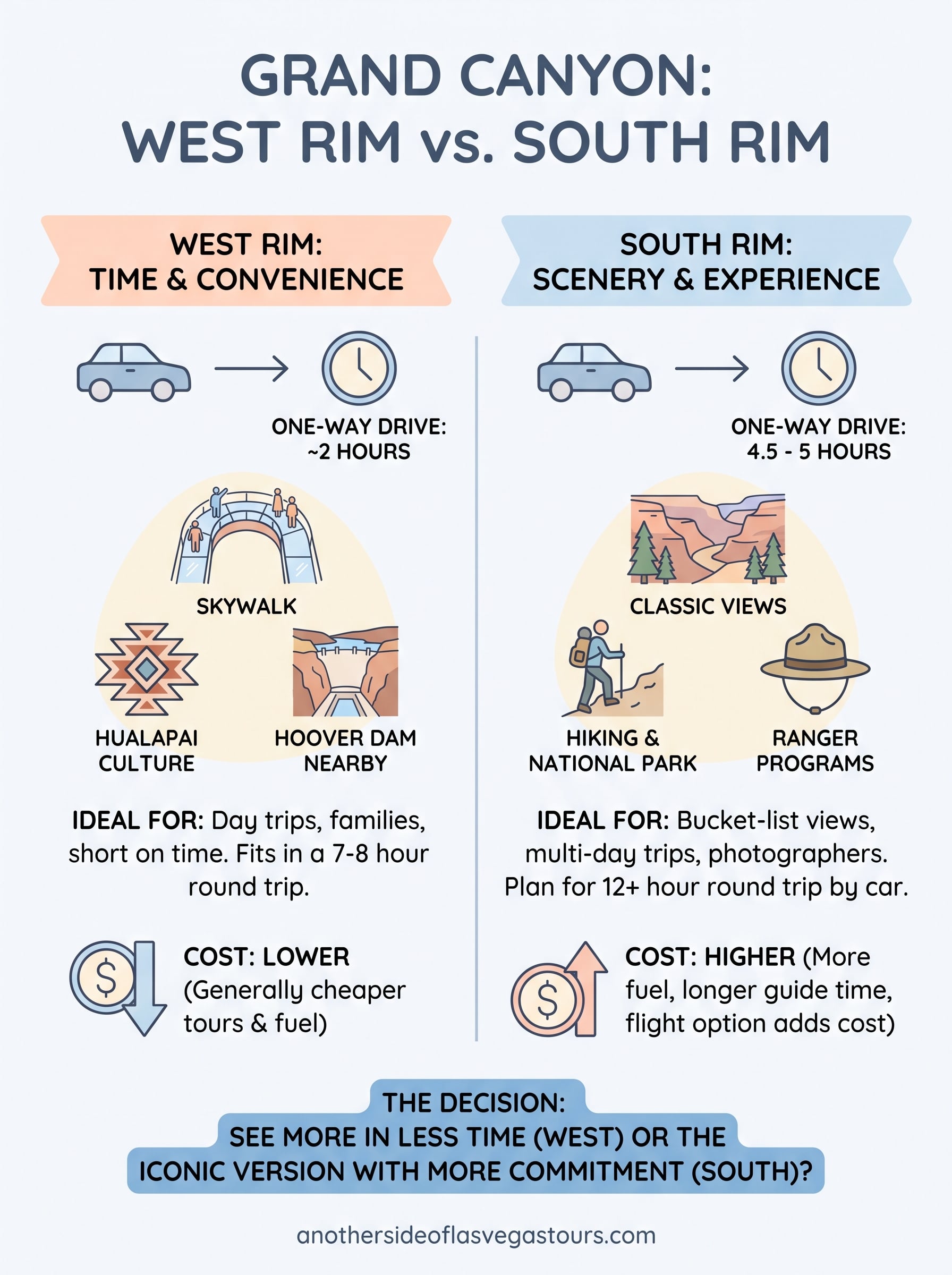
Guesswork disappears once you ask a single question honestly: would you rather see more of the canyon in less time, or the most iconic version of the canyon with a bigger time commitment? Answer that, and the rest of the planning gets a lot easier, which is exactly what the next section breaks down in hard numbers.
Comparing distance, cost, and travel time from Las Vegas
Numbers settle arguments faster than opinions, so here’s the side-by-side breakdown you actually need before you book anything. Mileage and drive time are the two figures that matter most, since they dictate everything else about your day, including what time you wake up and whether you’re eating dinner on the Strip or in a gas station parking lot somewhere in Arizona.
The hard numbers side by side
Looking at these figures together makes the trade-off obvious in a way paragraphs can’t quite capture.
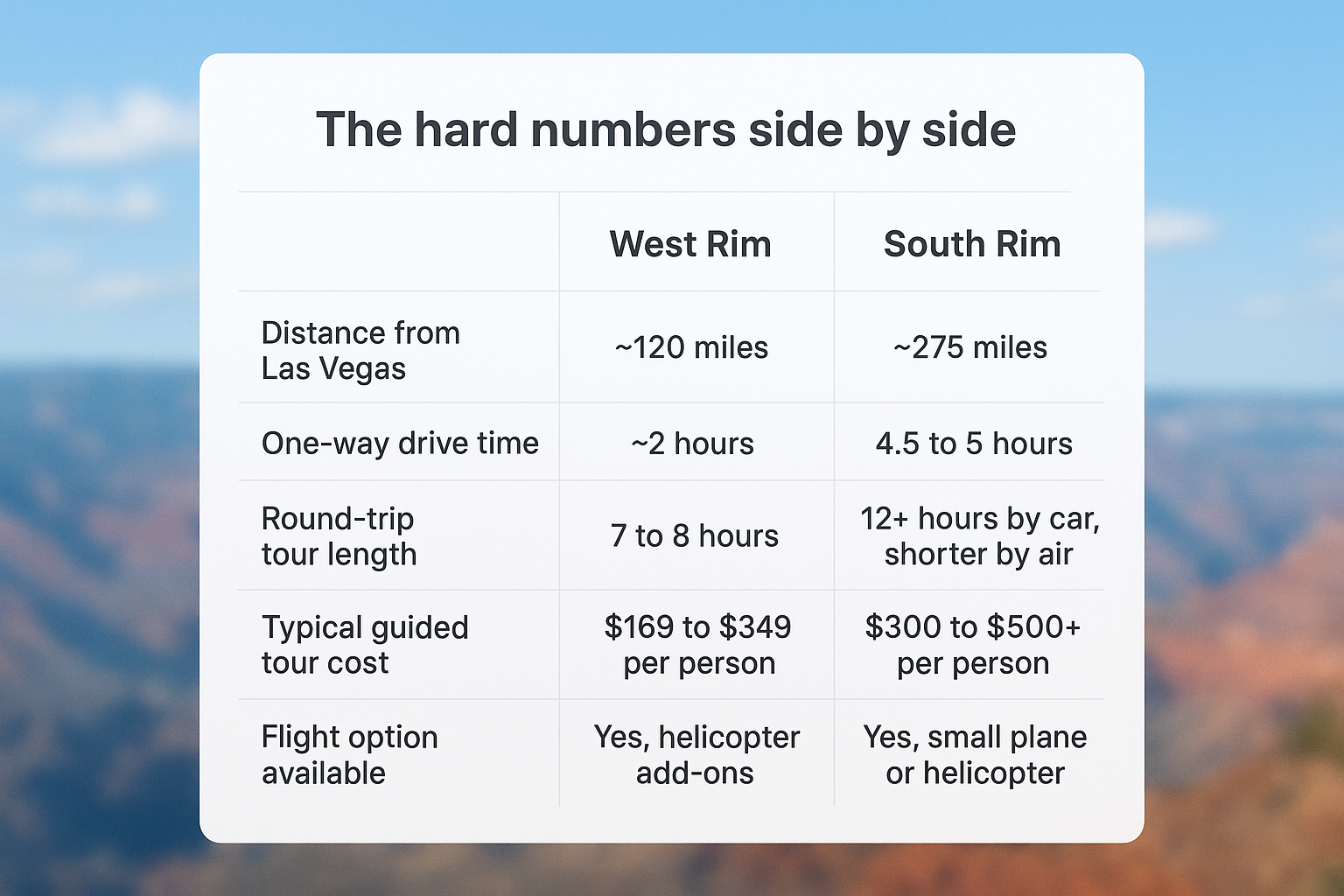
| Factor | West Rim | South Rim |
|---|---|---|
| Distance from Las Vegas | ~120 miles | ~275 miles |
| One-way drive time | ~2 hours | 4.5 to 5 hours |
| Round-trip tour length | 7 to 8 hours | 12+ hours by car, shorter by air |
| Typical guided tour cost | $169 to $349 per person | $300 to $500+ per person |
| Flight option available | Yes, helicopter add-ons | Yes, small plane or helicopter |
If your entire Grand Canyon budget is one day and $300, West Rim gets you there and back with hours to spare.
Why the price gap exists
Cost differences come down to logistics, not quality. West Rim tours cost less because the shorter drive means less fuel, less guide overtime, and a tighter operating window that keeps overhead down. South Rim trips run higher because operators are covering nearly double the mileage, often with a lunch stop, restroom breaks, and more time paying a guide to sit behind the wheel. Flying to South Rim shrinks the travel time dramatically, sometimes to under an hour each way, but it adds a few hundred dollars per person on top of the ground tour price.
What this means for your itinerary
Given these numbers, most Las Vegas visitors with a single free day gravitate toward West Rim, and it’s the option most local operators build entire day-trip packages around, since a guided West Rim tour package fits comfortably into a normal daytime schedule without requiring an overnight stay or a flight. Booking a South Rim trip out of Las Vegas still makes sense if you’ve set aside two full days or you’re combining the trip with Zion or Sedona. Either way, matching your calendar to these real numbers, not the ones you assumed, keeps you from booking a trip you’ll regret halfway through the drive.
What you’ll actually see and do at each rim
Beyond the drive time and price tag, the actual experience at each rim looks nothing alike. West Rim hands you glass-floor thrills and Hualapai culture packed into a few hours, while South Rim hands you a full National Park day with trails, museums, and ranger-led programs. Neither one is a watered-down version of the other, they’re built for different kinds of curiosity.
West Rim delivers a quick, dramatic hit of canyon; South Rim delivers a slower, deeper one.
West Rim: Skywalk, viewpoints, and Hualapai heritage
Stepping onto the Skywalk is the headline activity here, a horseshoe-shaped glass bridge that puts you 4,000 feet above the canyon floor with nothing but air below your feet, and it helps to know how West Rim tickets and the Skywalk work before you arrive. Guests also spend time at Eagle Point and Guano Point, two overlooks that show off the canyon’s western edge without the crowds you’ll find elsewhere.
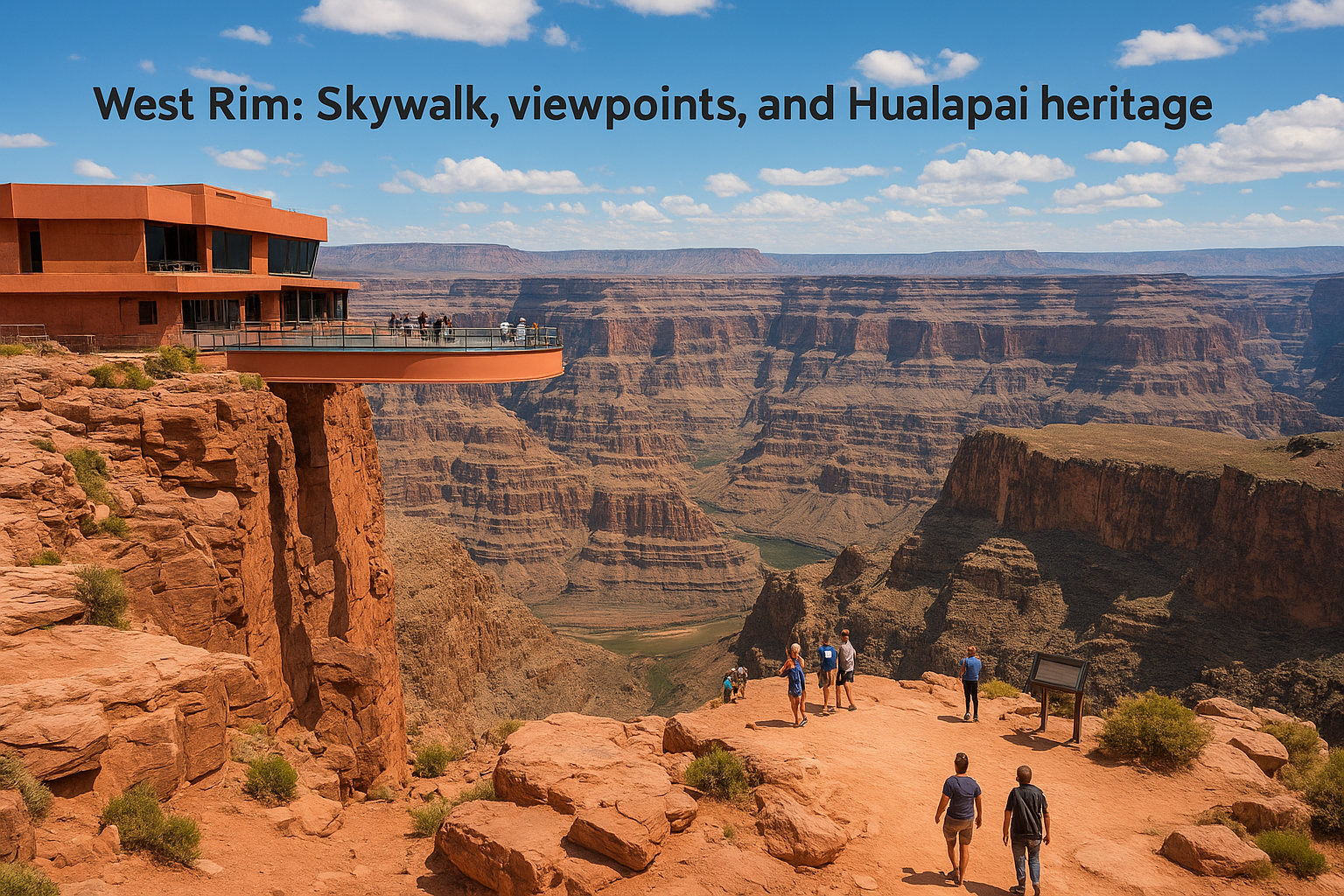
- Step onto the Skywalk (separate ticket, no personal cameras allowed on the bridge)
- Take in panoramic views from Eagle Point and Guano Point
- Sample Hualapai fry bread and browse Native-run vendor booths
- Pair the trip with a Hoover Dam stop, since it sits right along the route
Operators built entire itineraries around this rim for a reason, and if you’d rather have someone else handle the logistics, the Ultimate Grand Canyon West private tour bundles the Skywalk, the drive, and a Hoover Dam stop into one straightforward day.
South Rim: hiking, ranger talks, and postcard overlooks
Options multiply once you reach South Rim, since Grand Canyon National Park runs full visitor services rather than a single attraction. You can walk, learn, and explore the South Rim’s must-see stops at a pace that West Rim’s compact layout simply doesn’t offer.
- Walk sections of the paved, mostly flat Rim Trail
- Attend free ranger talks and geology programs
- Stop at Mather Point, the Yavapai Geology Museum, and Bright Angel Trailhead
- Watch sunset light shift across the canyon layers from Hopi Point
Getting the full South Rim vs West Rim picture usually comes down to this: one rim rewards a quick visit, the other rewards a longer stay.
Tips for planning a smooth Grand Canyon day trip
Getting the logistics right matters as much as picking the rim itself, since a poorly timed trip can undercut even the best-chosen destination. Grand Canyon West vs South Rim planning mistakes usually come down to timing, packing, and transportation, not the canyon itself, so a little prep work saves you from a miserable drive or a wasted afternoon.
Book your departure time strategically
Early starts pay off at both rims. Leaving Las Vegas before 7 a.m. gets you ahead of tour buses and midday heat, and it means you’re not driving desert highways in the dark on the way back. South Rim trips especially benefit from an early departure, since a late start can push your return into the middle of the night.
Leave early, and the canyon rewards you with cooler temperatures, thinner crowds, and better light for photos.
Pack for extreme temperature swings
Weather at either rim swings harder than most visitors expect, especially between the canyon floor and the rim elevation, so it pays to check how the canyon’s weather and crowds change month by month. Layers, water, and sun protection aren’t optional extras, they’re the difference between an enjoyable day and a cut-short one.
- Bring at least one liter of water per person, more in summer
- Pack a light jacket even in warm months, since rim elevation drops temperatures fast
- Wear closed-toe shoes if you’re walking any trail sections
- Apply sunscreen before you leave, since shade is scarce at both rims
Decide between driving yourself and booking a guide
Self-driving gives you flexibility, but it also means navigating unfamiliar desert roads, watching your gas gauge, and missing the historical context a guide provides along the way, which is the heart of the drive or tour question for the South Rim. Guided tours remove that guesswork entirely, and for West Rim day trips in particular, a guided tour from Las Vegas handles the driving, the Skywalk tickets, and the Hoover Dam stop so you’re not managing four separate bookings.
Rounding out your plan means checking weather forecasts the night before, confirming ticket reservations for the Skywalk or park entry, and building in buffer time for photo stops. None of this is complicated, but skipping it is exactly how a promising day trip turns into a stressful one.
Picking the canyon experience that’s right for you
Comparing grand canyon west rim vs south rim always comes back to the same trade-off: time versus scenery. West Rim gives you the Skywalk, Hualapai culture, and a manageable half-day trip from Las Vegas. South Rim gives you the postcard views and full National Park experience, but it costs you most of your day, sometimes two. Neither choice is wrong, but only one fits the schedule you actually have.
Once you’ve matched the rim to your available time, budget, and travel style, the rest of the planning gets easy. Don’t overthink it further, just book the option that matches your itinerary and stop second-guessing the drive.
If you’d rather skip the logistics entirely, book a private Grand Canyon experience from Las Vegas and let a guide handle the driving, timing, and details so your day at the canyon is the only thing you have to think about.