
Death Valley looks empty on a map, which is exactly why so many visitors underestimate it. You get one day, maybe two, and you don’t want to waste hours driving to overlooks that aren’t worth the detour. Knowing the real death valley national park highlights before you go saves you from guessing, and from missing the spots that actually earn the drive on a Death Valley day trip from Las Vegas.
This list answers the question straight: which viewpoints, trails, and natural features deserve your limited time in the park. You’ll find the salt flats at Badwater Basin, the golden folds of Zabriskie Point, and a few lesser-known stops that most rushed itineraries skip entirely. Each one is picked because it delivers a payoff, not just a parking lot and a sign.
We run guided tours through this region ourselves, so we’ve watched what stops visitors and what gets a quick photo and a shrug. Below, you’ll get nine highlights worth your time, roughly in the order you’d hit them on a loop through the park, so you can plan a route instead of piecing one together from scattered blog posts.**
1. Badwater Basin
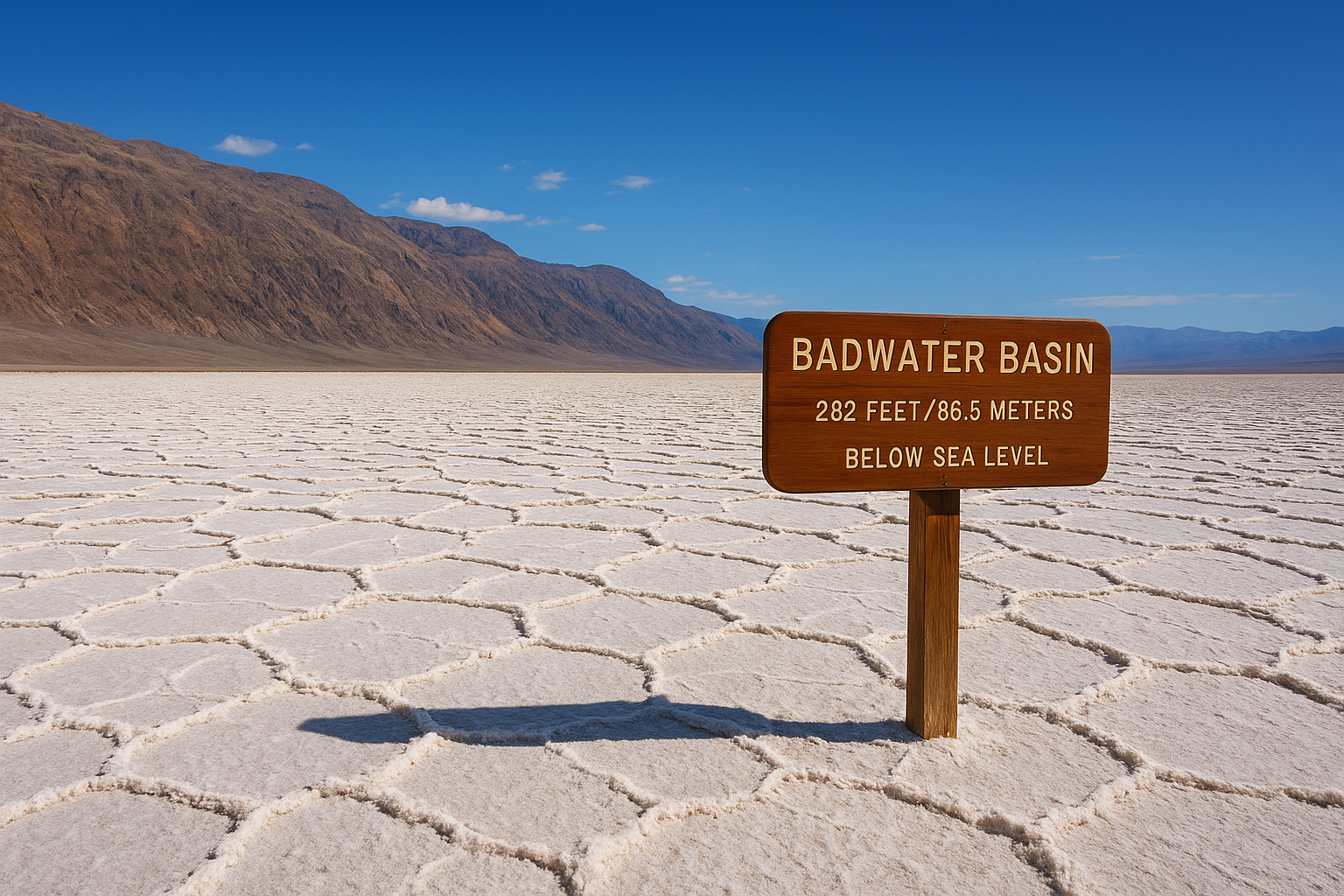
Badwater Basin sits 282 feet below sea level, making it the lowest point in North America, and it’s the stop most people picture when they think of Death Valley. The white salt flats stretch out toward the mountains in a pattern that looks almost engineered, and the scale of the place doesn’t hit you until you’re standing on it. This is the anchor point for any one-day Death Valley itinerary, and it earns that spot honestly.
What you’ll see
Walking out onto the salt flats feels like stepping onto a different planet. The crust breaks into polygon shapes formed by repeated flooding and evaporation, a process that’s been running for thousands of years. Look up toward the cliffside behind the parking area and you’ll spot a small sign marking sea level, a detail that shows just how far below the surrounding terrain you actually are. On clear days, the contrast between the blinding white salt and the dark Panamint Mountains ranks it among the best desert photography locations in the region.
Badwater Basin is the one stop in Death Valley where the scenery does all the talking, no narration needed.
How to get there
Badwater Basin sits right off Badwater Road, about 17 miles south of Furnace Creek, and the parking lot is well marked with plenty of space even during busy seasons. The walk onto the salt flats is flat and easy, though there’s no shade anywhere, so bring more water than you think you’ll need. Most visitors walk out about a half mile to reach the clearest polygon patterns, then turn back the same way.
Best time to visit
Go early morning or late afternoon if you’re visiting between May and September, since midday heat here regularly tops 110 degrees and the salt flat offers zero relief, which is why the season you pick for Death Valley changes the whole trip. Winter mornings bring a soft light that makes the salt glow, and temperatures stay comfortable enough for a longer walk. If you’re coming from Las Vegas on a day trip, plan Badwater Basin as either your first or last stop, since the light and heat both shift the experience dramatically depending on the hour.
2. Zabriskie Point
Zabriskie Point delivers the postcard shot of Death Valley, the one with golden badlands folding into sharp ridges under an early sun. It’s a five-minute stop for some and a half-hour photo session for others, but almost nobody leaves disappointed. If Badwater Basin shows you the valley floor, this spot shows you why the whole park looks sculpted rather than just eroded.
What you’ll see
The eroded badlands below the viewpoint were once part of an ancient lake bed, and millions of years of mineral deposits give the hills their yellow, gold, and rust coloring. Manly Beacon, a jagged peak rising from the badlands, anchors most photos taken here. A short paved path leads from the parking lot to the main overlook, so you don’t need hiking gear to get the view.
Zabriskie Point is proof that Death Valley’s best moments don’t always require a trail, just good timing.
How to get there
Zabriskie Point sits just off Highway 190, about five miles southeast of Furnace Creek, with a paved parking lot right at the overlook.
Best time to visit
Sunrise is the move here. The badlands catch the first light and shift color fast, and the crowds are thin enough to actually enjoy it before the tour buses arrive later in the morning.
3. Artist’s Palette and Artist’s Drive
Artist’s Drive is a nine-mile paved loop that swings through hills streaked with pink, green, purple, and orange, all from mineral deposits baked into the rock. The road itself rolls and dips enough to feel like a small ride, and the payoff comes about two-thirds through at a pullout called Artist’s Palette. This is one of the few Death Valley National Park highlights you experience mostly from behind the wheel, which makes it a good fit if you’re short on time or hiking energy.
What you’ll see
Oxidized metals in the volcanic rock create the color bands, with green coming from mica and pink and red from iron oxides. The Artist’s Palette pullout gives you the widest view of the hillside, and a short walk out onto the wash brings you close enough to see the color shifts in detail. Afternoon light tends to wash the colors out, so timing matters more here than at most stops.
Artist’s Drive turns a scenic detour into one of the clearest reasons Death Valley isn’t just sand and salt.
How to get there
The entrance sits off Badwater Road, roughly eleven miles south of Furnace Creek. The loop is one-way and only open to standard vehicles, no trailers or oversized RVs.
Best time to visit
Late afternoon, roughly two hours before sunset, brings out the sharpest color contrast across the hillside.
4. Mesquite Flat Sand Dunes
Mesquite Flat Sand Dunes give you the classic desert image that’s missing from the rest of the park, rolling waves of sand rising nearly 100 feet with almost nothing else in view. There’s no marked trail here, which is part of the appeal. You pick your own line through the dunes, and the landscape shifts with every gust of wind.
What you’ll see
The golden sand dunes ripple out for miles, with mesquite trees anchoring the lower slopes and casting long shadows once the sun drops. Footprints from the night before vanish by morning, so the sand always looks untouched at sunrise. Climb the tallest dune near the center of the field and you get a full 360-degree view of the valley, mountains on every side.
The dunes are the one spot in Death Valley where the desert looks exactly like you imagined it would.
How to get there
The dunes sit right off Highway 190, about two miles east of Stovepipe Wells, with a large gravel parking lot marking the trailhead. There’s no set path, so wear closed shoes and expect sand to work its way in regardless.
Best time to visit
Sunrise wins here, both for the light raking across the ridgelines and for the cooler air, since the sand radiates heat hard by midday. Full moon nights also draw visitors who want to walk the dunes under natural light, and the dark skies out here rival the best stargazing spots near Las Vegas.
5. Dante’s View
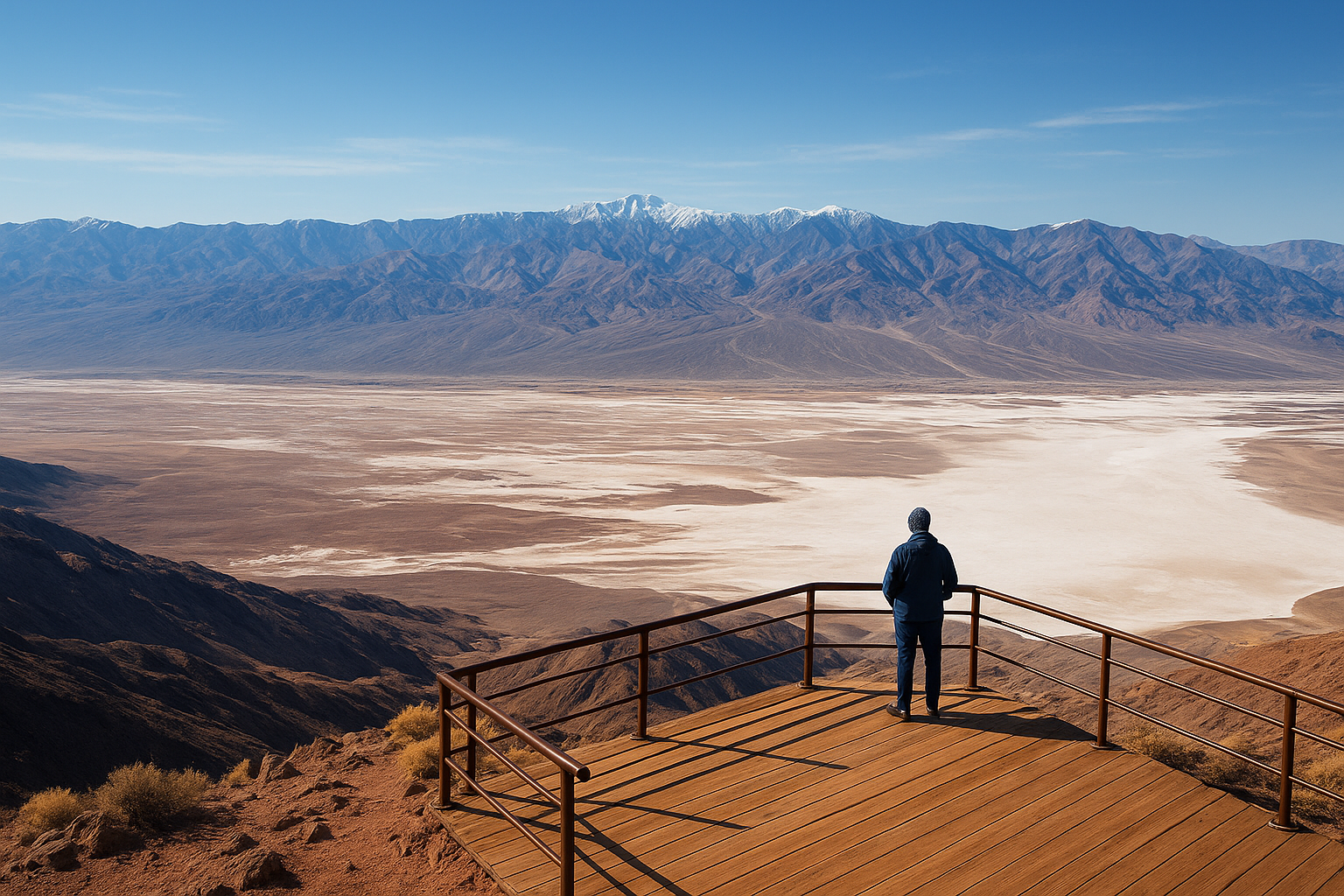
Dante’s View sits at 5,475 feet, staring straight down at Badwater Basin nearly two miles below. Few overlooks in the country give you this kind of vertical contrast, salt flats and snow-capped peaks visible in the same frame. It’s a quick drive up, but the payoff rivals anything else on this list of death valley national park highlights.
What you’ll see
Standing at the railing, you look down on the white salt pan of Badwater Basin while Telescope Peak rises behind you, often holding snow well into spring. On a clear day, you can see across the valley floor to the Panamint Range and pick out the ribbon of road you drove in on. The temperature drop from the valley floor is noticeable too, often 20 degrees cooler up here.
Dante’s View gives you the whole park in one glance, something no ground-level stop in Death Valley can match.
How to get there
Turn off Highway 190 onto Dante’s View Road, about 13 miles from Furnace Creek, then climb roughly 13 more miles up a steep, winding paved road to the parking area at the top. Vehicles over 25 feet aren’t recommended on this stretch.
Best time to visit
Early morning brings the clearest air and softest light for photos, while sunset works well if you’re heading back toward Furnace Creek or Las Vegas afterward. Avoid midday in summer, when haze can dull the view.
6. Devil’s Golf Course
Devil’s Golf Course looks like a frozen storm, jagged salt spires crusted over a dry lakebed so rough that early guidebooks joked only the devil could play golf on it. It sits close to Badwater Basin but feels like a completely different landscape, sharp instead of smooth, chaotic instead of flat. Anyone building a list of things to do in Death Valley should treat this as the counterpoint to the salt flats down the road.
What you’ll see
Spiky salt formations rise a few inches to a foot off the ground, each one carved by wind and rare rainfall into jagged, honeycomb-like ridges. Lean in close and you can hear faint popping and cracking as the salt crystals expand and contract in the heat. Nothing grows here, no wildlife crosses it, and the ground is too uneven to walk far without watching every step.
Devil’s Golf Course proves Death Valley can turn a dry lakebed into something that looks alive.
How to get there
Turn off Badwater Road onto a short, well-marked gravel spur about 13 miles south of Furnace Creek. Standard cars handle the unpaved section fine at low speed, and the parking area sits just a few steps from the salt formations.
Best time to visit
Morning works best, before the heat radiating off the salt becomes unbearable. Skip midday in summer entirely, since there’s no shade and the jagged surface makes a quick exit harder than it looks.
7. Golden Canyon
Golden Canyon flips the script on Death Valley’s usual scenery, trading wide-open flats for a narrow trail that winds through walls of gold and red mudstone. It’s one of the few death valley national park highlights that actually gets you moving on foot, and the payoff builds gradually instead of hitting you all at once. Families and casual hikers tend to like this stop because the trail is manageable without feeling like a throwaway walk.
What you’ll see
The canyon walls close in as you walk, showing off layered rock formations shaped by ancient flash floods and mineral staining. Push about a mile in and you’ll reach the base of the Red Cathedral, a wall of deep red rock that towers over the trail and makes a natural turnaround point for shorter visits. Hikers with more time can continue on toward Zabriskie Point, connecting two highlights into a single loop.
Golden Canyon rewards patience, the deeper you walk, the better the colors get.
How to get there
The trailhead sits off Badwater Road, about two miles south of Furnace Creek, with a dirt parking area right at the canyon mouth. No permit or reservation is needed, just water and sturdy shoes.
Best time to visit
Morning hours keep the canyon walls shaded and the air tolerable, especially since there’s little shade once the sun climbs higher.
8. Ubehebe Crater
Ubehebe Crater sits at the far north end of the park, and the drive out there weeds out the crowds that stick closer to Furnace Creek. The volcanic crater stretches half a mile across and drops 600 feet deep, blasted out by steam explosions roughly 2,000 years ago when rising magma hit groundwater. It’s a colder, starker landscape than anything else on this list of Death Valley National Park highlights, and that contrast is exactly why it’s worth the extra miles.
What you’ll see
Black and red volcanic rock rings the rim, layered like a cutaway diagram of the earth. A trail circles the entire crater edge, roughly 1.5 miles round trip, while a steeper path drops straight down to the crater floor if you want a closer look. Wind whips hard up here most days, kicking cinder dust across the rim and adding to the raw, exposed feel of the place.
Ubehebe Crater feels less like Death Valley and more like standing on the edge of another planet.
How to get there
Follow Scotty’s Castle Road north from Highway 190, about 55 miles from Furnace Creek. The pavement runs the whole way, and a parking lot sits right at the rim.
Best time to visit
Morning offers the calmest wind and softest light for photos. Afternoons here get brutally windy, which makes the rim trail miserable and the loose cinder footing on the crater floor trail genuinely risky.
9. Harmony Borax Works
Harmony Borax Works closes out this list with a dose of history instead of scenery, and that contrast makes it a smart last stop before you head back toward Furnace Creek. This was the site of Death Valley’s original borax mining operation, running from 1883 to 1888, and it belongs in the same story as the abandoned mining towns scattered across the desert that boomed and emptied just as fast. Compared to the canyons and craters earlier on this list, it’s a quieter, quicker visit, but it fills in the story behind the landscape you’ve spent the day driving through.
What you’ll see
Weathered wooden vats and rusted equipment sit exactly where workers left them, alongside interpretive signs explaining how borax got hauled out by the famous twenty-mule teams. A short, flat loop trail, less than half a mile, circles the ruins and takes maybe fifteen minutes to walk.
Harmony Borax Works turns Death Valley from a scenic drive into a place with an actual story attached.
How to get there
The site sits just off Highway 190, about one mile north of the Furnace Creek Visitor Center, with a paved parking lot right at the trailhead.
Best time to visit
Anytime works, since there’s no strenuous walking involved, though late afternoon light photographs the rusted machinery best.
Making the Most of Your Death Valley Visit
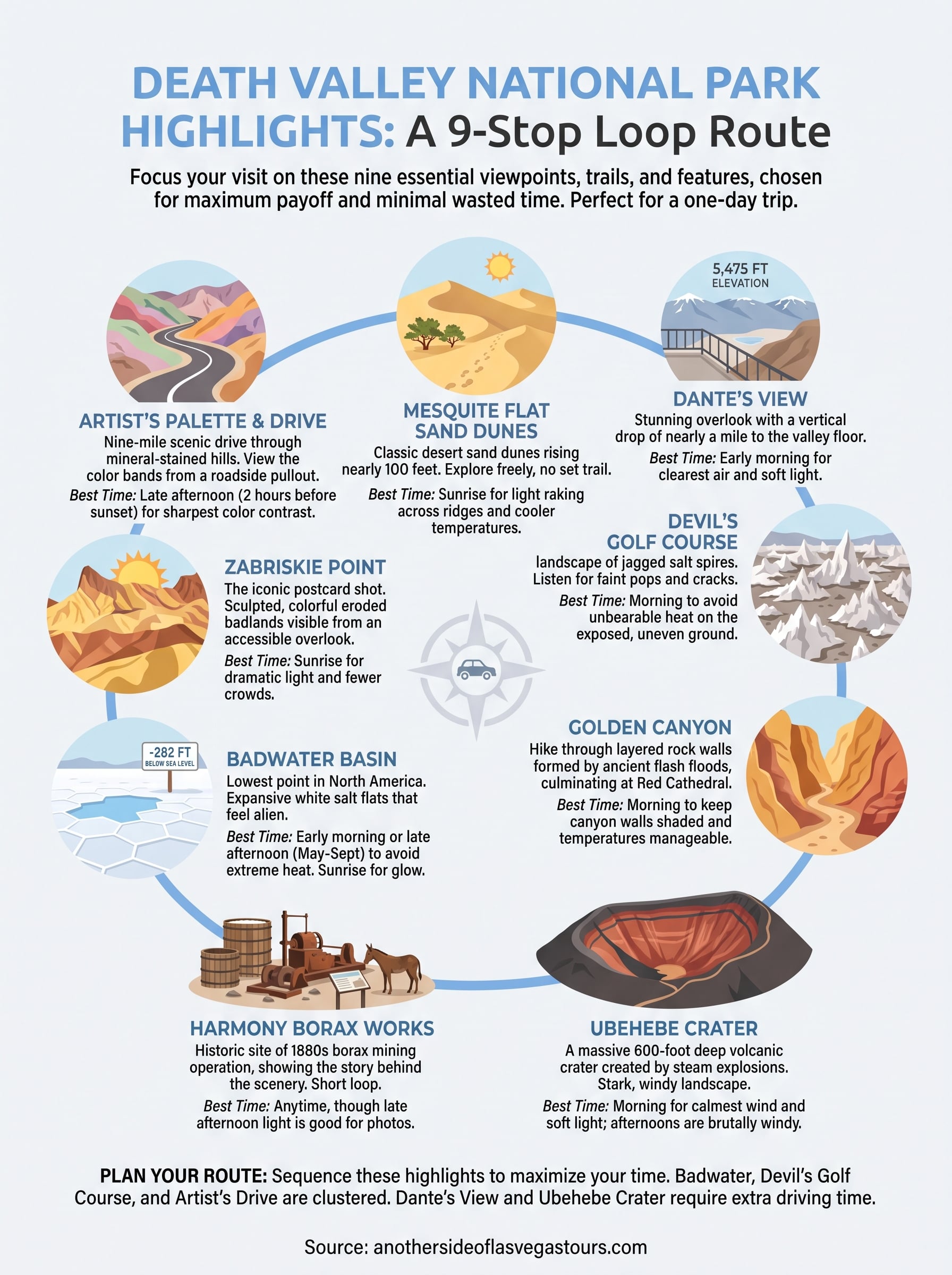
Nine stops sound like a lot until you’re standing at Zabriskie Point at sunrise, realizing the whole park works better as a loop than a checklist. Badwater Basin and Devil’s Golf Course pair naturally with a stop at Artist’s Drive, while Dante’s View and Ubehebe Crater reward anyone willing to add extra driving time for a payoff nothing else in the park matches. The trick isn’t seeing everything, it’s sequencing the handful of spots that actually earn your limited hours.
Death Valley is a brutal place to figure out solo on a tight schedule, between the distances, the heat, and the timing that makes or breaks each view. If you’d rather skip the guesswork and let someone who knows the roads and the light handle the route, our custom tours build a day around exactly the highlights that matter to you, no wasted miles, no missed sunrise.