
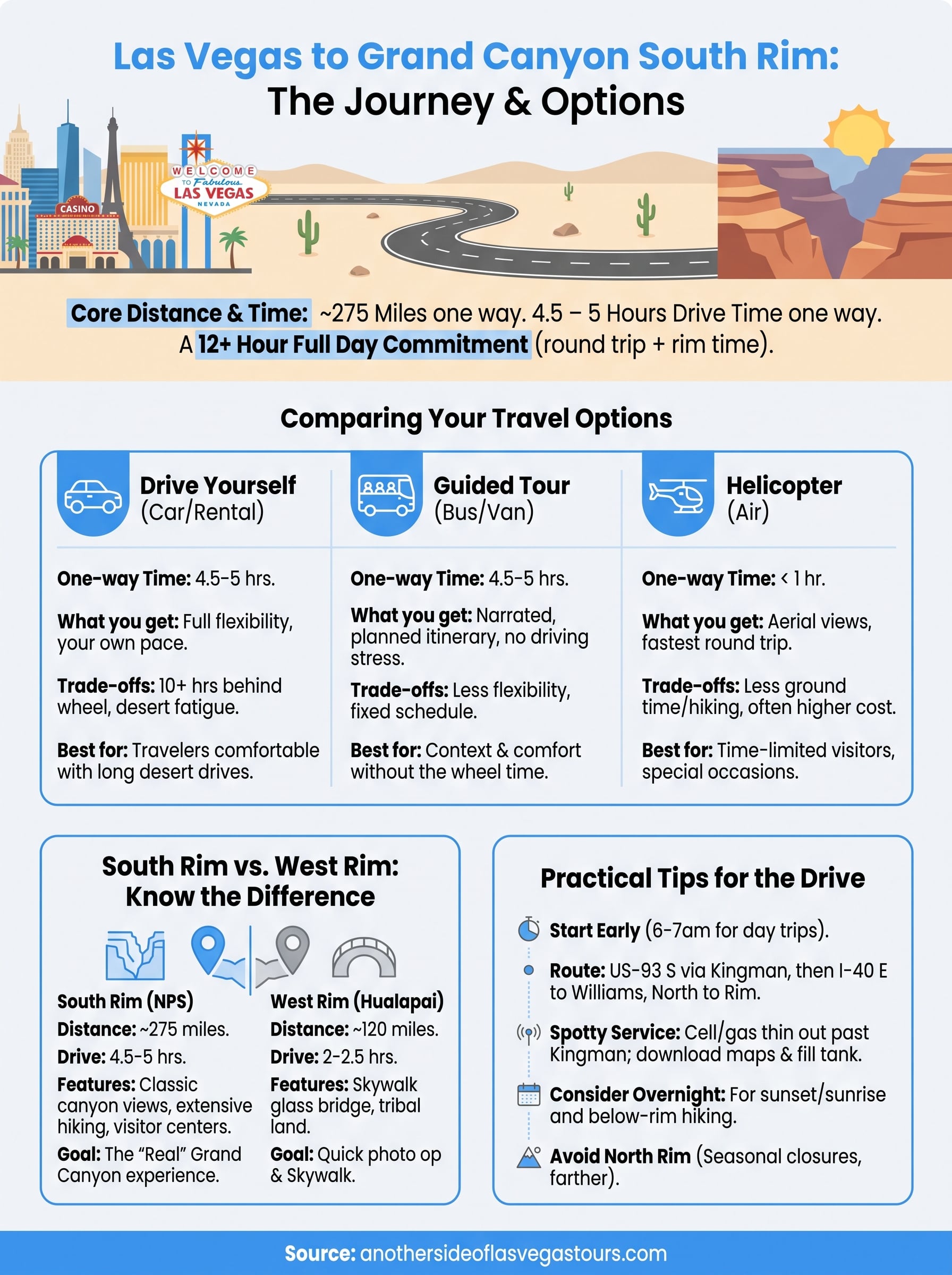
You’ve got Grand Canyon South Rim on your Las Vegas itinerary, and now you need real numbers before you commit a whole day to it. How far is Grand Canyon South Rim from Las Vegas? The short answer: about 275 miles, which puts you looking at a 4.5 to 5 hour drive one way depending on your route and how many stops you make along the way, and it helps to see the full picture of Grand Canyon mileage and drive times from Las Vegas before you decide.
That distance surprises a lot of visitors who assume the Grand Canyon sits just outside the city. It doesn’t. The South Rim is farther than the West Rim (which is closer to Vegas but offers a different experience), and knowing the real mileage changes how you plan your day, whether you’re renting a car, booking a shuttle, or considering a flight over driving.
Below, we break down the exact mileage from the Strip and from McCarran, the driving routes through Kingman or Williams, realistic time estimates with stops, and how a South Rim day trip compares to flying above the canyon by helicopter instead. If you’d rather skip the long drive altogether, we’ll also point out where a guided tour saves you the guesswork and the wheel time.
Why the distance matters for your trip planning
Most visitors underestimate the Las Vegas to Grand Canyon South Rim distance until they’re staring at a map wondering why their afternoon plan just fell apart. At 275 miles and roughly 4.5 to 5 hours each way, a South Rim trip isn’t something you squeeze in between a late checkout and dinner reservations. It’s a full day, and treating it like a quick side trip is the single biggest planning mistake we see visitors make.
It’s not a quick side trip
Doing the math backward helps. If you leave the Strip at 7 a.m., you’re not reaching the rim until close to noon. Give yourself two to three hours to actually walk the rim trails, catch the best South Rim viewpoints like Mather Point or Yavapai Point, and grab lunch, then you’re back in the car by mid-afternoon for another five-hour drive home. That’s a 12-plus hour day, and it doesn’t leave room for the traffic delays, road construction, or bathroom breaks that always eat into a schedule. Compare that to the West Rim, which sits roughly 120 miles from Vegas and can be done round-trip in about 7 hours, and you start to see why so many first-time visitors confuse the two rims when they’re booking, so it’s worth checking how far the West Rim is from Las Vegas too.
The South Rim isn’t a detour from your Vegas trip. It’s a separate trip that happens to start in Vegas.
Comparing your options: drive, tour, or helicopter
Once the distance sinks in, the real question becomes how you want to spend that travel time. Driving yourself gives you flexibility but also means five hours behind the wheel through desert highway, twice. A guided tour hands the driving to someone else and usually builds in stops, narration, and a set itinerary so you’re not guessing where to pull over. Flying by helicopter cuts the one-way travel time to under an hour, though it trades ground-level scenery and hiking time for aerial views and a shorter visit window.
| Option | One-way travel time | What you get | Best for |
|---|---|---|---|
| Self-drive | 4.5-5 hours | Full flexibility, your own schedule | Travelers comfortable with a long desert drive |
| Guided tour | 4.5-5 hours (someone else drives) | Narrated stops, planned itinerary, no navigation stress | Visitors who want context without the wheel time |
| Helicopter | Under 1 hour | Aerial views, faster round trip | Time-limited visitors, special occasions |
Only you know which trade-off fits your trip. If you’ve got three or four days in Vegas and want the classic canyon rim experience with hiking trails and overlooks, a guided ground tour makes sense. If you’ve got a single free afternoon, the helicopter option starts looking a lot more appealing, and it’s worth checking what a Grand Canyon helicopter tour costs and includes before you rule it out.
What time actually costs you
Think about what a 10 to 12 hour round trip actually takes off the table elsewhere in your itinerary. That’s a full show night gone, a pool day skipped, or a late dinner reservation you’ll need to cancel. For groups traveling with kids or older relatives, the drive length also matters more than the mileage itself. Ten hours of highway driving in one day tests everyone’s patience, no matter how good the canyon views are once you arrive.
Given all that, the honest advice is to decide early whether the South Rim’s specific scenery justifies the travel cost for your group, or whether the West Rim, Hoover Dam, or a helicopter flight gets you a comparable payoff for a fraction of the time. Either way, knowing the real distance upfront, rather than discovering it mid-drive, is what keeps this part of your trip from derailing the rest of it.
How to get from Las Vegas to the South Rim
Getting from Las Vegas to Grand Canyon South Rim comes down to three practical choices, the same three that shape how to visit the Grand Canyon from Las Vegas: drive yourself, book a seat on a guided tour, or fly. Each option changes your travel time, your cost, and how much of the day you actually spend enjoying the canyon instead of sitting in a vehicle. Route choice matters just as much as the mode of transport, since the two main highway paths add different amounts of time and scenery to your trip.
Driving yourself
Self-driving gives you full control but demands commitment. You’ve got two realistic routes: US-93 South through Kingman, then east on I-40 toward Williams and up to the South Rim, or a route that swings through Boulder City and Kingman before joining the same stretch of I-40. Both paths land you at roughly 275 miles and 4.5 to 5 hours one way, with the Kingman route being the more common choice because it’s better signed and has more services along the way, which is part of deciding whether to drive to the South Rim or book a tour.
Choosing a route is less about shaving minutes and more about deciding where you’re comfortable stopping for gas and food.
Gas stations thin out once you leave the Kingman area, so top off your tank before continuing east. Cell service also gets spotty through stretches of open desert, which matters if you’re relying on a phone for navigation or roadside help.
Guided tours and shuttles
Opting for a guided tour removes the navigation and the driving fatigue entirely. Most tours depart early from the Strip, run the same highway route in a coach or van, and build in a rest stop or two before reaching the rim. You’ll typically get several hours at the canyon itself, often with a guide who explains the geology and history rather than leaving you to read a trailhead sign. This is worth considering if you’d rather spend the ride resting or chatting than watching mile markers, and it’s the model behind our Grand Canyon and Hoover Dam tours from Las Vegas, which handle the driving so your group doesn’t have to.
Flying over driving
Flying cuts the equation down dramatically. A small plane or helicopter tour gets you to canyon airspace in well under an hour, though most fixed-wing tours land near the West Rim or fly over the South Rim rather than putting you on South Rim ground trails. If walking the rim trails matters to you, confirm exactly where a flight lands before booking, since "Grand Canyon flight" doesn’t always mean South Rim access.
What to expect along the drive
Once you commit to driving from Las Vegas to Grand Canyon South Rim, the road itself becomes part of the experience, and it ranks among the most scenic desert drives out of the city, whether you want it to be or not. The first hour out of the city still feels familiar: wide highway, casino billboards fading in your mirror, and traffic thinning as you clear the suburbs. After that, the landscape shifts fast into open Mojave Desert, and the drive settles into a rhythm of long straightaways, rock formations, and very little else for miles at a time.
The Kingman stretch
Leaving the Vegas valley behind, US-93 South carries you through some genuinely striking scenery, including a pass near the Hoover Dam bypass bridge, a landmark on any Las Vegas to Hoover Dam to Grand Canyon route, where you get a quick glimpse of Lake Mead before the road turns east. Kingman, Arizona shows up around the two-hour mark and works as the natural halfway point for gas, food, and a stretch break. From there, I-40 takes over, running straight and flat toward Williams before you turn north on the final approach to the South Rim entrance.
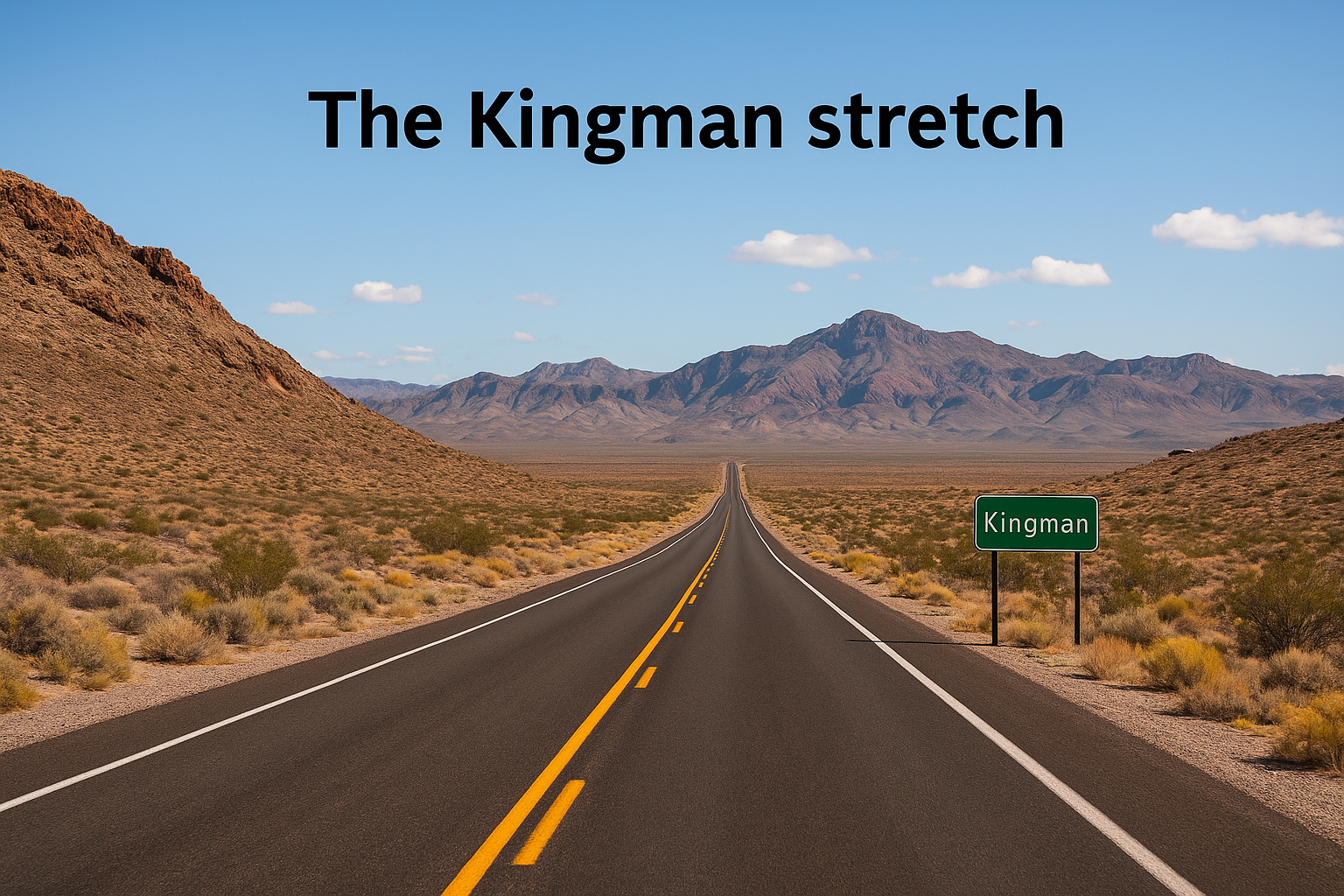
A few practical stops break up the monotony well:
- Hoover Dam viewpoint (optional detour, adds 20-30 minutes)
- Kingman for gas, coffee, and restrooms
- Seligman, a Route 66 town with diners and photo stops
- Williams, the last real town before the canyon turnoff
Road conditions and wildlife
Weather along this route swings harder than most visitors expect. Summer afternoons can push past 100 degrees in the lower desert stretches, while winter mornings near Williams sometimes bring snow and icy patches, especially as elevation climbs toward the rim. Wildlife crossings, particularly deer and the occasional elk near forested areas close to the canyon, become more common at dawn and dusk, so slow down if you’re driving those hours.
The drive itself teaches you something the mileage number can’t: this is high desert and mountain terrain, not a quick straight shot.
Gas and connectivity
Cell service drops out repeatedly once you’re past Kingman, particularly through the long stretches of I-40 and the final climb toward the canyon. Download offline maps before you leave the Strip, and don’t count on your phone for last-minute route changes. Gas stations also space out more than you’d expect, so fill up in Kingman or Williams rather than waiting until the tank light comes on somewhere between towns.
Day trip or overnight stay: which makes sense
Deciding whether to knock out the South Rim in a single day or split the trip with an overnight stay comes down to how much of the canyon you actually want to see versus how much driving you’re willing to absorb. A Grand Canyon day trip by bus or helicopter gets you there and back before midnight, but it leaves you with three or four hours at the rim after ten hours of driving. An overnight stay flips that ratio, trading a hotel bill for a full sunset, a full sunrise, and enough daylight to actually hike below the rim instead of just standing at the overlooks.
Making the day trip work
Going the day trip route only works if you commit to an early start, ideally on the road by 6 or 7 a.m., since every hour you sleep in is an hour you lose at the canyon later. Pack food and water in the car rather than planning to eat a sit-down lunch at the rim, and treat the stops in Kingman or Williams as quick refuels, not leisurely breaks. Families traveling with young kids or anyone prone to motion sickness should think twice here, since ten-plus hours of highway in a single day adds up fast.
A day trip gets you the view. An overnight stay gets you the canyon.
When an overnight stay pays off
Staying overnight near the South Rim changes the whole trip. Lodging options inside or near Grand Canyon Village let you catch both sunset and sunrise over the canyon, two very different shows that a day-trip schedule almost never allows for. It also opens up time for a real hike, even a short one below the rim on the Bright Angel Trail, without racing the clock to get back on the road.
A few signs an overnight stay makes more sense for your group:
- You want sunrise or sunset photos, not just midday views
- Anyone in your group has limited tolerance for long driving days
- You’re planning to hike below the rim, even briefly
- You’d rather split the drive across two lighter days than one long one
Weighing your own trip
Eventually the decision comes down to your itinerary and your patience for highway miles. Groups with a tight Vegas schedule and a guided ride, like the ones covered in our guided South Rim tour options, tend to lean toward the single-day version since a guide handles the driving and the pacing. Travelers with more flexible dates and a genuine interest in hiking below the rim usually come away happier building in one night near the canyon instead of rushing both directions in daylight.
How the South Rim compares to the other rims
Once you know the South Rim sits 275 miles out, it’s worth asking whether one of the other rims gets you a better payoff for less driving. Grand Canyon has four rims tourists actually visit or fly over: South Rim, West Rim, North Rim, and the lesser-known East Rim viewpoints inside the park. Each one delivers a different experience, and picking the wrong one for your priorities is an easy way to end up disappointed after a long drive.
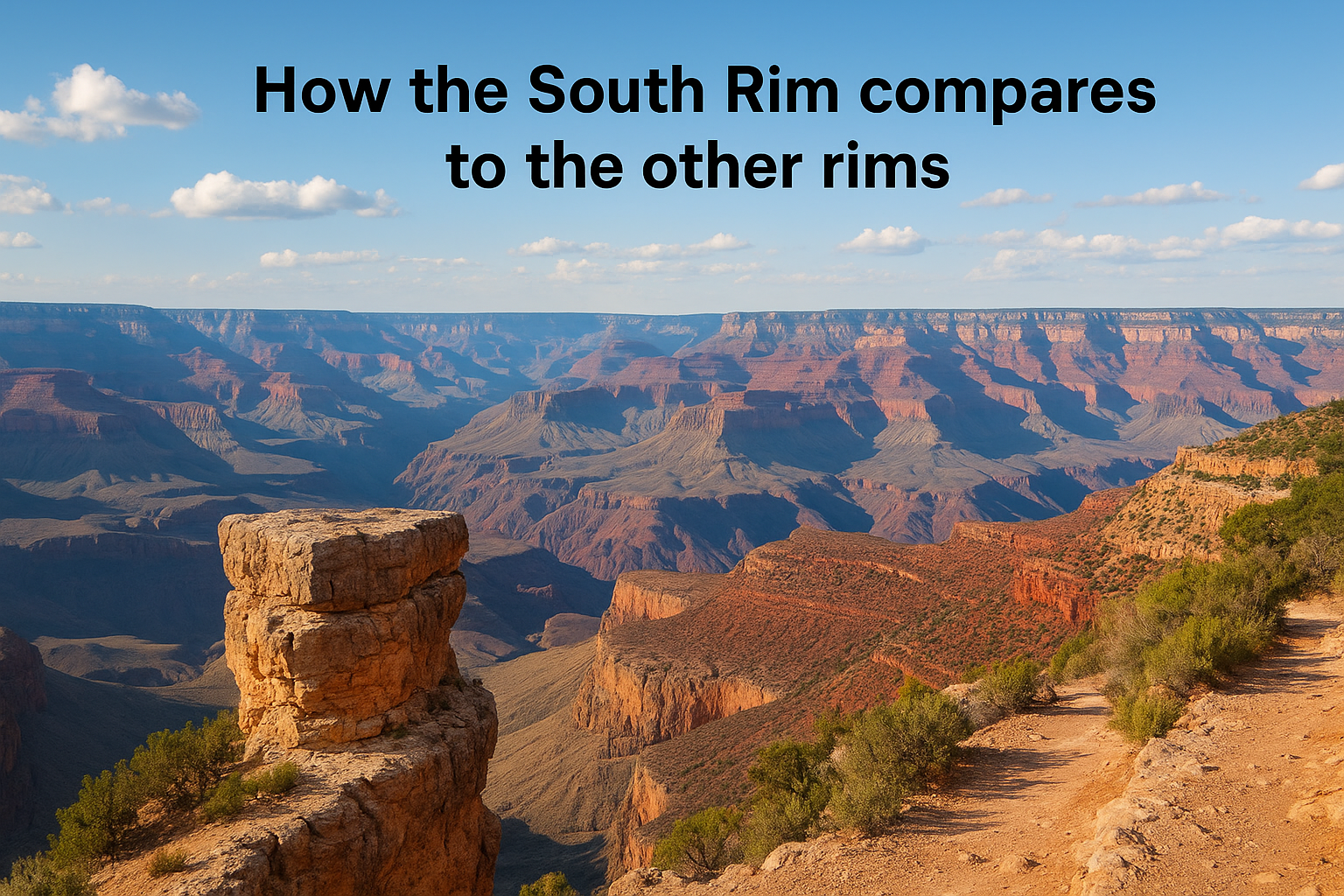
South Rim vs West Rim
Comparing the two most-booked options side by side clears up most of the confusion about how the South Rim and West Rim stack up. The West Rim sits on Hualapai tribal land, roughly 120 miles from Vegas, and is home to the Skywalk glass bridge. The South Rim belongs to the National Park Service, sits nearly 275 miles out, and offers the classic canyon views, established trails, and visitor infrastructure most people picture when they hear "Grand Canyon."
| Feature | South Rim | West Rim |
|---|---|---|
| Distance from Vegas | ~275 miles | ~120 miles |
| Drive time (one-way) | 4.5-5 hours | 2-2.5 hours |
| Managed by | National Park Service | Hualapai Tribe |
| Known for | Hiking trails, classic overlooks, full park amenities | Skywalk glass bridge, closer drive |
| Best for | Multi-day visits, hikers, first-timers wanting the "real" canyon | Quick day trips, photo stops, time-limited visitors |
If the Skywalk photo is the goal, go West Rim. If the canyon itself is the goal, go South Rim.
South Rim vs North Rim
Thinking past the West Rim, the North Rim rarely comes up in Vegas trip planning, and a South Rim vs North Rim comparison shows why. It sits even farther away than the South Rim, often five to six hours by the shortest available roads, and it closes seasonally from mid-October through mid-May due to snow. The North Rim offers a quieter, less-crowded canyon experience with different vegetation and elevation, but it’s simply not a realistic add-on to a Vegas trip unless the canyon is your entire itinerary rather than a side excursion.
Why most Vegas visitors still pick South Rim
Despite the longer drive, the South Rim wins out for most travelers because it has the infrastructure: visitor centers, ranger talks, marked trails, shuttle buses within the park, and the widest range of viewpoints. Amenities matter when you’re bringing kids, older relatives, or anyone who wants restrooms and food options nearby rather than a remote overlook with a parking lot. The National Park Service’s South Rim visitor guide backs this up, listing far more services and year-round access compared to the other rims.
Ultimately, the rim you choose should match what you actually want from the visit, not just the shortest drive on the map.
From the Strip to the canyon rim
So here’s where you land: the Grand Canyon South Rim sits about 275 miles from Las Vegas, a solid 4.5 to 5 hour drive each way, and no amount of route planning shrinks that number much. What changes is how you spend that time. Drive yourself and you control the pace but absorb the fatigue. Book a guided ride and you trade the wheel for narration, planned stops, and a group that handles the logistics for you. Neither choice is wrong, but pretending the distance is shorter than it is will wreck your schedule faster than any traffic jam on the Strip.
Given the mileage, a private guide often makes more sense than white-knuckling ten hours of desert highway solo. If you’d rather sit back and let someone else handle the driving, gas stops, and timing, look into our private guided day trips from Las Vegas before you commit to renting a car.