
You’ve seen the name on a map, maybe heard it’s the hottest place on earth, and now you’re wondering: is death valley worth visiting, or is it just a detour that eats up a day you could spend somewhere else? It’s a fair question. The park sits a couple hours from Las Vegas, temperatures can hit triple digits, and there’s no obvious "main attraction" like a waterfall or a canyon rim to snap a photo at and leave.
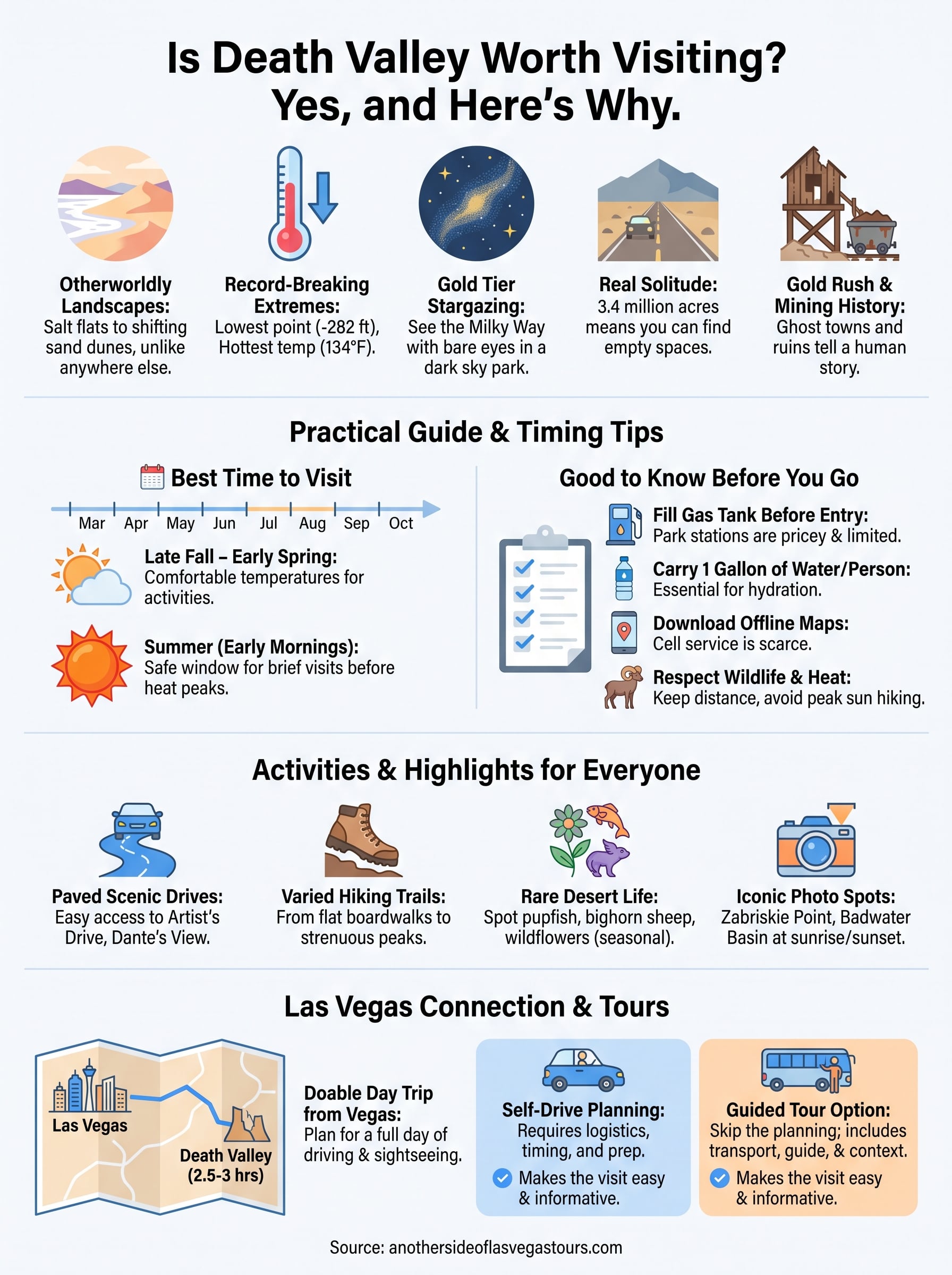
The short answer is yes, and not by a small margin. Death Valley delivers otherworldly landscapes you genuinely can’t find anywhere else in the country, from salt flats below sea level to sand dunes that shift with the wind. It rewards visitors who come prepared and know what to expect, rather than those who show up assuming it’s just an empty stretch of desert.
Below, we break down ten specific reasons this park earns its spot on your Las Vegas itinerary, covering everything from its record-setting scenery to practical timing tips that make the visit comfortable instead of grueling. If you’d rather skip the planning and let a local guide handle the driving and the details, that’s exactly what we do.
1. It boasts landscapes unlike anywhere else on Earth
Ask anyone who has stood at Zabriskie Point at sunrise and they’ll tell you the same thing: nothing else in the American desert looks like this. Death Valley National Park packs badlands, salt pans, sand dunes, and volcanic craters into roughly 3.4 million acres, more terrain variety than most people see in a lifetime of road trips. If you’re weighing is death valley worth visiting against another day at the pool, the scenery alone settles the argument.
What you’ll experience
The park’s signature Death Valley National Park highlights each feel like a different planet. Badwater Basin puts you on a crust of white salt 282 feet below sea level, the lowest point in North America, with the Panamint Range rippling in the heat behind you. Drive twenty minutes north and you hit Zabriskie Point, where eroded gold and rust-colored badlands fold into ridges that look almost sculpted. Keep going and you’ll find:
- Mesquite Flat Sand Dunes, rolling waves of sand that shift shape after every windstorm
- Artist’s Palette, a hillside streaked with pink, green, and purple mineral deposits
- Ubehebe Crater, a half-mile-wide volcanic crater you can walk the rim of in under an hour
If you already liked the striking rock formations on a guided Red Rock Canyon tour out of Las Vegas, Death Valley’s colors and scale take that same appeal several steps further.
Death Valley crams more landscape variety into one park than most travelers see across an entire desert road trip.
Best time to see it
Light changes everything here, so timing your visit around the sun matters as much as timing it around the season. Golden hour at Zabriskie Point or Dante’s View turns the badlands into a wash of orange and pink that flat midday light can’t touch, so aim to arrive within an hour of sunrise or sunset. Season-wise, late fall through early spring gives you comfortable temperatures for walking around at these overlooks without rushing back to an air-conditioned car every fifteen minutes.
Good to know before you go
Distances between sights are bigger than they look on the map, and cell service disappears almost entirely once you’re inside the park. Fill your gas tank before you enter, since stations inside the park charge a premium and aren’t always open. Carry at least a gallon of water per person for a full day of sightseeing, and download offline maps ahead of time so a dead signal doesn’t turn a scenic drive into a stressful one. None of this makes the park hard to enjoy, it just means a little prep goes a long way toward making the landscapes the highlight instead of the logistics.
2. It holds record-breaking extremes, from the lowest point to the hottest heat
Few national parks can claim a Guinness-level superlative, let alone a handful of them. Death Valley holds the title for the lowest elevation in North America and the hottest air temperature ever recorded on Earth, both inside the same 140-mile stretch of park boundary. If you’re still asking whether death valley worth visiting justifies the drive, standing in a place that literally sets planetary records answers that question fast.
What you’ll experience
Standing at Badwater Basin, you’re 282 feet below sea level, looking up at Telescope Peak, which tops out above 11,000 feet less than 20 miles away. That vertical range, over two miles of elevation change in a straight line, is the steepest in the lower 48 states. A few of the numbers worth knowing before you go:
| Record | Detail |
|---|---|
| Lowest point in North America | Badwater Basin, 282 ft below sea level |
| Hottest recorded air temperature on Earth | 134°F, Furnace Creek, 1913 (per the National Weather Service records) |
| Steepest elevation range in the lower 48 | Badwater Basin to Telescope Peak, over 11,000 ft of change |
| Driest park in the National Park System | Under 2 inches of average annual rainfall |
Death Valley doesn’t just look extreme, it holds the actual records for lowest elevation, hottest heat, and driest ground in the country.
Best time to see it
Since these extremes are exactly what draw curious travelers, most people want to experience the heat firsthand, at least briefly, and summer visits let you do that safely if you plan around it. Early morning, before 9 a.m., is the only realistic window for walking around outside between June and August. Outside of that stretch, November through March gives you the same record-setting scenery at temperatures you can actually enjoy for hours instead of minutes.
Good to know before you go
Temperatures at Furnace Creek regularly top 120°F in July and August, and pavement can reach twice that. Carry more water than you think you need, at least a gallon per person, and avoid strenuous hikes entirely during peak summer heat. Check your car’s coolant and tires before entering the park, since breakdowns in extreme heat turn from an inconvenience into a genuine emergency quickly.
3. It’s one of the best places in the country for stargazing
Death Valley earned Gold Tier certification from the International Dark-Sky Association, the highest rating a park can receive for night sky quality. That designation puts it among a short list of places in the country where you can see the Milky Way with your bare eyes, no telescope required. Anyone still debating whether death valley is worth visiting should factor in that most travelers never get to see a sky this dark in their lifetime.
What you’ll experience
Once the sun drops, the desert goes from bright and hot to pitch black and cool within an hour, and that’s when the sky takes over. Stand at Harmony Borax Works or Badwater Basin after dark and you’ll pick out thousands of stars, plus the Milky Way stretching overhead as a visible band rather than a faint smudge. On a clear night with no moon, you can often spot planets, satellites tracking across the sky, and the occasional meteor without any gear beyond your own eyes.
Death Valley’s Gold Tier dark-sky rating means you’ll see stars here that most travelers never see in their lifetime.
Best time to see it
Plan your visit around the new moon for the darkest possible sky, since a full moon washes out fainter stars the same way city lights do. Fall and winter nights are colder but clearer, with less atmospheric haze than summer. Check a moon phase calendar before you book your dates, and aim to be at your viewing spot at least 30 minutes after sunset so your eyes fully adjust to the dark.
Good to know before you go
Bring a red-light flashlight instead of a white one, since red light preserves your night vision while still letting you see the trail. Pack a jacket even in summer, because desert temperatures drop fast once the sun sets. A few practical notes worth keeping in mind:
- Cell service is essentially nonexistent after dark, so download directions before you leave
- Parking areas near Badwater Basin and Harmony Borax Works fill up on new-moon weekends
- A basic camera tripod turns a phone into a decent astrophotography setup with a long exposure
None of this requires special equipment or experience, just a clear night and a spot away from Furnace Creek’s limited lighting, the same rule that applies at the darkest stargazing spots away from the Strip.
4. It’s remote enough that you can still find real solitude
Most national parks funnel crowds into a handful of parking lots and overlooks, but Death Valley is big enough to swallow its visitors whole. At 3.4 million acres, it’s one of the largest national parks in the country, and outside of a few marquee stops, you can drive for miles without seeing another car. If you’re the kind of traveler who wants a national park experience without shoulder-to-shoulder crowds, that space alone makes death valley worth visiting over more heavily trafficked parks in California and Utah.
What you’ll experience
Getting off the main road even slightly changes the whole feel of the park. Pull into Eureka Dunes or drive out to the Racetrack Playa, where mysterious sliding rocks leave trails across the dry lakebed, and you’ll likely have the whole place to yourself. Even popular spots like Zabriskie Point or Artist’s Drive thin out fast once you move fifteen or twenty minutes past the visitor center at Furnace Creek. The silence out here isn’t just an absence of noise, it’s a total absence of other people, which is rare for a park that still pulls over a million visitors a year.
Death Valley is large enough that a short drive off the main road can leave you with a national park view all to yourself.
Best time to see it
Weekday mornings offer the emptiest roads and overlooks, even during the busier winter season. Spring break and holiday weekends bring noticeably more traffic to Badwater Basin and the dunes, so if solitude is your priority, avoid those windows. Shoulder months like October and April give you fewer crowds along with milder temperatures, a combination that’s hard to beat if you want the park mostly to yourself.
Good to know before you go
Remote sections of the park, including Racetrack Playa and the Eureka Dunes, require unpaved roads that regular sedans shouldn’t attempt. A high-clearance or four-wheel-drive vehicle makes these areas accessible, but check current road conditions at the visitor center before heading out, since washouts happen. Solitude also means fewer people around if something goes wrong, so tell someone your planned route, carry extra water, and don’t count on cell service to bail you out.
5. It’s steeped in Gold Rush and mining history
Long before it became a national park, Death Valley was a working landscape, scraped over by prospectors chasing borax, gold, and silver. Like the old Nevada mining towns scattered across the region, ghost towns and abandoned mine works still dot the valley floor, and walking through them gives the desert a human story to go along with the geology. Anyone asking whether death valley worth visiting includes more than scenery will find the answer here, since these ruins turn a drive-through park into a place with actual layers of history.
What you’ll experience
Start at Harmony Borax Works, where you can still see the crumbling remains of the refinery that processed borax hauled out by twenty-mule teams in the 1880s. Push further into the park and you’ll hit Rhyolite, one of the most complete ghost towns within driving range of Las Vegas, sitting just outside the boundary near Beatty, Nevada, with a skeleton bank building and a house built entirely from glass bottles. Inside the park itself, the Keane Wonder Mine trail lets you climb past old tramway towers and mining equipment left exactly where crews abandoned it decades ago.
Death Valley’s ghost towns and mine ruins turn an empty-looking desert into a place with a real human story.
Best time to see it
Mining sites sit in exposed, shadeless areas, so the same rule applies here as elsewhere in the park: fall through early spring keeps the walk comfortable. Morning visits work best at Rhyolite and Harmony Borax Works, since both have minimal shade and get uncomfortably warm by midday even in cooler months. If photography matters to you, the low-angle light of early morning also brings out the texture of the old wood and rusted machinery far better than harsh noon sun, the same trick that works at other desert photography spots near Las Vegas.
Good to know before you go
Some mining structures are fragile and off-limits to climb on, so respect posted barriers even when a building looks sturdy enough to explore. The Keane Wonder Mine area has open shafts nearby, so stick to the marked trail rather than wandering. If you’d rather have a guide point out which ruins matter and skip the ones that don’t, that’s the kind of context our full-day guided tours out of Vegas are built to provide, saving you the guesswork of figuring it out alone.
6. Its scenic drives make sightseeing easy for everyone
Not every visitor wants to hike two miles into the badlands to see something worth photographing, and Death Valley doesn’t require that trade-off. Several of its best views sit within a short walk of a paved pullout, which means anyone can experience the park’s biggest highlights, whether that’s a grandparent, a toddler, or someone who just doesn’t want to hike in 100-degree heat. If you’re still weighing is death valley worth visiting for a group with mixed mobility or interest levels, the drive-up access to major overlooks makes it one of the more forgiving national parks to tackle in a single day.
What you’ll experience
Artist’s Drive is the clearest example: a 9-mile one-way loop that winds through the multicolored hills of Artist’s Palette without ever requiring you to leave the car if you don’t want to. Dante’s View delivers one of the best panoramas in the park, a full look down at Badwater Basin from nearly a mile up, reachable by a paved road that ends steps from the overlook. Twenty Mule Team Canyon and the main road through Zabriskie Point work the same way, letting you string together four or five major sights in an afternoon without lacing up a single boot.
Death Valley’s paved scenic drives put its best views within a short walk of the parking lot, no hiking required.
Best time to see it
As with any of the best scenic drives in the region, early morning and late afternoon give you the best light for photos along Artist’s Drive and at Dante’s View, though the roads work at any time of day. Midday works fine too, since you’re mostly staying in an air-conditioned car between stops, which makes this one of the few park activities that holds up even during a summer visit. Spring and fall still offer the most comfortable stretches for the short walks at each overlook.
Good to know before you go
Artist’s Drive is one-way and closed to vehicles longer than 25 feet, so oversized RVs need to skip it. A few practical notes:
- Dante’s View sits at nearly 5,500 feet, so temperatures there run 20-25°F cooler than Badwater Basin
- Pull-outs along Artist’s Drive are narrow, so pass slower cars carefully rather than stopping mid-lane
- If you’d rather sit back and let someone else drive the loop while narrating what you’re looking at, that’s exactly the setup on our Las Vegas day tours
7. Its trails offer something for every hiking ability
Sightseeing from the car covers a lot of ground, but Death Valley’s trail network gives you a reason to get out and stretch your legs too. Options here range from a flat ten-minute stroll to a full-day summit push, so the park works whether you’re traveling with kids or chasing a real workout, much like the hiking trips you can take from the Strip. Anyone still asking is death valley worth visiting for hikers specifically will find more variety here than almost any other desert park in the Southwest.
What you’ll experience
Beginners can walk the Golden Canyon Trail, a 2-mile round trip through narrow, gold-walled canyon walls that stays mostly flat and shaded in spots. Families often head to the Salt Creek Boardwalk, a wheelchair-accessible half-mile loop where you can spot the endangered Salt Creek pupfish swimming in the shallow stream. Experienced hikers push toward Telescope Peak, a strenuous 14-mile round trip that climbs over 3,000 feet to the park’s highest point, or tackle Mosaic Canyon, where smooth marble walls narrow into a scramble-worthy slot canyon.
| Trail | Distance | Difficulty |
|---|---|---|
| Salt Creek Boardwalk | 0.5 miles | Easy, wheelchair accessible |
| Golden Canyon | 2 miles | Easy to moderate |
| Mosaic Canyon | 3.5 miles | Moderate |
| Telescope Peak | 14 miles | Strenuous |
Whether you want a ten-minute stroll or a 3,000-foot summit climb, Death Valley has a trail built for exactly that level of effort.
Best time to see it
Hiking here depends almost entirely on temperature, more than any other activity in the park. November through March is the only realistic window for the longer trails like Telescope Peak, since summer heat makes anything beyond a short walk dangerous. Short trails like Golden Canyon and Salt Creek Boardwalk stay manageable year-round if you start before 8 a.m. and turn back the moment you feel overheated.
Good to know before you go
There’s no shade on most Death Valley trails, so a hat, sunscreen, and more water than you’d normally carry are non-negotiable. Rangers recommend at least one gallon of water per person for anything longer than two miles, and turning around is always the safer call than pushing through fatigue. If a guided hiking tour sounds better than navigating trailheads solo, we can build a stop into your route without you having to plan the logistics yourself.
8. It rewards visitors with rare desert wildlife and plants
Extreme heat and bone-dry ground make Death Valley look lifeless from the highway, but the park actually shelters over 1,000 plant and animal species, several found nowhere else on the planet. These survivors have adapted to conditions that would kill most desert life elsewhere, which is exactly what makes spotting them feel like a small discovery. Anyone still on the fence about whether death valley is worth visiting should know the wildlife here isn’t an afterthought, it’s one of the park’s more surprising rewards.
What you’ll experience
Keep an eye on rocky slopes near Titus Canyon and you might spot desert bighorn sheep picking their way across cliffs that look impossible to climb. Down at Salt Creek, the endangered Salt Creek pupfish survives in a shallow, salty stream where almost nothing else could live, a species found in this exact spot and nowhere else. Roadrunners dart across open flats, kit foxes come out at dusk near Furnace Creek, and if a wet winter sets off a wildflower bloom, entire hillsides turn gold and purple with desert gold poppies and phacelia almost overnight.
Death Valley hides more than 1,000 species behind its empty-looking surface, several of them found nowhere else on Earth.
Best time to see it
Wildflowers peak between February and April, though the bloom’s size depends entirely on winter rainfall, so a wet year can mean carpets of color while a dry year produces almost nothing. Animals are most active at dawn and dusk, when temperatures drop enough for them to move around comfortably, so plan your wildlife watching for those windows rather than midday. Cooler months overall, from November through March, give you the best odds of seeing bighorn sheep and foxes actually out and moving.
Good to know before you go
Keep your distance from any wildlife you spot, especially bighorn sheep, since approaching them stresses the animals and it’s against park rules regardless. A few things worth checking before your visit:
- Call the park’s wildflower hotline or check the visitor center website for current bloom reports
- Never feed wildlife, including the seemingly harmless roadrunners near parking areas
- Bring binoculars, since most animals keep well away from roads and trails
None of this requires special skill, just patience and the right time of day.
9. It works well as a day trip from Las Vegas
Distance is usually the first worry for anyone comparing Death Valley against a lazy pool day, but the drive is shorter than most people expect. From the Strip, it’s roughly a 2.5 to 3-hour drive each way, which puts the park’s highlights well within reach of a single long day, right alongside the other best day trips out of Las Vegas. For travelers short on vacation days, that logistics question is really what settles is death valley worth visiting on a Vegas trip, and the answer is yes, as long as you plan the day around driving time.
What you’ll experience
Most day-trip routes hit three or four stops rather than trying to cover the whole park, and that’s the right call. A typical Death Valley day trip itinerary runs through Badwater Basin, Artist’s Drive, and Zabriskie Point, with a stop at Furnace Creek for lunch or a bathroom break in between. That combination gives you the salt flats, the colored hills, and the badlands view in one trip, without the exhaustion of trying to squeeze in remote spots like Racetrack Playa or Eureka Dunes that need a full day on their own.
A well-planned route can cover Badwater Basin, Artist’s Drive, and Zabriskie Point in a single day trip from Las Vegas.
Best time to see it
Leaving Las Vegas by 6 or 7 a.m. gets you to the park in time for cooler morning temperatures and puts you back on the road before evening traffic builds up near Pahrump. Fall through spring is the most comfortable stretch for a full day of stops, since you won’t be racing the heat between overlooks. Summer day trips are doable, but they demand tighter timing, with most outdoor stops squeezed into the early morning hours before 10 a.m.
Good to know before you go
Gas up before leaving Las Vegas, since fuel inside the park costs noticeably more and stations aren’t always staffed. Pack food and water for the whole day, because dining options are limited to Furnace Creek and nothing else along the route. If self-driving that much desert road in one day sounds like more work than vacation, here’s how to plan a Death Valley day trip from Vegas where the driving, timing, and stops are handled for you.
10. It’s easy to experience without the planning headaches
Everything covered so far, the timing windows, the water requirements, the road conditions, the seasonal quirks, adds up to a real amount of planning if you’re doing this solo. That’s not a reason to skip the park, but it is a reason to consider whether you actually want to be the one managing logistics on your vacation day. For a lot of travelers, the final piece of is death valley worth visiting comes down to whether someone else can handle the driving and timing while you just show up and look around.
What you’ll experience
A guided trip strips out the guesswork entirely. Instead of cross-referencing sunrise times with drive distances, you get picked up, driven in an air-conditioned vehicle, and dropped at each overlook with someone narrating what you’re seeing and why it matters. Our Death Valley day trips from Las Vegas cover the same highlights self-drivers chase, Badwater Basin, Artist’s Drive, Zabriskie Point, but with a guide filling in the mining history, the geology, and the record-setting numbers you’d otherwise have to look up yourself. Private and small-group options exist too, so families or couples who want a more customized pace aren’t stuck matching a stranger’s schedule.
Skipping the planning doesn’t mean skipping the experience, it just means someone else handles the parts that make Death Valley intimidating.
Best time to see it
Guided trips run year-round, but the same seasonal logic applies. October through April gives you the most comfortable temperatures for the stops that involve walking, while summer tours lean harder on air-conditioned time between quick outdoor stretches. Booking a morning departure, regardless of season, still gets you the best light at Zabriskie Point and the coolest temperatures at Badwater Basin.
Good to know before you go
Guided tours typically run $169 to $399 per person depending on length and vehicle type, with VIP options available for groups wanting extra privacy and comfort. Booking a few days ahead secures your preferred date, especially during the busier fall and spring months. You can check availability and book directly at Another Side Tours or talk through options with our team at 1-702-819-9127 if you’d rather speak to a real person before deciding.
Weighing your Death Valley trip
So, is death valley worth visiting? Ten reasons in, the case holds up: record-setting landscapes, dark skies, real solitude, and history you won’t find packaged this way anywhere else in the Southwest. None of that requires you to be an experienced desert hiker or a logistics expert. It just requires showing up at the right time of day, with enough water, and a rough plan for where you’re headed.
What trips up most first-timers isn’t the park itself, it’s the planning: fuel stops, heat windows, drive times from Las Vegas. Handing that part off doesn’t make the trip less authentic, it just removes the parts that turn a great day into a stressful one. If you’d rather skip the spreadsheet and get a guide who knows exactly when to hit Zabriskie Point and where to skip the crowds, our private guided tours from Las Vegas let someone else handle the driving.