
Zion National Park sits about 160 miles from the Las Vegas Strip, close enough for a zion national park day trip from las vegas but far enough that you need a real plan. Leave without one and you’ll waste hours guessing about parking, shuttle lines, or which trail actually fits your timeline before dark.
This guide answers the practical questions you’re actually asking: how long the drive takes, what time to leave, which trails work for a single day, and whether booking a guided tour beats renting a car and navigating the park’s shuttle system yourself. Zion gets over 4 million visitors a year, and the ones who plan ahead spend their day hiking instead of stuck in entrance lines.
Below, you’ll find a sample itinerary built around a realistic day trip window, honest driving time estimates, and a breakdown of what you gain from professional guided transportation versus going it alone. If you’d rather skip the logistics entirely, that’s exactly the kind of trip our guides at Another Side Tours handle every week.
What to know before planning your Zion day trip
Zion National Park covers 148,000 acres, but a day trip from Las Vegas realistically limits you to Zion Canyon, the main corridor where the famous hikes and views live. You won’t reach Kolob Canyons or the backcountry sections, and that’s fine. Most first-time visitors only want the highlights anyway: the Virgin River Narrows, Angels Landing views, Emerald Pools, and the scenic drive itself. Knowing this upfront keeps you from overplanning and running out of daylight.
The drive eats more time than the map suggests
Google Maps says the trip from Las Vegas takes about two and a half hours, but that number assumes zero traffic, zero stops, and a car that doesn’t need gas. Add construction on I-15 through the Virgin River Gorge, a bathroom break, or weekend traffic near St. George, and you’re closer to three hours each way. That’s six hours of driving baked into a single day, which is the biggest reason many visitors choose a guided tour instead of white-knuckling it themselves after a full day of hiking.
A Zion day trip from Las Vegas isn’t about how much park you can see, it’s about how much daylight you have left after the drive.
The shuttle system controls your schedule
For most of the year, private vehicles can’t drive the Zion Canyon Scenic Drive at all. You park at the visitor center and ride the free park shuttle to trailheads like The Narrows, Angels Landing, and Emerald Pools. Shuttle lines can run 30 to 60 minutes during peak season, and that’s before you’ve hiked a step. Build shuttle wait time into your plan the same way you’d budget for the drive itself.
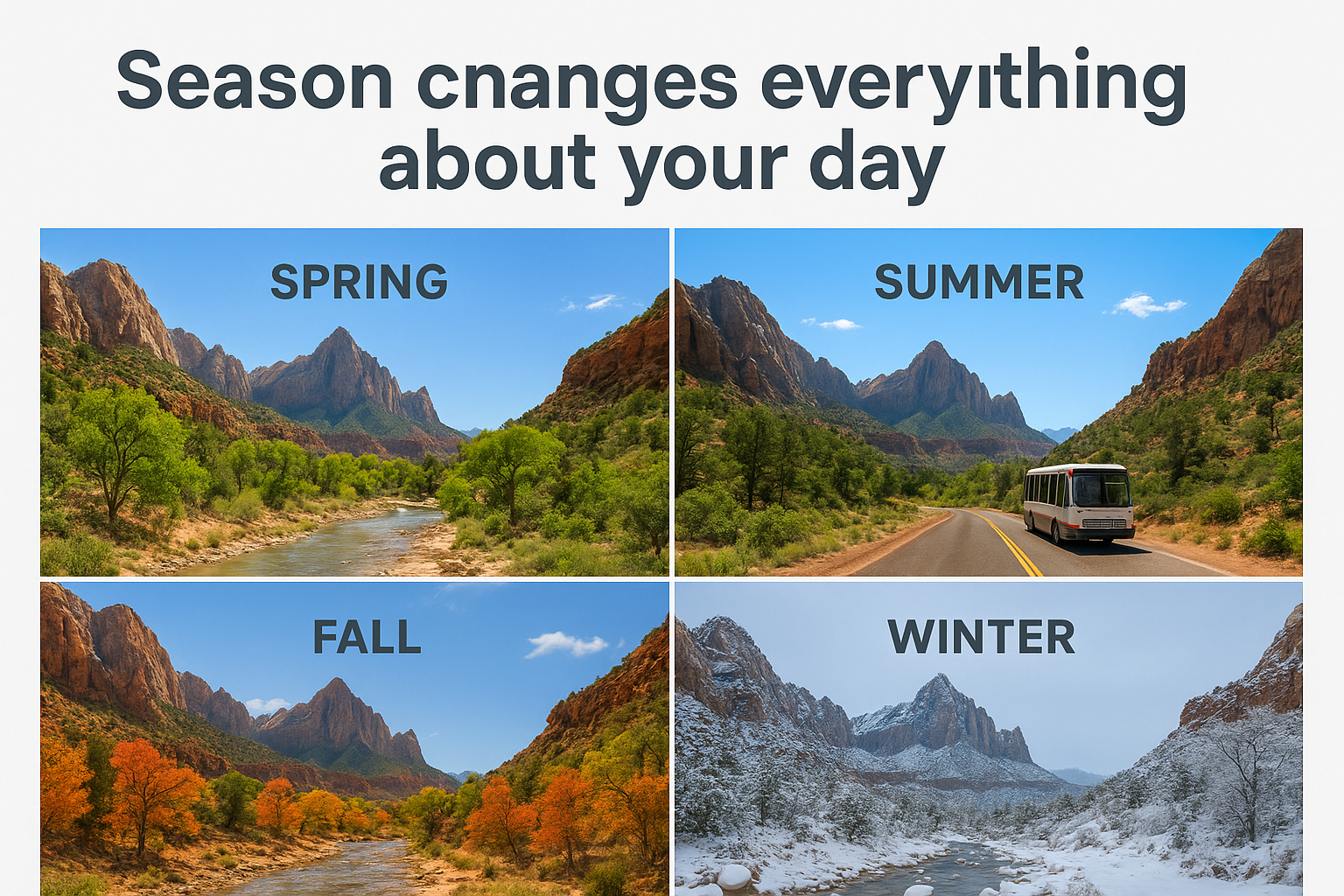
Season changes everything about your day
Zion’s weather swings hard between seasons, and the best time to visit Zion National Park affects what you can realistically do in a single visit.
| Season | Typical High Temp | Shuttle Operation | Crowd Level |
|---|---|---|---|
| Spring (Mar-May) | 65-80°F | Daily | High |
| Summer (Jun-Aug) | 90-105°F | Daily | Very High |
| Fall (Sep-Nov) | 60-80°F | Daily through Nov | High |
| Winter (Dec-Feb) | 40-55°F | Weekends/holidays only | Low |
Summer heat is no joke on exposed trails like Angels Landing, and flash flood risk closes The Narrows without warning during monsoon season, typically July through September. Winter offers thinner crowds but limited shuttle service, meaning you might need to walk or drive further to reach trailheads. Check the National Park Service Zion alerts page the morning of your trip, not the week before.
One day means picking a lane, not seeing everything
Trying to hike Angels Landing, walk The Narrows, and drive the full scenic route in one day isn’t realistic once you factor in the drive, shuttle waits, and Zion’s afternoon heat. Pick one signature hike as your anchor and build shorter stops around it. This is where a lot of self-guided trips fall apart: people build a wish-list itinerary based on what they’d do with three days, then run out of time by 2 p.m. and miss the drive home before dark. A tighter, realistic plan beats an ambitious one you can’t finish.
Step 1. Map the drive from Las Vegas to Zion
The standard route out of Las Vegas runs east on I-15 through Arizona’s Virgin River Gorge before crossing into Utah near St. George. This 160-mile stretch is almost entirely interstate driving, which sounds easy until you hit the two-lane squeeze through the gorge, where semi trucks and weekend RV traffic slow everything down. From St. George, you’ll exit onto UT-9 and drive through Hurricane and Springdale, the small town that sits right at Zion’s south entrance. That last 30-minute stretch on UT-9 is scenic but slower, with stoplights, pedestrians, and tour buses funneling into the park gate.
Budget three hours each way, not the two and a half Google Maps promises, because that extra 30 minutes is what saves your afternoon plans.
Gas up before you leave Las Vegas. Fuel prices climb noticeably once you cross into rural Arizona and Utah, and stations thin out along the gorge. Plan your fuel stops around Mesquite, Nevada or St. George, Utah rather than waiting until you’re low.
Rough mile-by-mile breakdown
Use this table to gauge where you are on the drive and what’s left:
| Segment | Distance | Approx. Drive Time |
|---|---|---|
| Las Vegas to Mesquite, NV | 80 miles | 1 hour |
| Mesquite to St. George, UT | 35 miles | 40 minutes |
| St. George to Springdale, UT | 40 miles | 45 minutes |
| Springdale to Zion Visitor Center | 2 miles | 10 minutes |
Add time for any stop, and remember the return trip often runs slower thanks to afternoon traffic pulling into St. George and evening congestion back into Las Vegas.
Think about the return leg while you’re still planning the outbound one. Driving three hours home after a full day of hiking in desert heat is when fatigue creeps in, and it’s the single biggest safety risk of a self-driven zion national park day trip from las vegas. If that six-hour round trip sounds like more driving than vacation, our Zion National Park tour handles the entire route with a professional driver, so you can nap on the way back instead of white-knuckling I-15 at dusk.
Step 2. Decide between self-driving and a guided tour
Once you’ve mapped the miles, the real question becomes who’s behind the wheel. Self-driving gives you total control over your schedule, but it also hands you six hours of driving, gas stops, navigation, and parking on top of a full day of hiking. A guided tour trades that control for someone else handling the logistics, which matters more than people expect once the sun starts baking the pavement at mile marker 40.
What self-driving demands from you
Renting a car or using your own means you’re the one tracking construction zones in the Virgin River Gorge, finding parking at the visitor center before it fills, and staying alert on the drive home after a day on your feet. You’ll also need to research shuttle schedules, trail conditions, and entrance procedures yourself, since nobody’s doing that prep work for you. It’s the right call if you want flexibility to linger at a viewpoint or skip a stop entirely, but it puts every decision, and every mile of fatigue, on you.
What a guided tour takes off your plate
Booking a Zion tour from Las Vegas means a professional driver handles the gorge, the gas stops, and the return trip while you focus on the park itself. Guides also know which trailheads get crowded first, so they can adjust the day’s order on the fly, something you can’t do from the driver’s seat while also reading trail signs.
The real cost of self-driving to Zion isn’t the miles, it’s the mental energy you spend on logistics instead of the park.
| Factor | Self-Driving | Guided Tour |
|---|---|---|
| Driving fatigue | High, both ways | None |
| Local trail knowledge | Self-researched | Built in |
| Schedule flexibility | Full control | Set itinerary |
| Parking stress | Your problem | Not your problem |
| Cost | Gas, rental, park fee | Single upfront price |
Weigh how you’ll feel at hour eleven of a fourteen-hour day. If that sounds exhausting rather than adventurous, a guided option like Another Side Tours’ Zion trip removes the driving math entirely and puts a local expert in charge of the timing, which is one of the clearest benefits of a private guided tour.
Step 3. Time your departure for the best start
Picking your departure time matters as much as picking your route. Leave too late and you’ll spend your first hour in Zion standing in a shuttle line instead of on a trail, then rush the drive home in the dark. Early departure is the single biggest lever you control on a self-driven day trip, and it costs you nothing but sleep.
Why sunrise beats sleeping in
Aim to leave Las Vegas by 6:00 a.m. That gets you to the Zion Canyon Visitor Center by 9:00 a.m., ahead of the peak shuttle crush that builds by mid-morning in spring, summer, and fall. Arriving early also means cooler trail temperatures, which matters if Angels Landing or the lower Narrows is on your list. Beating the crowds isn’t just about comfort, it’s the difference between a two-hour Narrows hike and a two-hour wait just to board a shuttle.
Every hour you sleep in is an hour you lose at the park, not an hour you gain in bed.
Match your departure to the season
Daylight hours shift the math depending on when you’re visiting. Use this as a rough guide for your Zion day trip timing:
| Season | Recommended Departure | Sunset (Approx.) | Latest Safe Return Departure |
|—|—|—|
| Spring (Mar-May) | 6:00 a.m. | 7:30-8:00 p.m. | 4:30 p.m. |
| Summer (Jun-Aug) | 5:30 a.m. | 8:00-8:15 p.m. | 5:00 p.m. |
| Fall (Sep-Nov) | 6:30 a.m. | 6:00-7:00 p.m. | 3:30 p.m. |
| Winter (Dec-Feb) | 7:00 a.m. | 5:00-5:30 p.m. | 2:00 p.m. |
Summer’s long days give you the most breathing room, but they also come with brutal midday heat, so an early start still pays off even when sunset isn’t your limiting factor. Winter compresses everything, since limited shuttle hours mean you’re working with a shorter effective day even if you leave on time.
Think about how a departure time actually plays out logistically before you commit to it. Self-drivers need to factor in loading the car, a coffee stop, and traffic leaving the Strip, all of which eat into that 6:00 a.m. target fast. Guided tours solve this by setting a fixed pickup time and building the buffer in for you, so you show up and let someone else worry about whether you actually left on schedule.
Step 4. Sort out your park pass and permits
Zion charges a straightforward entrance fee, but one hike inside the park requires a separate permit that catches self-drivers off guard every week. Angels Landing has required a permit since 2022, and you can’t buy one at the gate the morning you arrive. Sorting this out before you leave Las Vegas saves you from standing at the trailhead with a ticket you don’t have.
What the entrance fee actually covers
Entry to Zion runs $35 per vehicle, valid for seven days, or $20 per person if you’re arriving without a car of your own. If you already hold an America the Beautiful annual pass, it covers your entrance fee at Zion and every other federal recreation site, which pays for itself fast if you’re also stopping at Hoover Dam or Red Rock Canyon on the same trip.
| Pass Type | Cost | Covers |
|---|---|---|
| Vehicle pass | $35 | 1 vehicle, 7 days |
| Individual pass | $20 | 1 person, 7 days |
| America the Beautiful annual pass | $80 | All federal sites, 1 year |
Locking down the Angels Landing permit
Angels Landing permits are issued through a lottery system, split into a seasonal lottery and a day-before lottery. The seasonal lottery opens months in advance and covers broad date ranges, while the day-before lottery releases a smaller batch of permits the night before your hike. For a single day trip, the day-before lottery is usually your only realistic shot, and it’s genuinely a gamble.
If Angels Landing matters to your day trip, plan for the permit lottery, not just the drive.
Here’s how the day-before window works:
- Applications open at 12:01 a.m. Mountain Time the day before your hike
- The window closes at 3:00 p.m. the same day
- Results post by 5:00 p.m. Mountain Time
- Each permit costs $6 per person, charged only if you win
Check the NPS Angels Landing permit page for exact dates, since the system occasionally pauses for trail maintenance. No permit is required for The Narrows as a bottom-up day hike or for Emerald Pools, so build your backup plan around those if the lottery doesn’t go your way. Guided tours skip this uncertainty entirely, since itineraries are built around trails that don’t depend on winning a lottery the night before.
Step 5. Choose your must-do hikes and sights
Zion Canyon packs a surprising number of iconic hikes into a corridor you can drive shuttle stop to shuttle stop, but a single day forces you to rank them. Picking your anchor hike first, then filling in shorter stops around it, keeps your itinerary realistic instead of aspirational.
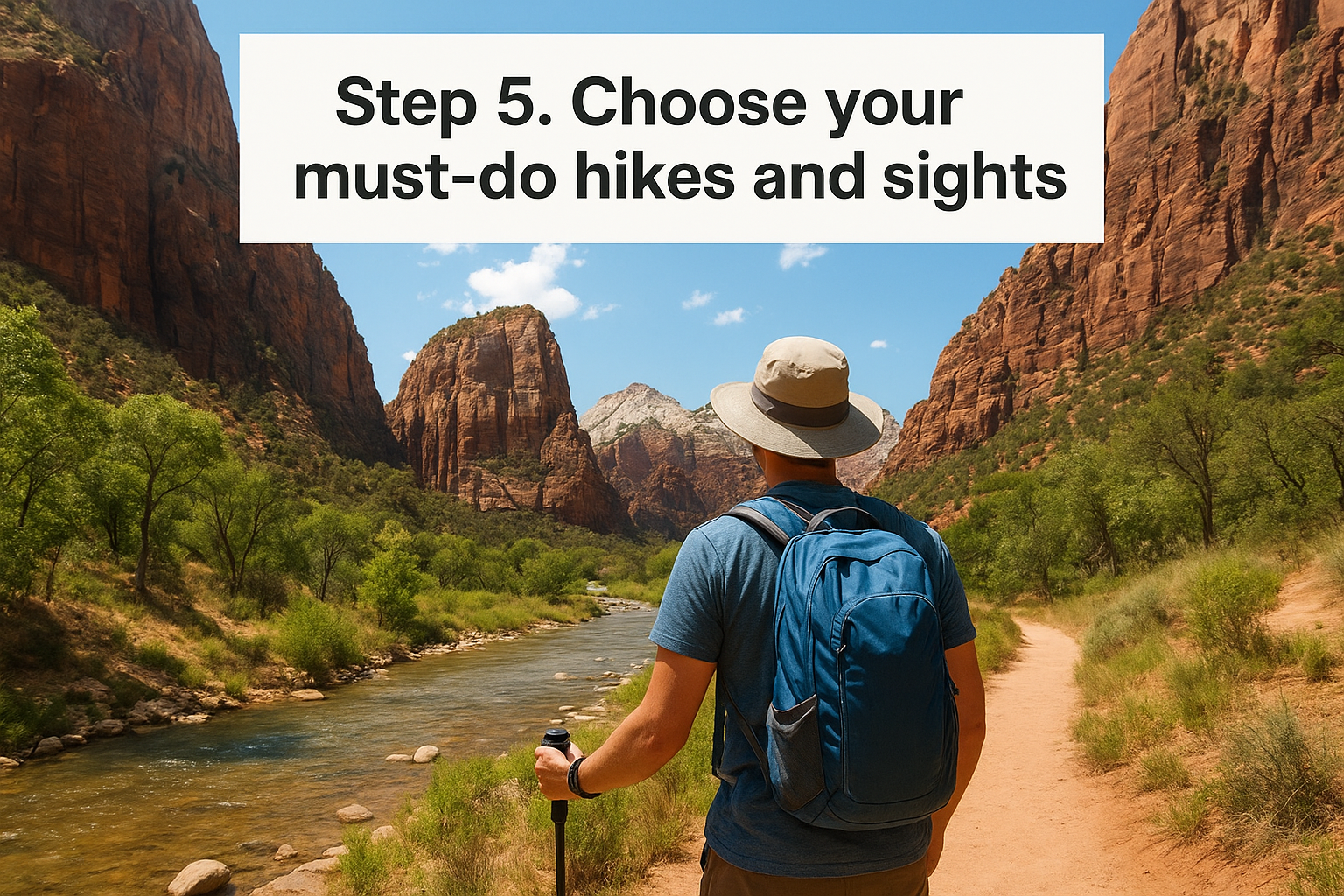
The Narrows without a permit
Wading upstream through the Virgin River is the hike most visitors picture when they run through the must-see spots in Zion National Park, and the good news is the bottom-up route needs no permit or reservation. You can walk as little as 30 minutes or push several miles upstream, turning around whenever the current or your schedule says stop. Rent water shoes and a walking stick in Springdale the morning of your trip if you didn’t pack your own.
Angels Landing if the lottery favors you
If you won the permit lottery covered in Step 4, Angels Landing delivers the view every Zion photo promises, chains and all. Budget four hours round trip minimum, since the exposed switchbacks slow everyone down regardless of fitness level.
The best Zion day trip hike isn’t the most famous one, it’s the one that fits the hours you actually have left.
Easier stops that still deliver
Emerald Pools and the Riverside Walk reward you with waterfalls and canyon views without the crowds or exposure of Angels Landing, making them smart backups if the lottery doesn’t go your way.
| Hike | Round-Trip Distance | Typical Time | Permit Needed |
|—|—|—|
| The Narrows (bottom-up) | 0.5-9.4 miles | 1-6 hours | No |
| Angels Landing | 5.4 miles | 4-5 hours | Yes |
| Lower Emerald Pool | 1.2 miles | 1 hour | No |
| Riverside Walk | 2.2 miles | 1-1.5 hours | No |
Selecting two hikes, one longer and one short, gives you a buffer if the drive runs late or a shuttle line eats your morning. Overloading the day with three major trails is exactly the trap that turns a Zion day trip from Las Vegas into a rushed sprint back to the parking lot at closing time.
Step 6. Build your hour-by-hour itinerary
Once you know your drive time, departure window, permit status, and anchor hike, the pieces snap into a single schedule. A written itinerary keeps you honest about how much time each stop actually takes, instead of guessing and losing an hour you didn’t budget for. Below is a sample hour-by-hour plan built around a spring or fall day trip with a Narrows-focused itinerary, since it needs no permit and works for almost any group.
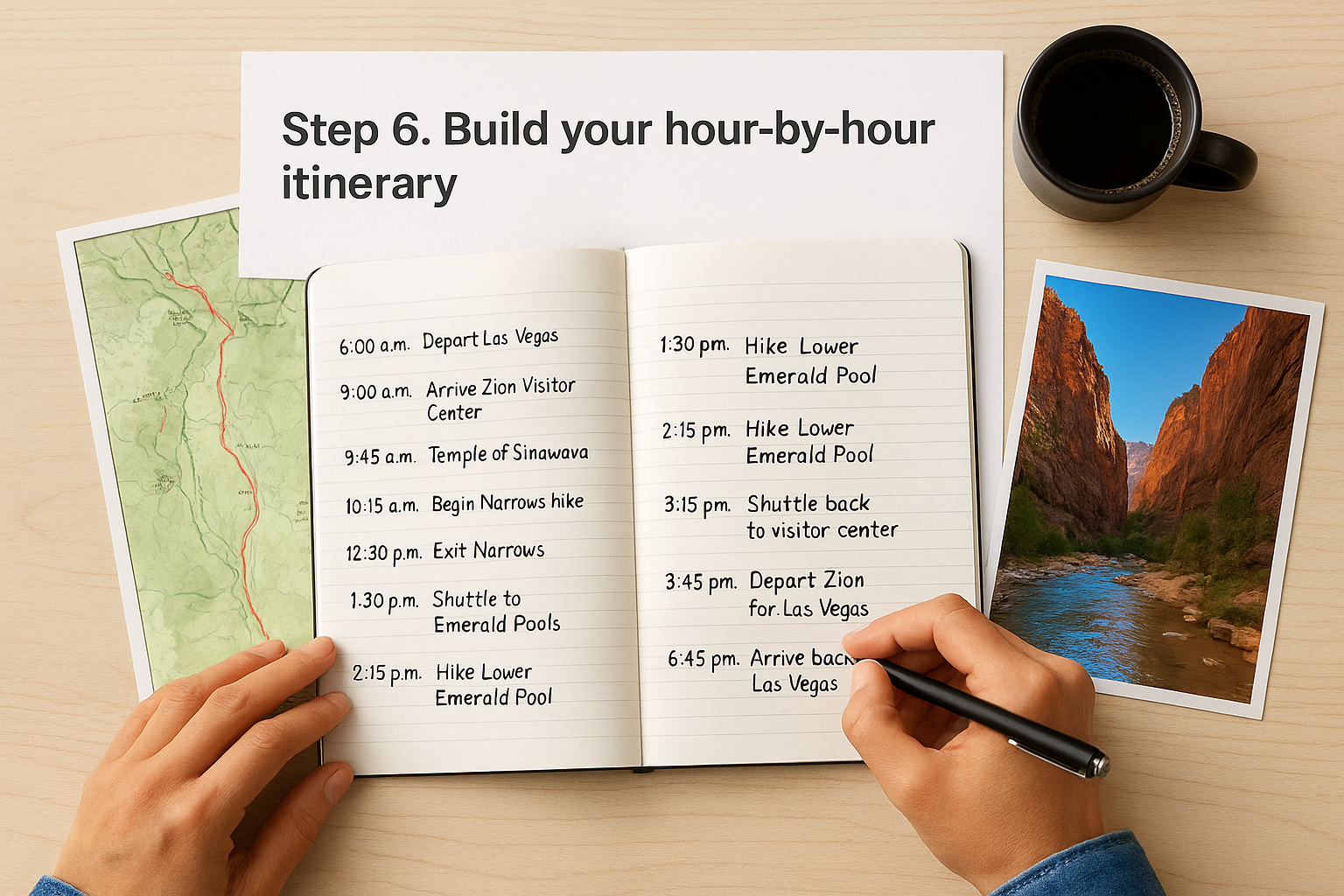
A sample schedule that actually works
This timeline assumes a 6:00 a.m. departure from Las Vegas and treats The Narrows as the anchor hike, with Emerald Pools as a shorter add-on if time allows.
| Time | Activity |
|---|---|
| 6:00 a.m. | Depart Las Vegas |
| 9:00 a.m. | Arrive Zion Visitor Center, catch shuttle |
| 9:45 a.m. | Reach Temple of Sinawava, start Riverside Walk |
| 10:15 a.m. | Begin Narrows hike upstream |
| 12:30 p.m. | Exit Narrows, lunch in Springdale or on shuttle route |
| 1:30 p.m. | Shuttle to Emerald Pools trailhead |
| 2:15 p.m. | Hike Lower Emerald Pool loop |
| 3:15 p.m. | Shuttle back to visitor center |
| 3:45 p.m. | Depart Zion for Las Vegas |
| 6:45 p.m. | Arrive back in Las Vegas |
A good Zion itinerary has slack built into it, because the schedule that survives contact with a shuttle line is the one you actually finish.
Build in buffer, not just activities
Gaps matter as much as the stops themselves. Buffer time between the Narrows exit and the Emerald Pools shuttle absorbs a slow lunch, a longer bathroom line, or a shuttle that runs behind schedule during peak season. Trim that buffer to make room for a third stop and you’re the group jogging back to the last shuttle at 5:45 p.m.
Realistically, this schedule leaves your afternoon return departure with almost an hour of margin before the fall or spring safe-return window closes. Swap in Angels Landing if your permit came through, but subtract the Emerald Pools stop entirely rather than trying to stack all three. Guided day tours out of Las Vegas run a version of this same logic every day, which is exactly why the pickup-to-return times rarely slip.
Step 7. Pack smart and know the shuttle rules
What you carry into Zion shapes how much of your day trip you actually enjoy versus endure. Packing light but smart matters more here than on a typical sightseeing day, since you’re combining desert heat, river wading, and hours without easy access to a car. Nail this step and the rest of your itinerary runs smoother, because you’re not backtracking to a locker or losing time hunting for water.
What belongs in your daypack
Zion doesn’t sell much gear inside the park itself, so bring what you need from Las Vegas or grab it in Springdale before you head in. A solid daypack for a Zion day trip looks like this:
- Two liters of water per person minimum, more in summer
- Closed-toe water shoes if you’re hiking The Narrows
- Sunscreen, a hat, and sunglasses, since shade is scarce on most trails
- A lightweight rain shell in spring and fall, when afternoon storms roll in fast
- Snacks or a packed lunch, since food options inside the canyon are limited
- A portable charger, since phone signal and outlets are both unreliable past the visitor center
Forgetting water in Zion isn’t a minor inconvenience, it’s the fastest way to cut your hiking day short.
How the shuttle rules affect your plan
Once you’re past the visitor center, shuttle rules dictate your pace whether you like it or not. Buses run roughly every 7 to 10 minutes during peak season and every 15 to 30 minutes during shoulder months, and they stop running at sunset, which means you need to be on the last one back or you’re walking the scenic drive in the dark. Riders board in the order they arrive, no cutting the line for a missed connection, and bikes need the designated racks rather than the aisle.
Expect backpacks and hiking poles on board, but leave coolers and large gear in the car, since storage space is tight. Pets aren’t allowed on the shuttle at all, so plan around that if you’re traveling with a dog. Guided tours sidestep most of this friction, since your Zion tour guide already knows which shuttle stop gets you to the next trailhead fastest, timing pickups so you’re not the group sprinting for the last bus of the day.
Making the most of your day in Zion
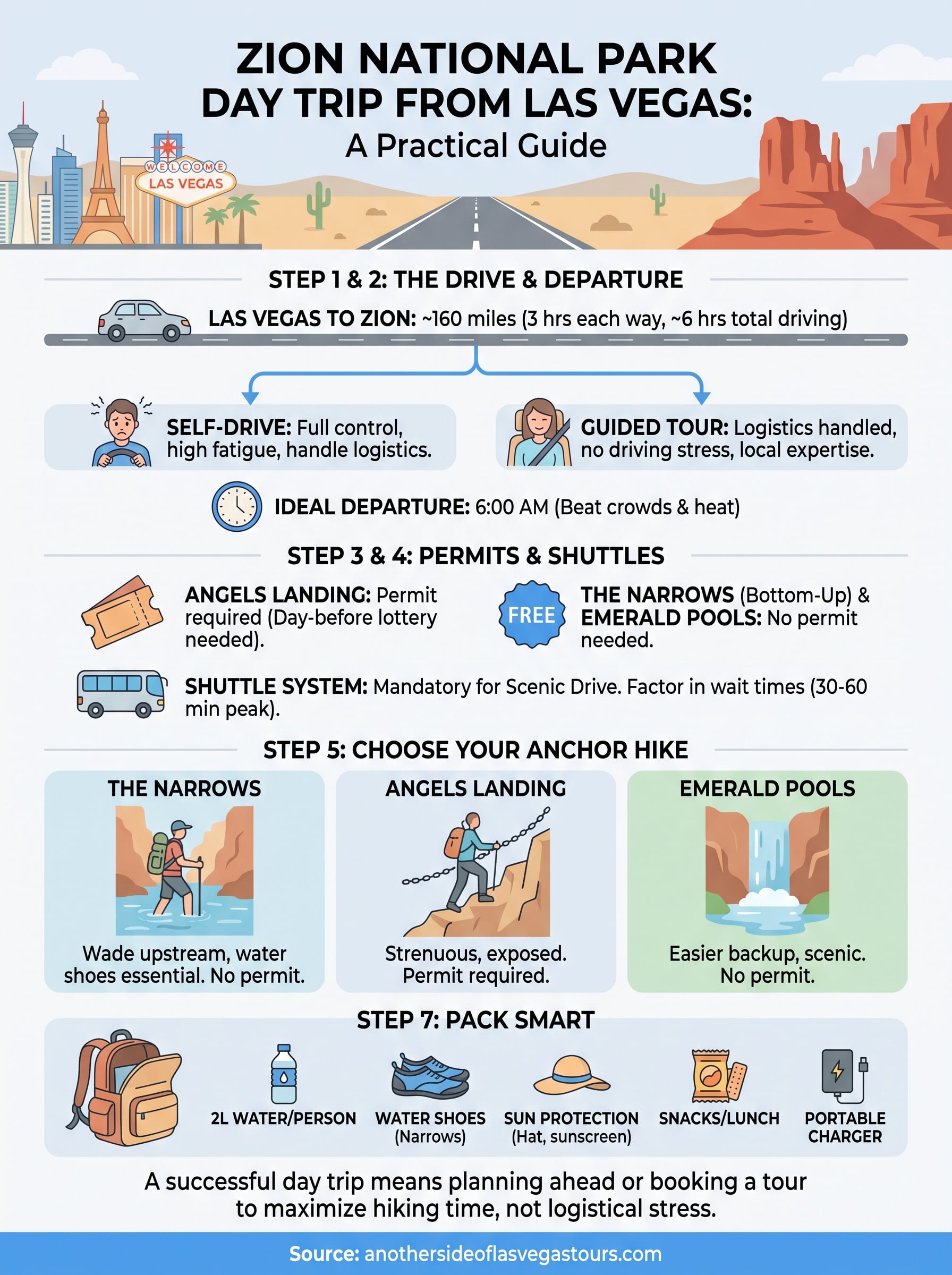
A Zion National Park day trip from Las Vegas comes down to a handful of decisions you make before you ever start the car: when you leave, which hike anchors your day, and whether you’re driving yourself or letting someone else handle the six hours behind the wheel. Get those right, and the park delivers everything you came for, red canyon walls, cold river water, views that don’t photograph the same twice. Get them wrong, and you spend your day chasing shuttles instead of hiking.
None of this planning is required if you’d rather show up and hike. Our guides run this route often enough to know exactly which trailhead fills up first and which lunch stop actually has a bathroom. If six hours of driving sounds like the worst part of your vacation, hand it off and book a private Zion tour from Las Vegas instead.