
Zion National Park packs towering red cliffs, narrow slot canyons, and some of the best hiking in the Southwest into one relatively compact space, which is exactly why so many Las Vegas visitors add it to their trip. If you’re trying to figure out what to see at Zion National Park with only a day or two on the ground, the sheer number of trailheads and viewpoints can feel overwhelming fast.
This guide cuts through that by focusing on the spots that actually deliver, the ones seasoned guides point out again and again because they capture the park’s scale and drama without requiring a week of planning. You’ll get a straight answer on which trails are worth the effort, where to catch the best light for photos, and what to skip if your time is tight.
We’ll walk through 12 must-see locations, from the famous switchbacks of Angels Landing to quieter overlooks most tourists miss. Whether you’re driving in on your own or joining one of the best day trips from Las Vegas, this list gives you a clear, practical plan for making the most of your visit.
1. Angels Landing
What makes it special
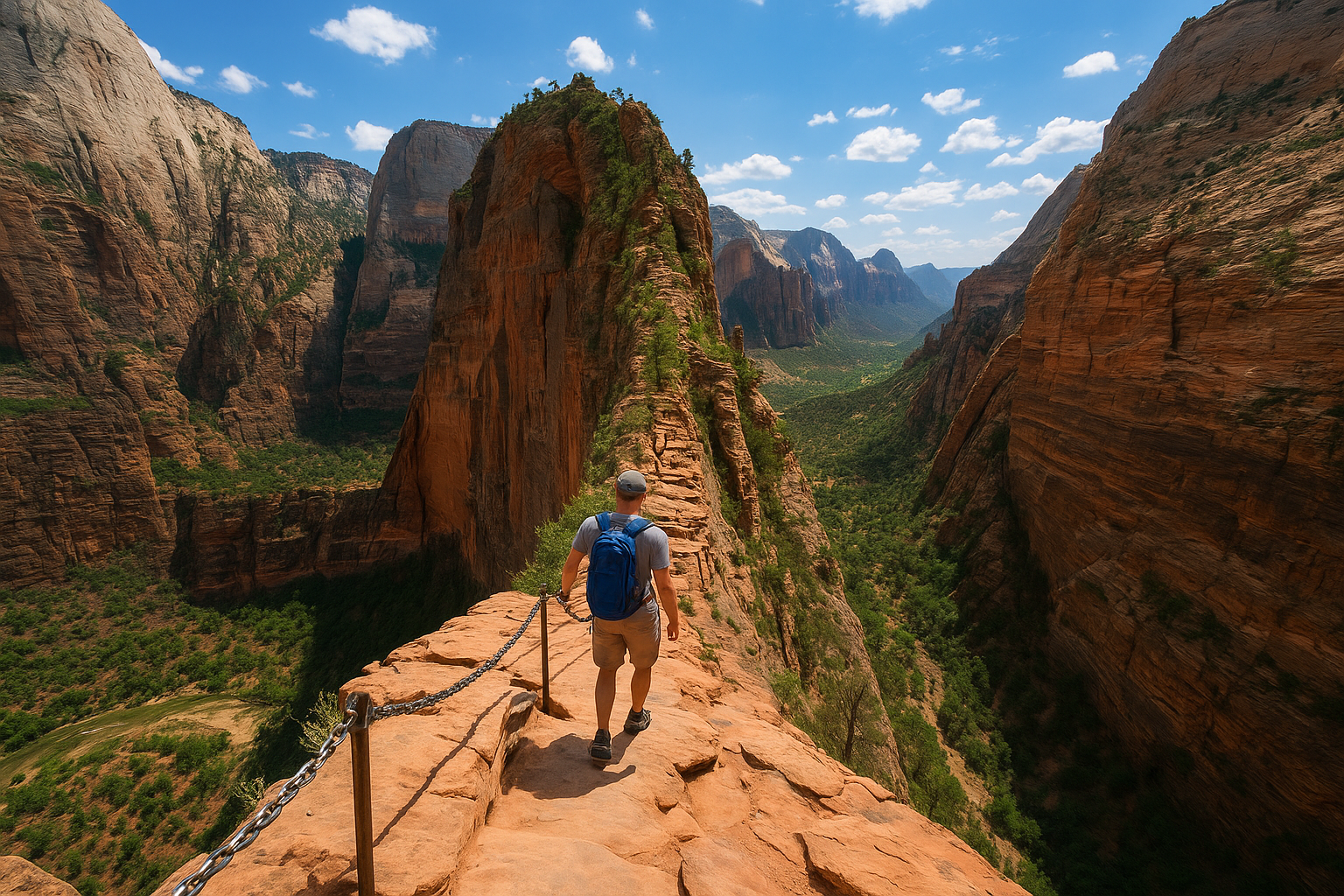
Angels Landing is the single most photographed hike in the park, and for good reason. The trail climbs a narrow sandstone fin with sheer 1,000-foot drop-offs on both sides, ending at a summit that looks straight down Zion Canyon. Chains bolted into the rock give you something to grip during the final half-mile, which is the part every hiker talks about afterward. If you only have room for one bucket-list hike on your trip, this is the one most guides recommend, and it’s usually the first answer you get when you ask a ranger what to see at Zion National Park.
The final chained section of Angels Landing is short, but it’s the moment that defines most people’s Zion trip.
Difficulty and time needed
Plan on 4 to 5 hours round trip for the full 5.4-mile hike, including breaks. The trail gains roughly 1,500 feet in elevation, and the last section past Scout Lookout is where things get serious: narrow rock, exposed edges, and a steady stream of hikers going both directions on the same chains. Rangers rate it strenuous, not because of the distance but because of the exposure near the top.
| Detail | Info |
|---|---|
| Distance | 5.4 miles round trip |
| Elevation gain | ~1,500 feet |
| Time | 4-5 hours |
| Permit required | Yes, since 2022 |
| Best for | Experienced hikers comfortable with heights |
Tips for visiting
Since 2022, the National Park Service has required a permit lottery for the chains section, and you can’t just show up and start climbing. Applications open through the seasonal lottery or the day-before lottery on Recreation.gov, and demand far outpaces the number of permits issued each day. Start early, both for cooler temperatures and shorter lines at the chains, where bottlenecks can add 30 minutes or more to your hike during peak season.
Consider these before you go:
- Apply for the permit lottery as early as your travel dates allow; last-minute walk-ups aren’t an option anymore.
- Skip this hike if you have a fear of heights or are hiking with young kids; Scout Lookout makes a solid turnaround point instead.
- Bring at least 2 liters of water per person, since there’s no shade on the exposed final stretch.
- Wear shoes with real grip. Smooth-soled sneakers are a genuine hazard on the polished sandstone near the chains.
If navigating permits and trail logistics on your own sounds like a hassle, this is exactly the kind of planning a Zion National Park tour from Las Vegas handles for you, including timing your visit around the lottery system and weather windows so you’re not scrambling the night before.
2. The Narrows
What makes it special
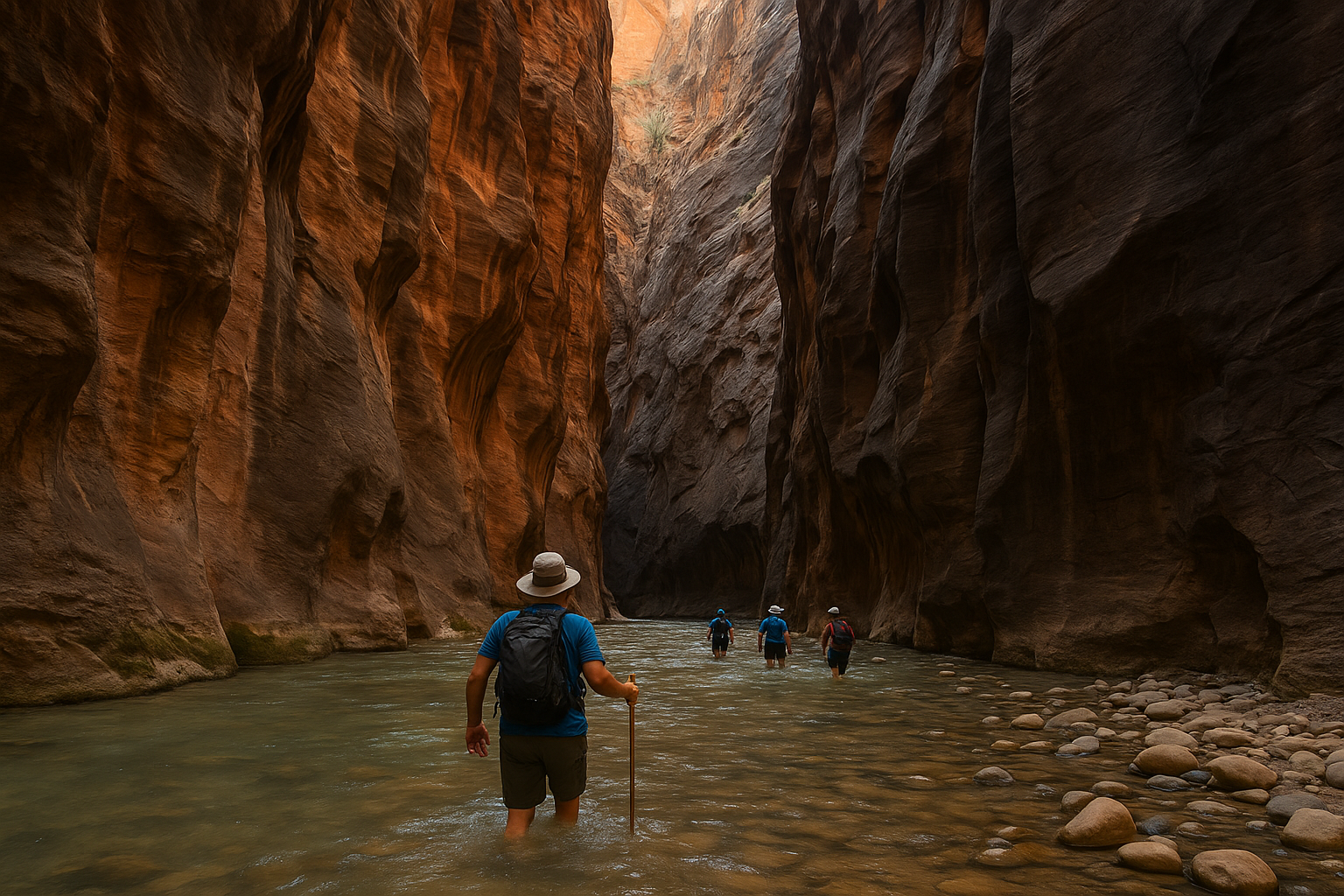
The Narrows is the part of Zion where you hike in the river instead of beside it. The Virgin River carved this slot canyon over millions of years, and in places the walls rise a thousand feet while the gap between them narrows to just 20 or 30 feet across, a scale that rivals what you get when you visit Antelope Canyon. Wading through knee-deep to waist-deep water with towering sandstone on either side is unlike any other trail in the park, and it’s consistently ranked among the top reasons people ask what to see at Zion National Park before they even book a flight.
Walking the river itself, not a path beside it, is what makes The Narrows unforgettable.
Difficulty and time needed
Most visitors do the bottom-up route from the Temple of Sinawava, which requires no permit and lets you turn around whenever you’re ready. A round trip to Wall Street, the narrowest and most dramatic section, typically runs 3 to 4 hours covering about 4 miles. Going further, all the way to Big Springs, can stretch the day to 6 or more hours. The full top-down 16-mile route through the canyon does require a permit and a full day, plus a shuttle to the trailhead outside the park.
Tips for visiting
Water levels and flash flood risk change daily, so always check conditions at the visitor center before starting, and never enter if a flood advisory is posted.
- Rent water shoes and a walking stick from outfitters near the park entrance; regular hiking boots get heavy and slippery fast.
- Check the Virgin River flow rate; anything above 150 cubic feet per second usually means the hike is closed.
- Go early on weekdays if you can. Wall Street gets crowded by mid-morning in summer.
- Bring a dry bag for your phone and wallet since you will get wet above the knees.
The National Park Service posts daily flood forecasts and closures, worth checking the night before at nps.gov/zion.
3. Zion Canyon Scenic Drive
What makes it special
Zion Canyon Scenic Drive is the six-mile road that threads the floor of the main canyon, and it’s the backbone of any visit since nearly every major trailhead branches off it. You’ll pass towering formations like the Great White Throne and the Court of the Patriarchs without leaving the shuttle, making this the easiest way to answer what to see at Zion National Park if your legs need a break between hikes. The drive itself feels like a moving overlook, with the canyon walls closing in tighter the further you go toward the Temple of Sinawava, easily earning a spot among the most scenic drives near Las Vegas.
The scenic drive is the one route in Zion where you can see the whole canyon without lacing up your boots.
Difficulty and time needed
There’s no hiking required to enjoy the drive itself, just riding the park shuttle from stop to stop, which makes it accessible for visitors of any fitness level or age. Budget at least half a day if you plan to hop off at multiple stops, since the shuttle runs on a loop and waiting for the next one can eat 10 to 15 minutes between stops. Doing the full loop with short stops at each viewpoint takes roughly 2 to 3 hours; add more time if you’re pairing it with a trail like Emerald Pools or Weeping Rock along the way.
Tips for visiting
From spring through fall, private vehicles aren’t allowed on this road, so you’ll ride the free park shuttle from the visitor center. Reservations for the shuttle aren’t typically required, but lines form early during peak season.
- Arrive at the visitor center by 8 a.m. in summer to beat the shuttle line.
- Grab a seat on the right side heading north for the best canyon views.
- Check the NPS shuttle schedule at nps.gov/zion before you go, since hours shift seasonally.
- In winter, when the shuttle isn’t running, you can drive the road yourself, which is worth planning your trip around if you’d rather skip the wait.
If coordinating shuttle timing around your other plans feels like one more thing to manage, a guided Zion tour from Las Vegas builds the scenic drive into a set itinerary, so you’re not stuck guessing when the next shuttle arrives.
4. Emerald Pools Trail
What makes it special
Emerald Pools Trail delivers waterfalls, hanging gardens, and shaded pools within a short walk from the canyon floor, making it one of the friendliest answers to what to see at Zion National Park for families or anyone short on hiking gear. Three connected pools, Lower, Middle, and Upper, sit at different elevations, each with its own personality: the lower pool has a misty waterfall you can walk behind, while the upper pool sits tucked against a sheer cliff face fed by a seasonal cascade. Cottonwood trees and ferns cling to the rock walls here, a stark contrast to the desert scrub just outside the canyon.
The Lower Emerald Pool alone justifies the stop, waterfall spray and all, without demanding a strenuous hike to reach it.
Difficulty and time needed
Reaching the Lower Emerald Pool is an easy 1.2-mile round trip on a paved, mostly flat path, doable in under an hour. Pushing on to the Middle and Upper Pools adds rockier, steeper terrain and brings the full loop to about 3 miles, which takes most hikers 2 to 3 hours round trip. None of the three sections require technical skill, just sturdy shoes and a bit more stamina for the upper stretch.
Tips for visiting
Access the trailhead from either the Zion Lodge shuttle stop or the Grotto stop, both of which connect directly to the scenic drive loop.
- Start at Zion Lodge if you want the shortest path to the Lower Pool.
- Wear shoes with grip; the trail surface near the Upper Pool gets slick when wet.
- Visit in spring for the fullest waterfalls, since the seasonal flow often dries up by late summer.
- Combine this trail with a stop at the Grotto if you’re building a half-day loop with other easy walks.
Guides on Las Vegas day tours often pair this stop with a longer hike, timing the visit so you catch the pools without missing the shuttle back.
5. Observation Point via East Mesa Trail
What makes it special
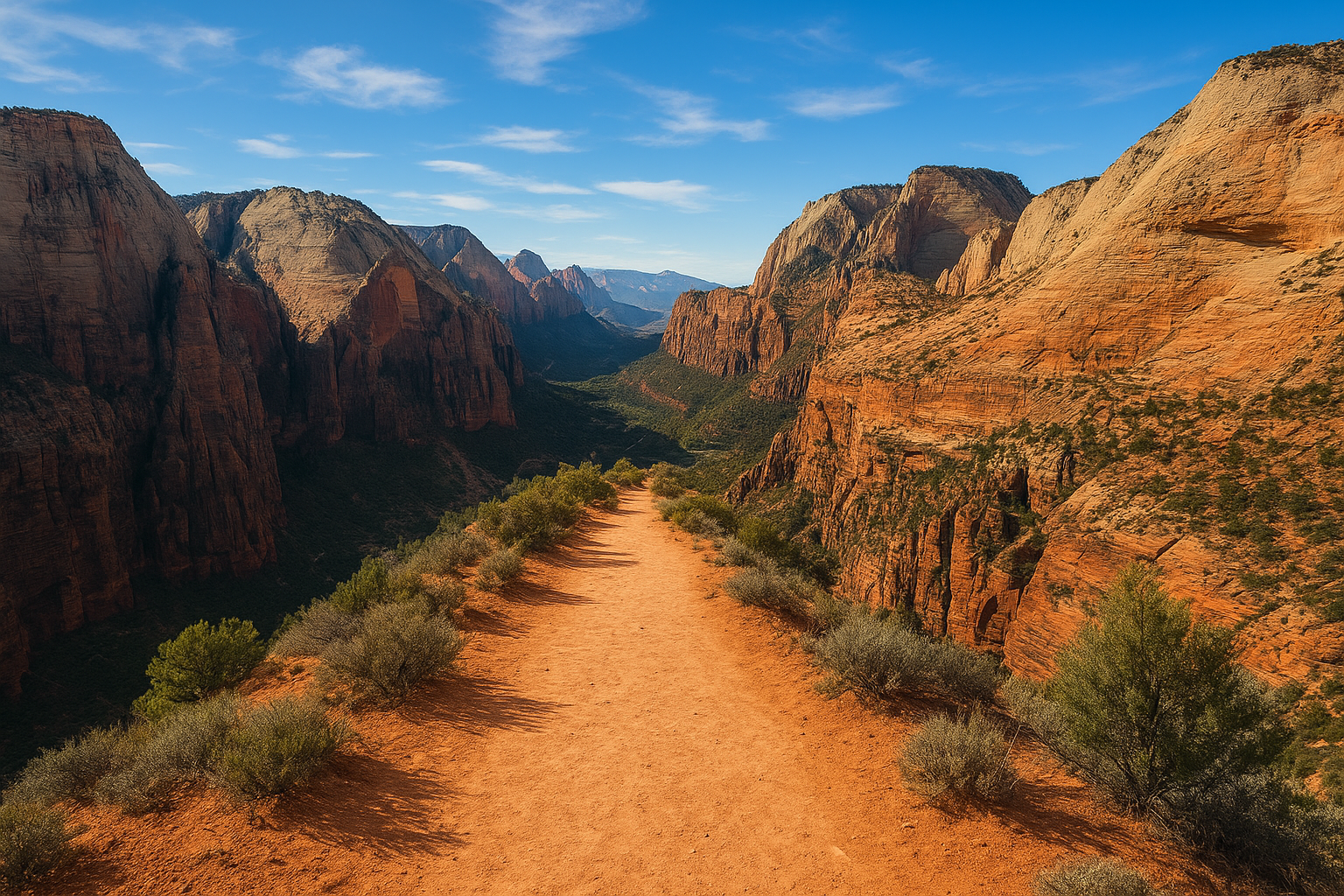
Observation Point sits 700 feet higher than Angels Landing, and from the rim you look straight down onto the fin that everyone else is climbing. East Mesa Trail is the back-door route to that overlook, approached from the plateau above rather than the canyon floor, which means you skip the exposed chains entirely while still landing the best panoramic view in the park. Ask any guide what to see at Zion National Park if you want Angels Landing’s payoff without its crowds, and this is usually the answer.
Observation Point gives you the same jaw-dropping canyon view as Angels Landing, minus the chains and the crowds.
Difficulty and time needed
The East Mesa approach runs about 6.4 miles round trip with roughly 700 feet of elevation gain, spread gently across mostly flat, exposed plateau terrain before a short final descent to the viewpoint. Most hikers finish in 3 to 4 hours, and the trail is rated moderate rather than strenuous since there’s no technical scrambling or sheer drop-offs to navigate. Compare that to the original Weeping Rock route, which climbed nearly 2,150 feet from the canyon floor and stayed closed for years after rockfall damage.
Tips for visiting
Getting to the trailhead takes some planning since it’s outside the main shuttle system, on unpaved Forest Road 588 near Zion Ponderosa Ranch Resort.
- Drive a high-clearance vehicle if it’s rained recently; the dirt road gets rutted.
- Start early since there’s little shade across the mesa, especially in summer heat.
- Bring more water than you think you need; there’s no refill point along the route.
- Time your arrival for sunrise or late afternoon, when the light hits the canyon walls below at their best angle.
Because the trailhead sits well outside the park’s shuttle loop, this is one spot where guided Las Vegas hiking excursions genuinely simplify logistics, handling the drive out to East Mesa so you’re not troubleshooting road conditions on your own.
6. Court of the Patriarchs
What makes it special
Court of the Patriarchs is the easiest big view in Zion, a roadside stop that rewards you without a single step of hiking. Three massive sandstone peaks, named Abraham, Isaac, and Jacob, rise together on the west side of the canyon, their layered rock faces catching dramatic shadows as the sun moves across the sky. Mormon pioneers named these formations in the 1800s, and the biblical theme carries through the park’s early naming history. For anyone weighing what to see at Zion National Park with kids in tow or limited mobility, this stop belongs near the top of the list simply because the payoff requires almost no effort.
Three peaks, zero hiking, and one of the best photo opportunities in the entire park.
Difficulty and time needed
There’s no trail involved at the main viewpoint, just a short walk from the shuttle stop to the overlook, which takes most visitors under 10 minutes round trip. If you want a slightly different angle, a quarter-mile spur trail called Sand Bench Trailhead climbs a bit higher for a broader view of all three peaks together, adding maybe 20 to 30 minutes. Either way, this is one of the most accessible stops on the scenic drive, suitable for wheelchairs and strollers at the main overlook.
Tips for visiting
Catch this stop early in the morning, since the peaks face east and get their best light shortly after sunrise, before the sun climbs high and flattens the contrast on the rock.
- Ride the shuttle to the Court of the Patriarchs stop; there’s no separate parking lot here during peak season.
- Bring a wide-angle lens or phone panorama mode to fit all three peaks in one shot.
- Pair this quick stop with Zion Human History Museum, just a short shuttle ride away, to fill an otherwise light morning.
- Skip the midday visit if photos matter to you; the light gets harsh and washes out the layered rock colors.
7. Weeping Rock
What makes it special
Weeping Rock is a natural spring seeping through a sandstone alcove, and it’s one of the few places in Zion where you can stand behind a curtain of dripping water without getting soaked. Rainwater falls on the plateau above, filters through porous Navajo sandstone for over a thousand years, then hits a layer of shale it can’t pass and seeps back out along the cliff face right above the trail. Hanging gardens of moss, columbine, and maidenhair fern cling to the rock where the water emerges, a tiny ecosystem that survives entirely on that slow drip. It’s a quick, quiet stop that answers what to see at Zion National Park for anyone who wants a short break between longer hikes without giving up the scenery.
Weeping Rock proves you don’t need a long hike to see something genuinely strange and beautiful in Zion.
Difficulty and time needed
The current trail runs about 0.4 miles round trip with a modest, paved climb to the viewing platform, taking most visitors 20 to 30 minutes including a pause under the alcove. This is shorter than the original route, which stayed closed for several years after a 2019 rockfall damaged the upper section; the National Park Service reopened a rebuilt, shorter path to the main overlook afterward. It’s rated easy, though the paved surface does get slick right where the water drips onto the trail.
Tips for visiting
Hop off at the Weeping Rock shuttle stop, since there’s no parking here during the season the shuttle runs.
- Wear shoes with decent tread for the wet section near the alcove.
- Visit after rain or snowmelt for the heaviest, most dramatic flow.
- Check current conditions before you go, since sections occasionally close again for maintenance.
- Pair this with Emerald Pools or the Grotto for an easy half-day loop of short walks.
A guided Zion day trip from Las Vegas usually slots this stop in as a breather between bigger hikes, saving you the guesswork on current trail status.
8. Canyon Overlook Trail
What makes it special
Canyon Overlook Trail sits just outside the main canyon, near the east entrance tunnel, and delivers one of the best payoffs-to-effort ratios in the whole park. The final overlook looks down on Pine Creek Canyon and gives you a clear line of sight to the Towers of the Virgin and the West Temple, all without the crowds that pack the scenic drive stops. Sandstone potholes, a small natural arch, and a slot canyon carved below the trail add texture along the way, making this a favorite quick stop for anyone weighing what to see at Zion National Park on a tight schedule between the east and south entrances.
A short walk near the tunnel gets you a view that rivals anything deep inside the main canyon.
Difficulty and time needed
Running about 1 mile round trip with roughly 150 feet of elevation gain, this trail takes most hikers 45 minutes to an hour, including time at the overlook to take photos. The path is rated moderate rather than easy because of some rock scrambling and a few narrow ledges near the start, though nothing close to the exposure on Angels Landing. It’s a solid option if you’ve already done a longer hike that day and want one more view without much additional walking.
Tips for visiting
Parking at the small lot near the trailhead fills up fast, especially in the hours right before sunset when photographers arrive for the best light.
- Arrive early or plan for a short wait for a parking spot along the highway shoulder.
- Wear grippy shoes; some sections are exposed sandstone with loose gravel.
- Time your visit for late afternoon, when the setting sun lights up the canyon walls below.
- Skip this one if you’re uneasy on narrow ledges, since a few short sections sit close to the edge.
Because the trailhead sits along the east entrance road rather than the shuttle route, an organized tour from Las Vegas often works this stop in on the drive between Zion and the highway back to the city.
9. Kolob Canyons
What makes it special
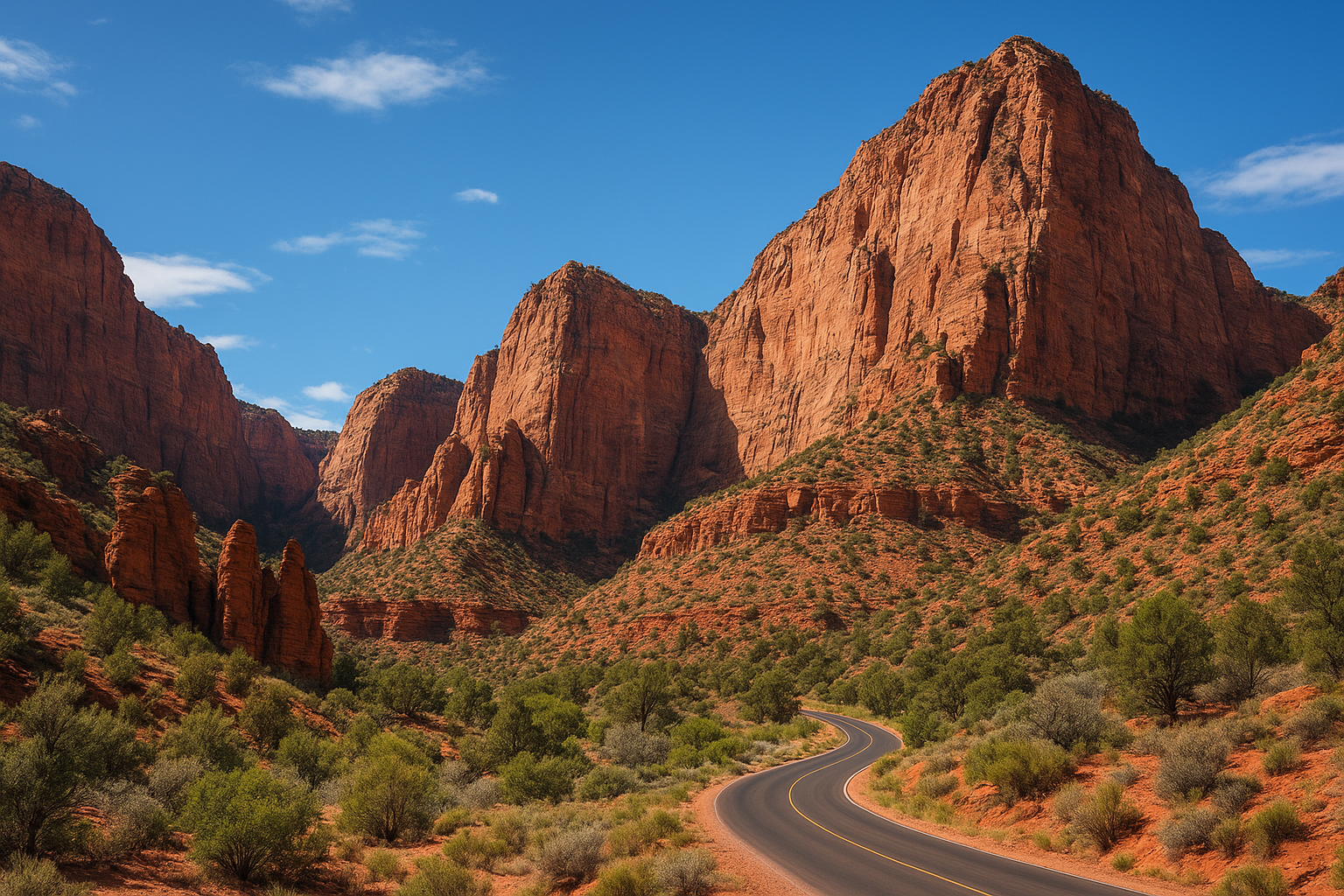
Kolob Canyons is the section of Zion most visitors never see, tucked off Interstate 15 nearly 40 miles from the main canyon entrance. Finger canyons of red and orange rock rise sharply from the desert floor here, carved by the same forces that shaped the main park but without the shuttle lines or packed parking lots. Anyone researching what to see at Zion National Park beyond the obvious highlights should put this on the list, since it feels like a private preview of the park’s geology minus the summer traffic jams.
Kolob Canyons gives you Zion’s signature scenery with a fraction of the crowds.
Difficulty and time needed
A five-mile scenic drive winds through the canyons to Kolob Canyons Viewpoint, and you can see the whole thing from your car in under an hour if that’s all you have time for. Hikers who want more should tackle Taylor Creek Trail, a moderate 5.4-mile round trip to the Double Arch Alcove that takes 3 to 4 hours and passes two historic homestead cabins along the way. Longer options exist too, including the strenuous 14-mile round trip to Kolob Arch, one of the largest freestanding arches in the world, which requires a full day or an overnight permit.
Tips for visiting
Bring cash or a card for the entrance fee if you’re arriving fresh from Interstate 15, since this entrance doesn’t connect to the main park’s shuttle system at all.
- Check the road status before driving out; winter snow occasionally closes the scenic drive.
- Fill your gas tank in advance, since services near this entrance are limited.
- Pack water and snacks if you’re hiking Taylor Creek, as there’s no facility at the trailhead.
- Visit in late afternoon for warm light on the canyon walls, especially near the main viewpoint.
Because it sits so far from the main canyon, Kolob Canyons rarely fits into a single day trip built around the rest of the park, something worth flagging if you’re comparing guided tours departing Las Vegas that focus on Zion’s better-known highlights.
10. Pa’rus Trail
What makes it special
Pa’rus Trail is the one paved path in Zion where bikes, strollers, wheelchairs, and dogs on leashes are all welcome, tracing the Virgin River along the canyon floor from the visitor center to Canyon Junction. Cottonwoods line the water on both sides, and the trail offers some of the widest, most open views of the Watchman and East Temple without a single steep step involved. Families looking for what to see at Zion National Park that doesn’t require a permit, a shuttle reservation, or hiking boots usually end up here, often as their first or last stop of the day, much like the easy wins on any list of family friendly things to do in Las Vegas.
Pa’rus Trail is the rare Zion path where the whole family, dog included, can actually walk together.
Difficulty and time needed
Covering 3.5 miles round trip with almost no elevation change, this flat, paved trail takes most walkers 1 to 1.5 hours, less if you’re just heading to the first river crossing and back. It’s rated easy across the board, which makes it one of the few Zion trails genuinely suited to strollers, wheelchairs, and young kids without adult assistance. Cyclists often ride it in 20 to 30 minutes, connecting straight from the visitor center to the start of the scenic drive shuttle route at Canyon Junction.
Tips for visiting
Start at the visitor center parking lot, where the trailhead sits right off the main entrance, so there’s no shuttle needed to reach it.
- Rent bikes near the south entrance if you’d rather cover the trail on wheels than on foot.
- Bring your leashed dog. This is the only trail in the park that allows pets.
- Walk it at sunrise for cooler temperatures and soft light on the Watchman formation.
- Use it as a low-effort warmup before a longer hike later that day.
Guides on an organized Zion tour from Las Vegas often build in time here for anyone in the group who wants a lighter option while the rest of the party tackles Angels Landing or The Narrows.
11. Zion Human History Museum
What makes it special
Zion Human History Museum sits just inside the south entrance and gives you the backstory behind everything you’ve already hiked past. Exhibits cover the Southern Paiute people who lived in the canyon long before it became a park, along with the Mormon settlers, miners, and early park rangers who shaped its modern history. A 22-minute film runs on a loop in the small theater, walking through the geology and human story of Zion in a format that works well if you need an air-conditioned break during a hot afternoon. Travelers building a list of what to see at Zion National Park often skip the museum in favor of trails, but it adds context that makes the rest of the park click into place.
Twenty minutes in this museum makes every canyon wall you pass afterward mean something more.
Difficulty and time needed
There’s no hiking involved here at all, just a self-paced walk through the exhibit hall, which most visitors finish in 30 to 45 minutes including the film. The building sits at the edge of a small plaza with a wide porch view of the canyon, so you can extend your visit with a few extra minutes outside if the weather cooperates. It’s fully accessible, rated easy for any visitor regardless of fitness level, and works well as a shaded rest stop between longer hikes.
Tips for visiting
Catch the shuttle to the Zion Human History Museum stop, the second stop on the main line right after the visitor center, so parking isn’t a concern during peak season.
- Check the film schedule at the desk when you arrive, since showtimes run on a set rotation rather than continuously.
- Visit midday during summer when you need a break from the heat between trails.
- Browse the bookstore inside for trail maps and field guides if you didn’t grab one at the main visitor center.
- Pair this stop with Court of the Patriarchs, just a short shuttle ride further up the canyon.
Guides on an organized Las Vegas day trip often work this stop in early, using the film as a quick orientation before the group heads out to the bigger hikes.
12. Checkerboard Mesa
What makes it special
Checkerboard Mesa sits near the east entrance, and it’s one of the strangest rock formations you’ll see anywhere in Zion. Crosshatched lines carve the sandstone into a grid pattern, the result of vertical fractures from freeze-thaw cycles cutting across horizontal bands left by ancient windblown dunes. No other formation in the park shows this pattern so clearly, which is why it shows up on so many lists of what to see at Zion National Park even though most visitors just glimpse it from the road. You don’t need a permit, a hike, or even much time to appreciate it, just a pullout and a few minutes looking up.
Checkerboard Mesa turns a roadside pullout into one of the most photographed rock formations in the park.
Difficulty and time needed
There’s no trail here in the traditional sense, just a short walk from the parking pullout to a good viewing spot, taking most visitors 10 to 15 minutes round trip. Some hikers scramble a bit higher onto the lower slopes of the mesa for a closer look at the checkerboard pattern, though the National Park Service doesn’t maintain a formal path up. This is as easy as stops in Zion get, suitable for any fitness level and any age, with zero elevation gain if you stick to the roadside overlook.
Tips for visiting
The pullout sits along the east entrance road, outside the shuttle system, so you’ll need a private vehicle or a tour that includes this stretch of highway.
- Stop here on your way in or out through the east entrance rather than making a special trip.
- Visit midday for the clearest light on the crosshatched pattern, since low sun angles wash out the contrast.
- Bring a zoom lens if you want to pick out the fracture lines in detail from the pullout.
- Pair this with Canyon Overlook Trail, just a short drive away on the same road.
Guides running an organized tour from Las Vegas typically fold this stop into the drive along the east entrance road, so you catch it without adding extra time to the day.
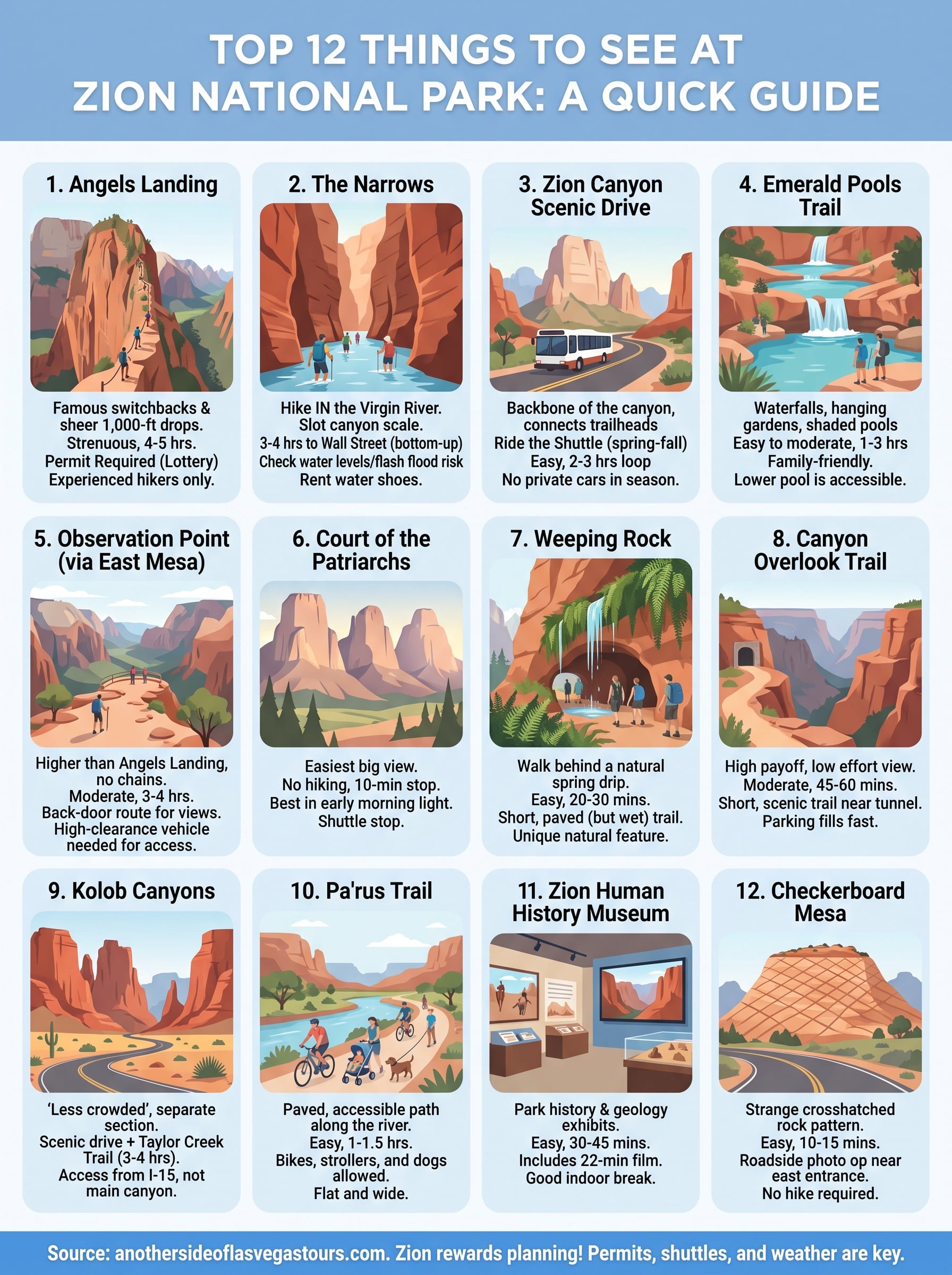
Planning your visit to Zion
Twelve stops, one clear takeaway: Zion rewards planning more than most parks. Angels Landing and The Narrows deliver the bucket-list moments, but the quieter picks, Kolob Canyons, Weeping Rock, Checkerboard Mesa, round out a trip that actually reflects the park’s range instead of just its highlight reel. Knowing what to see at Zion National Park is only half the job; matching those spots to your fitness level, permit timing, and available hours is what separates a smooth day from a rushed, frustrating one.
If you’d rather skip the permit lotteries, shuttle schedules, and road logistics, that’s exactly what a guide handles for you. Another Side Tours builds itineraries around exactly this kind of trip, pairing Zion’s must-see spots with the transportation and timing to actually pull it off in a single day from Las Vegas. Ready to hand off the planning? Browse our private guided tours from Las Vegas and let a local expert map out your Zion day.